









Gregorio Prestopino
American, 1907 - 1984
Born in the Little Italy section of New York City, Prestopino was awarded a scholarship to the National Academy of Design at the age of fourteen. Early in his career he came under the influence of the French Impressionists, but was soon drawn to the American realists of the Ashcan School, whose work led him directly to the study of urban life.
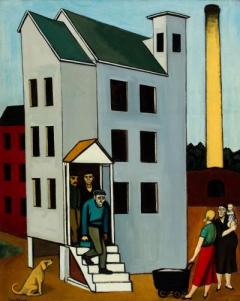
As a young man Prestopino set up his first studio in Harlem. During the 1930s his social realist paintings had an anecdotal quality in their description of everyday incidents of the working class, depicting the grit of city life – docks, laborers, vendors, Lower East Side streets.
Prestopino lived in Brooklyn for many years, spending summers at a farm near Clinton, New Jersey. At the farm Prestopino painted in the barn, while his wife - illustrator Elizabeth Dauber - had a studio in the house.
He moved to Roosevelt, New Jersey in 1949. Other artists who have lived in Roosevelt include Ben and Bernarda Shahn, their son Jonathan Shahn, Jacob Landau, David Stone Martin and his son, Stefan Martin, and Robert Mueller. Prestopino was buried in Roosevelt after his death in 1984.
By the mid-1940s and the 1950s he concentrated on large, solid images that were able to function as universals with heightened drama while preserving their qualities as specific expressionistic images. His more realistic studies are largely black and white and detail poor urban suffering. Exemplifying this style is the series of paintings done in 1957 for Life Magazine in connection with an article on Green Haven, a New York state prison. During this time Prestopino received high recognition along with Ben Shahn and Philip Evergood, well-known social realist painters. In the late 1950s Prestopino used Harlem as his subject. He created paintings that inspired the well-known American movie makers, John Hubley and Faith Elliot. During the filming they never took the camera off the paintings. The film, "Harlem Wednesday", with a jazz score by Benny Carter, won first prize at the First International Festival of Art Film in Venice.
In 1954, he became a director of the MacDowell Colony, beginning a lifelong association that profoundly influenced his art. In the MacDowell Colony he made friends with the painters Milton Avery, Sally Avery, Giorgio Cavllon, Linda Lindeberg and many others who were among the Fellows of MacDowell Colony. In 1958 Prestopino's landscape paintings were showing abstract tendencies. There is a noticeable cubist influence in his work as well. Much of his more cubist work uses brightly contrasting colors and involves human forms. Wet, sensuous color areas appeared on his canvases. Mythological figures, woods, brooks, fields, islands, mountains were joined-on powerful canvases that showed Prestopino’s new vitality. According to the celebrated photographer Russel Lynes “the sound of the city…gave way to the sounds of the country, the relentless of bricks and pavement and steel to the happy disorder of dappled things.”
During the 1930s and 40s Prestopino exhibited at the Art Institute of Chicago, the Whitney Museum of American Art, and the Museum of Modern Art; his work was also shown at the 1939 World’s Fair in New York. In 1934, he summered at the MacDowell Colony in Peterborough, New Hampshire, and in 1954 he became a director of the Colony. During his career he taught painting at the Brooklyn Museum School (1946-51); the New School for Social Research (1950-67); and was an artist-in-residence at Michigan State University (1960).
As a young man Prestopino set up his first studio in Harlem. During the 1930s his social realist paintings had an anecdotal quality in their description of everyday incidents of the working class, depicting the grit of city life – docks, laborers, vendors, Lower East Side streets.
Prestopino lived in Brooklyn for many years, spending summers at a farm near Clinton, New Jersey. At the farm Prestopino painted in the barn, while his wife - illustrator Elizabeth Dauber - had a studio in the house.
He moved to Roosevelt, New Jersey in 1949. Other artists who have lived in Roosevelt include Ben and Bernarda Shahn, their son Jonathan Shahn, Jacob Landau, David Stone Martin and his son, Stefan Martin, and Robert Mueller. Prestopino was buried in Roosevelt after his death in 1984.
By the mid-1940s and the 1950s he concentrated on large, solid images that were able to function as universals with heightened drama while preserving their qualities as specific expressionistic images. His more realistic studies are largely black and white and detail poor urban suffering. Exemplifying this style is the series of paintings done in 1957 for Life Magazine in connection with an article on Green Haven, a New York state prison. During this time Prestopino received high recognition along with Ben Shahn and Philip Evergood, well-known social realist painters. In the late 1950s Prestopino used Harlem as his subject. He created paintings that inspired the well-known American movie makers, John Hubley and Faith Elliot. During the filming they never took the camera off the paintings. The film, "Harlem Wednesday", with a jazz score by Benny Carter, won first prize at the First International Festival of Art Film in Venice.
In 1954, he became a director of the MacDowell Colony, beginning a lifelong association that profoundly influenced his art. In the MacDowell Colony he made friends with the painters Milton Avery, Sally Avery, Giorgio Cavllon, Linda Lindeberg and many others who were among the Fellows of MacDowell Colony. In 1958 Prestopino's landscape paintings were showing abstract tendencies. There is a noticeable cubist influence in his work as well. Much of his more cubist work uses brightly contrasting colors and involves human forms. Wet, sensuous color areas appeared on his canvases. Mythological figures, woods, brooks, fields, islands, mountains were joined-on powerful canvases that showed Prestopino’s new vitality. According to the celebrated photographer Russel Lynes “the sound of the city…gave way to the sounds of the country, the relentless of bricks and pavement and steel to the happy disorder of dappled things.”
During the 1930s and 40s Prestopino exhibited at the Art Institute of Chicago, the Whitney Museum of American Art, and the Museum of Modern Art; his work was also shown at the 1939 World’s Fair in New York. In 1934, he summered at the MacDowell Colony in Peterborough, New Hampshire, and in 1954 he became a director of the Colony. During his career he taught painting at the Brooklyn Museum School (1946-51); the New School for Social Research (1950-67); and was an artist-in-residence at Michigan State University (1960).

