










Paul Cadmus
American, 1904 - 1999
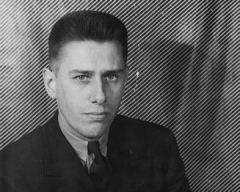
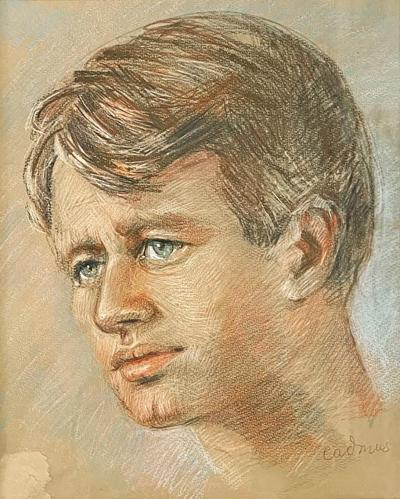
A confirmed student of the human form and a dedicated draftsman, Paul Cadmus rendered, with great beauty, the sensuality of the human figure. Telling of a commitment to academic training and a commitment to his own sexuality, his works are testaments not only of physical beauty but also of social understanding.
Raised within the artistic community of New York City, as the son of two professional artists, Cadmus was called to the medium at a young age. His art was illustrated in the New York Herald Tribune at the young age of fourteen. This first foray into the art world soon developed into committed study when Cadmus enrolled in the National Academy of Design in 1916 and the Art Students League in 1928, where he studied with Joseph Pennell.
In 1930, Cadmus sailed for Europe and was inspired by many life drawing classes and a growing appreciation for the French and Italian Masters. On her shores he found a freedom of expression and celebration of sexuality that came in strong contrast to the stifled naivete he had seen in America. This freedom is articulated in Jerry (1931, Private Collection), the first significant male nude that Cadmus created.
Set upon this new path of representation, Cadmus studied the works of Ingres and the Italian Renaissance Masters. For Cadmus, Ingres represented the celebration of eroticism and the ability to create, through exquisite detail and precision, works that teemed with subdued sexuality.
Inspired by the works of the Italian Renaissance, Cadmus found, in these artists, an appreciation of the nude male form, and a straightforward yet evocative use of composition. Artists at this time sought the understanding of anatomy through academic drawing.
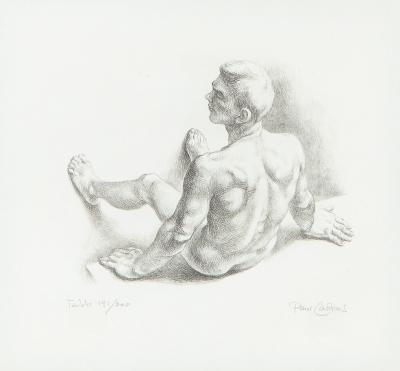
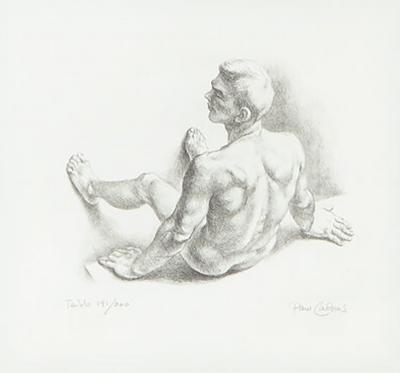
Cadmus drew upon these Italian Renaissance and French Academic ideals in his depictions of the male nude, and added a very poignant and personally relevant narrative. Through symbolism, Saltaire becomes as much a beautiful and sensual figure study as a comment on his own sexuality. This work, with crisp draftsmanship and a masterful rendering of form, tells of an exact knowledge of the medium, inspiration from masters, and the relationship between the figures.
Raised within the artistic community of New York City, as the son of two professional artists, Cadmus was called to the medium at a young age. His art was illustrated in the New York Herald Tribune at the young age of fourteen. This first foray into the art world soon developed into committed study when Cadmus enrolled in the National Academy of Design in 1916 and the Art Students League in 1928, where he studied with Joseph Pennell.
In 1930, Cadmus sailed for Europe and was inspired by many life drawing classes and a growing appreciation for the French and Italian Masters. On her shores he found a freedom of expression and celebration of sexuality that came in strong contrast to the stifled naivete he had seen in America. This freedom is articulated in Jerry (1931, Private Collection), the first significant male nude that Cadmus created.
Set upon this new path of representation, Cadmus studied the works of Ingres and the Italian Renaissance Masters. For Cadmus, Ingres represented the celebration of eroticism and the ability to create, through exquisite detail and precision, works that teemed with subdued sexuality.
Inspired by the works of the Italian Renaissance, Cadmus found, in these artists, an appreciation of the nude male form, and a straightforward yet evocative use of composition. Artists at this time sought the understanding of anatomy through academic drawing.
Cadmus drew upon these Italian Renaissance and French Academic ideals in his depictions of the male nude, and added a very poignant and personally relevant narrative. Through symbolism, Saltaire becomes as much a beautiful and sensual figure study as a comment on his own sexuality. This work, with crisp draftsmanship and a masterful rendering of form, tells of an exact knowledge of the medium, inspiration from masters, and the relationship between the figures.


 Loading...
