




Camille Pissarro
French, 1830
CAMILLE PISSARRO
Camille Pissarro was born in 1830 on the Island of St.Thomas, a then-Danish colony of the Antilles (now the United States Virgin Islands). His family background was mixed French, Portuguese and Jewish. He was sent to Paris to school when he was twelve. Although at an early age he wanted to make art his career, his father sent for him in 1847 to return to St. Thomas and for the next five years the young Pissarro was engaged against his will in the family business. In 1852 he went to Venezuela with Fritz Melbye, an artist, and brought back various sketches. Going to Paris in 1855 he made the acquaintance of Corot and fell under his influence. A realist at heart, he followed Corot's advice always to paint out of doors.
By 1866 he had met Cezanne, Renoir and Sisley and was a member of the group that frequented the Cafe Guerbois - a group of artists, critics and congenial men that centered about Manet. He had also married (the family maid, Julie) and settled at Pontoise, near Paris. They had eight children, of the eight, Lucien, Georges, Felix, Ludovico Rodolph, Paul-Emile and a daughter, Orovida, were artists. Each of his children and the grandchildren were encouraged daily to draw everything they saw.
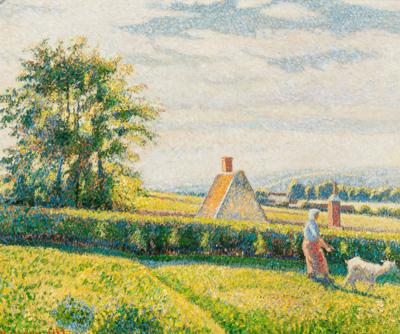
When the War of 1870 broke out, he went to London and his studio was pillaged by the Germans and his early work destroyed. He studied Turner while he was in England, together with Monet he helped to develop the theories of Impressionism. He was the only impressionist to show in all seven of the impressionist exhibitions. For a time he followed the methods of Seurat and became identified with the Neo-Impressionists. His best work was done from 1892 to 1903, his last period and most original one. He died in 1903 at the age of seventy-three.
Camille Pissarro was born in 1830 on the Island of St.Thomas, a then-Danish colony of the Antilles (now the United States Virgin Islands). His family background was mixed French, Portuguese and Jewish. He was sent to Paris to school when he was twelve. Although at an early age he wanted to make art his career, his father sent for him in 1847 to return to St. Thomas and for the next five years the young Pissarro was engaged against his will in the family business. In 1852 he went to Venezuela with Fritz Melbye, an artist, and brought back various sketches. Going to Paris in 1855 he made the acquaintance of Corot and fell under his influence. A realist at heart, he followed Corot's advice always to paint out of doors.
By 1866 he had met Cezanne, Renoir and Sisley and was a member of the group that frequented the Cafe Guerbois - a group of artists, critics and congenial men that centered about Manet. He had also married (the family maid, Julie) and settled at Pontoise, near Paris. They had eight children, of the eight, Lucien, Georges, Felix, Ludovico Rodolph, Paul-Emile and a daughter, Orovida, were artists. Each of his children and the grandchildren were encouraged daily to draw everything they saw.
When the War of 1870 broke out, he went to London and his studio was pillaged by the Germans and his early work destroyed. He studied Turner while he was in England, together with Monet he helped to develop the theories of Impressionism. He was the only impressionist to show in all seven of the impressionist exhibitions. For a time he followed the methods of Seurat and became identified with the Neo-Impressionists. His best work was done from 1892 to 1903, his last period and most original one. He died in 1903 at the age of seventy-three.

 Loading...
