


The Evergreen Allure of Gustavian Style
 |
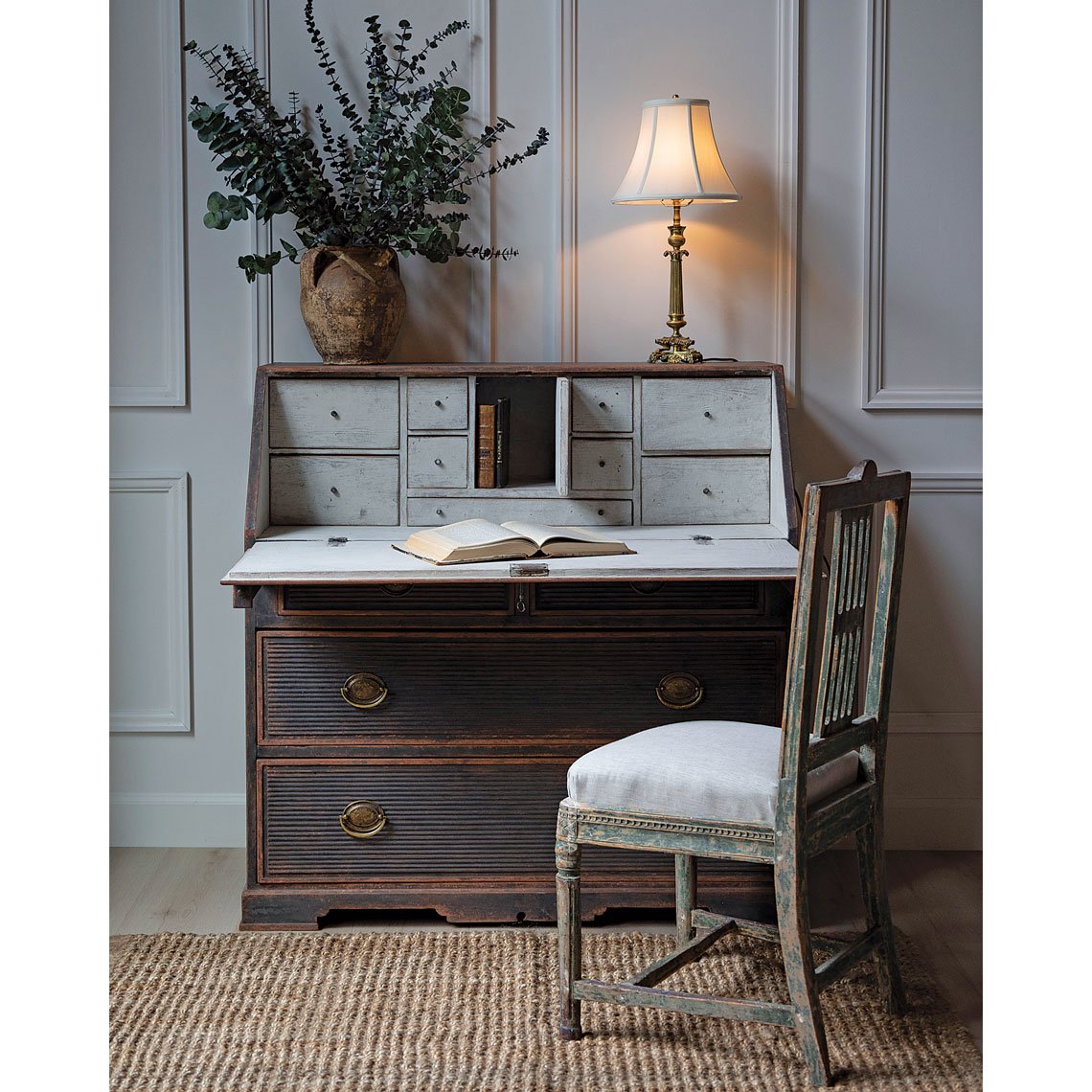 |
Early 19th Century Swedish Secretary in black with painted interior, circa 1810. Pine with decorative horizontal fluting |
 |
by Benjamin Genocchio
Gustav III was an authoritarian ruler; nonetheless, his 20-year reign was marked by significant cultural patronage. He became King in 1771, following the death of his father, and promptly set off on a Grand Tour of European royal capitals. He returned to Scandinavia determined to transform Stockholm into the ‘Paris of the North’, and set about building and remodelling palaces and public buildings in a style inspired by French Rococo and 18th-century Italian Neoclassicism. The Royal Swedish Opera House, opened in 1782, was one of his signature projects.
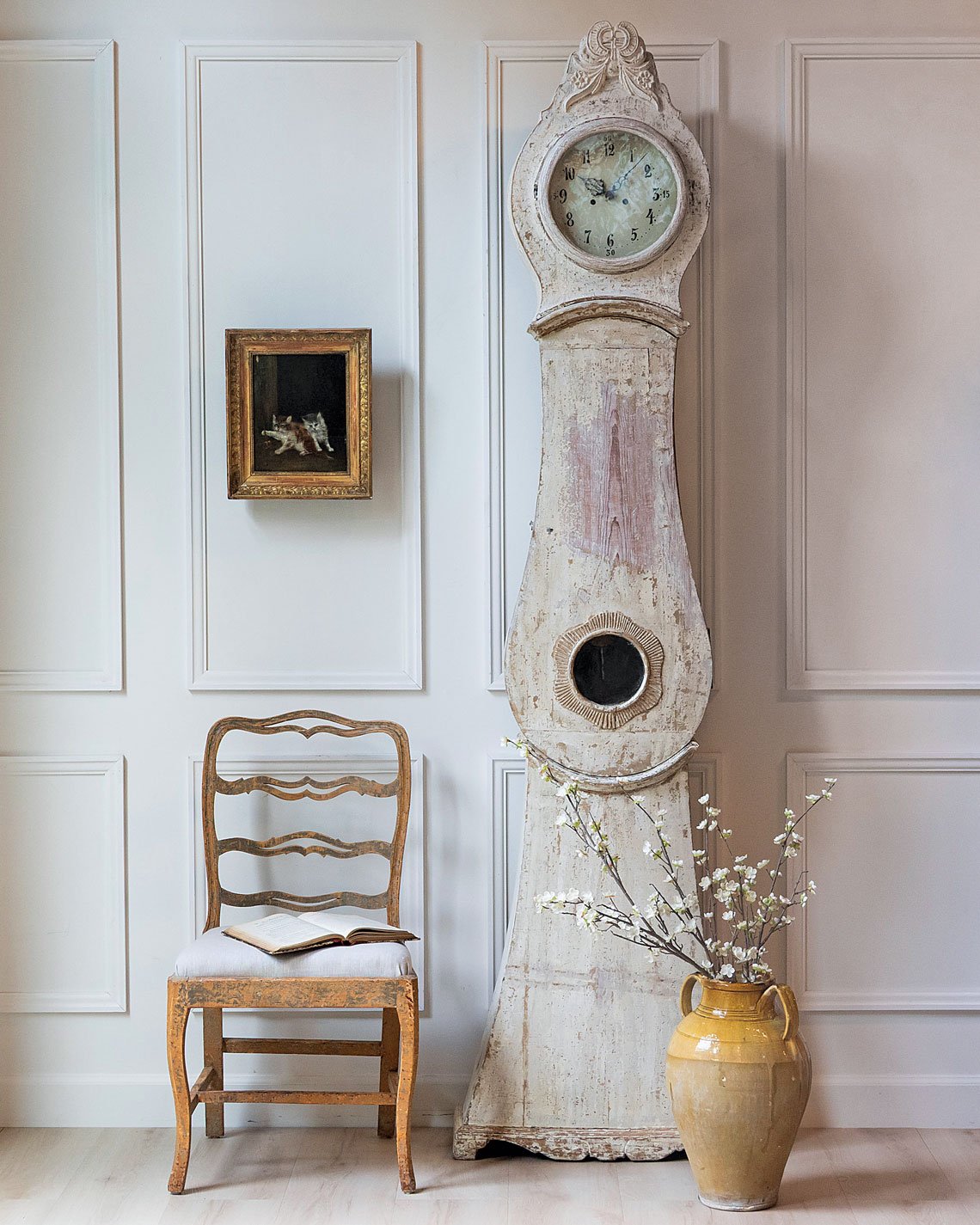 |  | |
Left: Mora clock with original paint, mechanism, pendulum, and weights, Northern Sweden, circa 1820. Hand-carved detailing around the crown and door frame. From Jacqueline Adams Antiques on Incollect. com, photo: Claudia McDade Right: Set of 8 Gustavian period side chairs with elegant oval openwork backs, Lindome, Sweden, circa 1800. From Jacqueline Adams Antiques on Incollect.com, photo: Claudia McDade | ||
Gustavian furniture and the design style that bears his name today emulate the simple, timeless forms and gentle symmetry of classical design, filtered through a Swedish aesthetic sensibility. The color palettes are muted, chalky, and earthy, reflecting the local landscape. Formal silhouettes are softened, simplified, and refined, while patinas tend to highlight natural materials, especially pine, oak, and beech woods, which are often simply painted or decorated with inlaid wood. Decoration, in short, is restrained, tasteful, and simplified — a kind of Protestant take (Sweden converted to Lutheranism in 1536) of the gilded excesses favored at the courts of the powerful Catholic European monarchs.
High Gustavian style is probably best exemplified today in the design and decoration of the Swedish Royal palaces, including Drottningholm and Gripsholm Castle. But its underlying stylistic ethos of elegance balanced with practicality proved surprisingly versatile, amenable to decorating Royal places as well as the homes of everyday people, and the style spread rapidly across Scandinavia and beyond. Gustavian style endures today in a ‘shabby chic’ sensibility popular with devotees of timeworn patinas, softer palettes, and neoclassical-inspired silhouettes. It is the inspiration for much of what you might find at Pottery Barn.
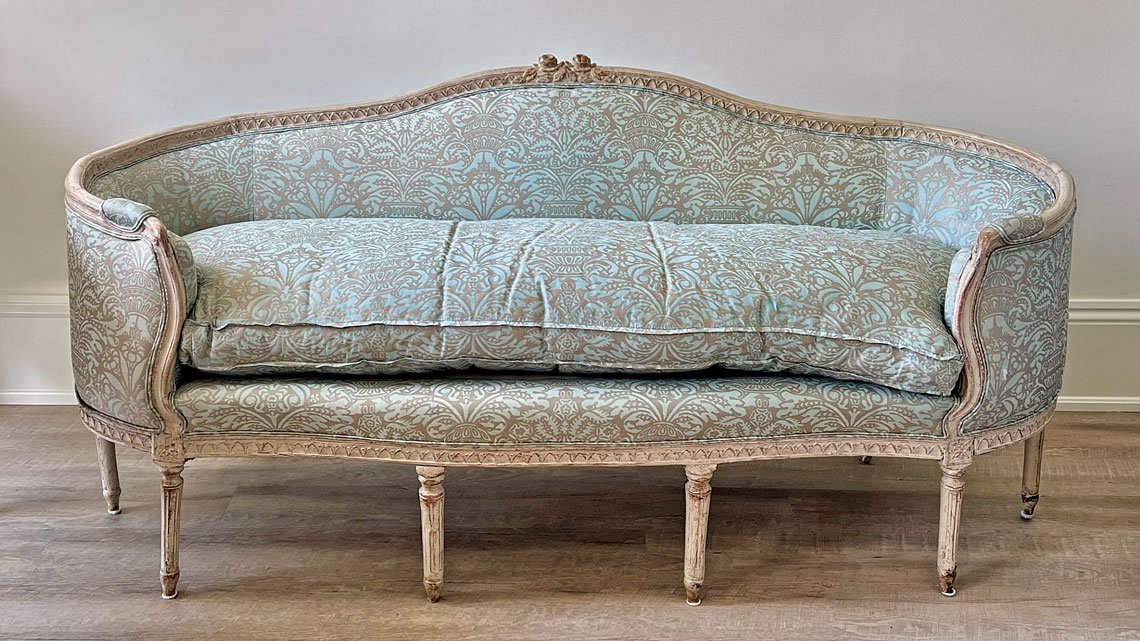 |
18th-century Gustavian corbeille sofa exhibits classical hallmarks of Gustavian design: tapered, fluted legs; balanced, symmetrical ornamentation; and a subtly scalloped crest adorned with floral carving. The pale, softly distressed paint recalls the way Swedes historically used light colors to brighten the long winter months. From Maison de Provence on Incollect.com, photo courtesy Maison de Provence |
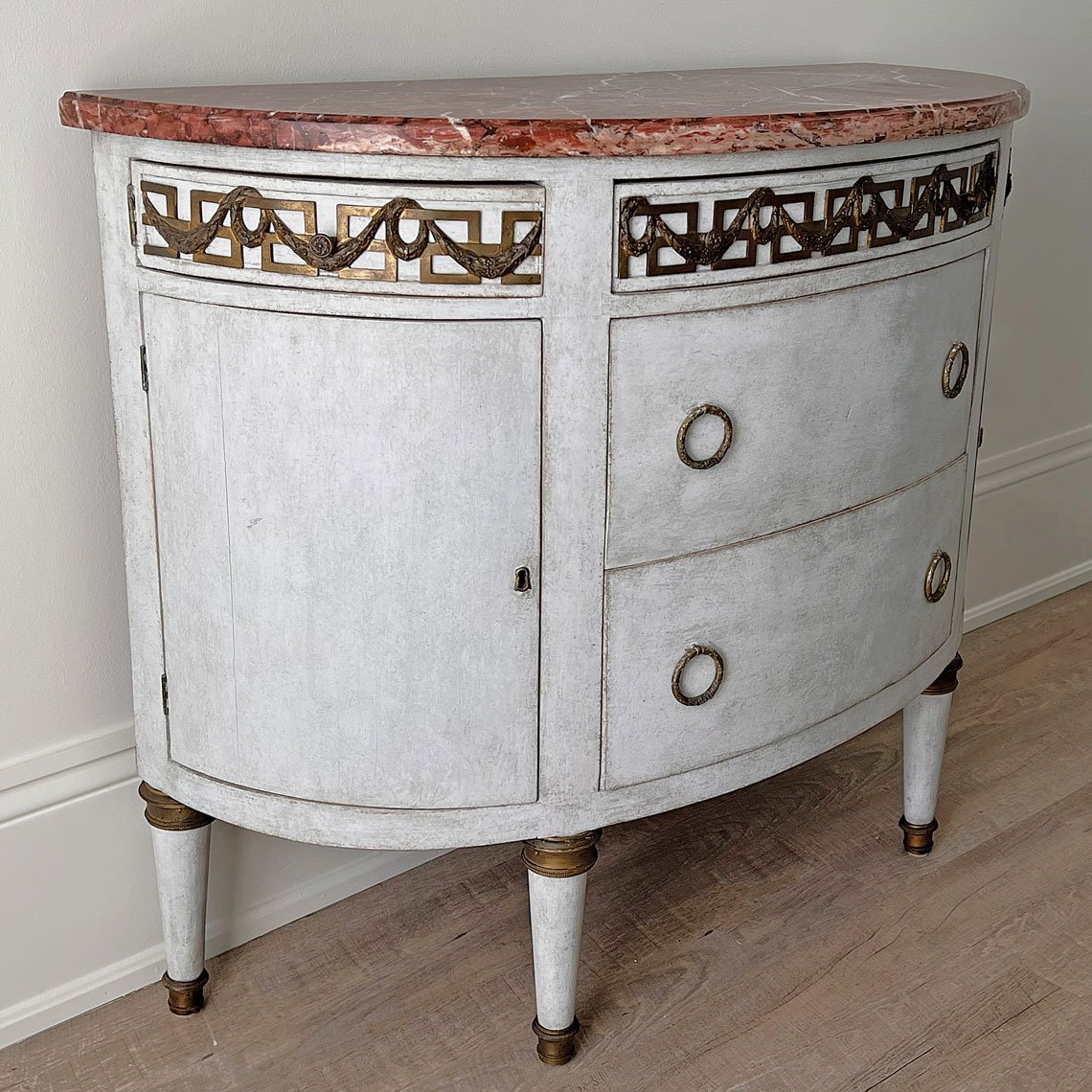 | |
19th-century Gustavian demi-lune commode with rouge marble top. Original molded bronze decorative panels, curved drawers, and doors. From Maison de Provence on Incollect.com, photo courtesy Maison de Provence |
James Adams, from Jacqueline Adams Antiques in Atlanta, a major dealer in the material, attributes the enduring popularity of Gustavian furniture as rooted in a timeless craving for craftsmanship and “quiet elegance” in design. “It’s a style that balances refinement and restraint, both pale and dark painted finishes, and sculptural silhouettes. It is elegant, but it never tries too hard, which is exactly why people love it,” he says.
Adams says clients and designers are drawn frequently to the style for interior projects that require “a sense of history without the heaviness.” Touches of ornamentation are never excessive, he explains, “simply enough to catch the eye.” He also points to the versatility of the style within interiors, something echoed by many other dealers. “It can feel airy and delicate or bold and architectural, depending on how it’s used, that's why Gustavian furniture fits just as beautifully and appropriately in a modern space as it does in a more traditional home.”
Several of his pieces of inventory on Incollect reveal why the Gustavian style continues to have widespread appeal. “The black painted Gustavian pieces are now incredibly popular with interior designers,” he says. “They are both classical and cool; that deep finish against a pale interior gives off a bold, modern, and architectural presence. The early 19th-century painted commodes or consoles show the beauty of time itself, with their layers of chalky whites and soft greys showing traces of the original pigment and the intricate handwork beneath.”
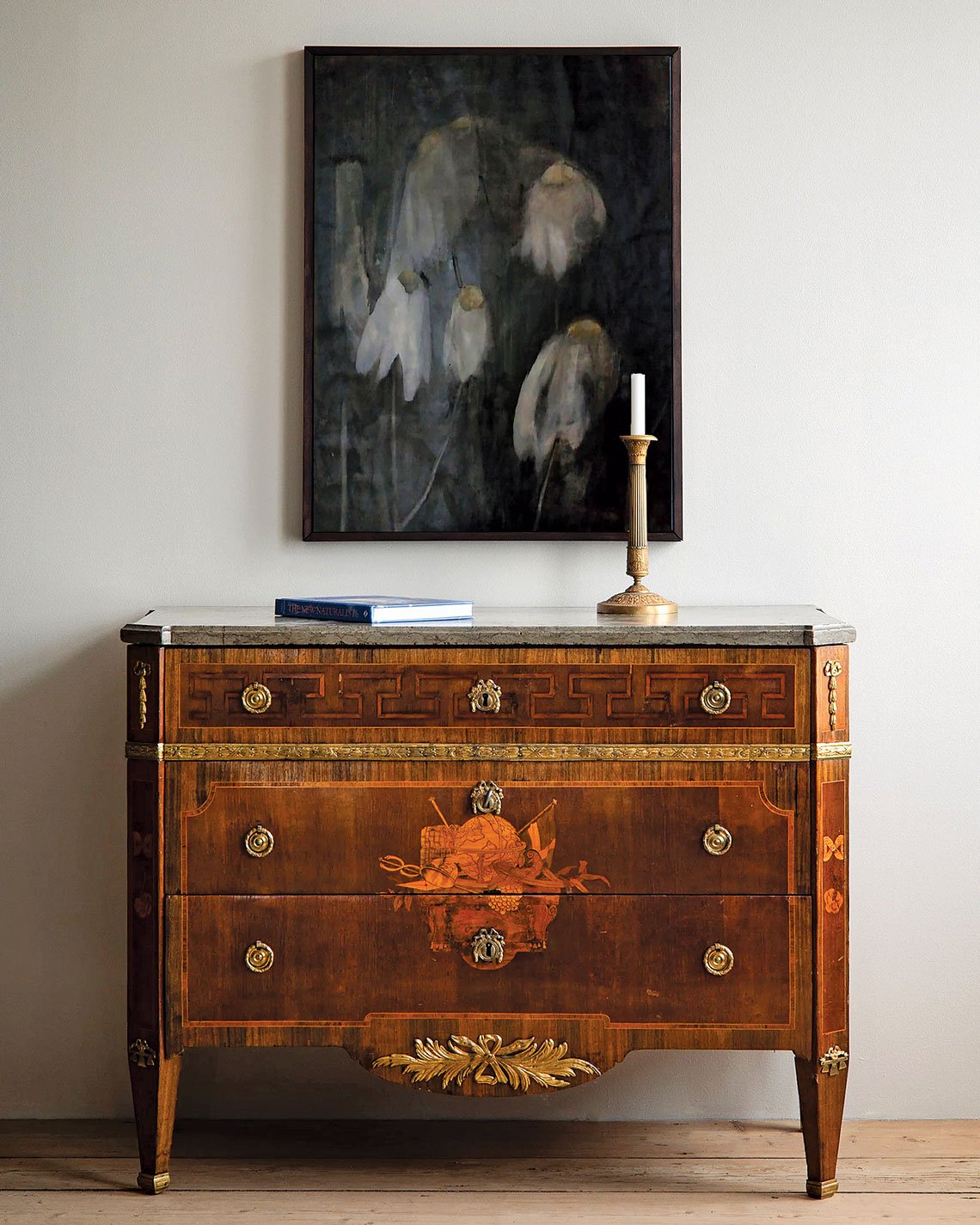 |  | |
| Left: Early 19th-century Gustavian chest of drawers veneered with amaranth, birch, jacaranda, and maple. Limestone top, gilt brass fittings, à la grecque upper case and sides, front with marquetry symbolizing seafaring and commerce with emblem of Mercury’s helmet, the god of trade and seafaring. Master work, Stockholm, Sweden, circa 1800. Extra special because of the craftsmanship, size, and great proportions. From D. Larsson on Incollect.com, photo courtesy D. Larsson Right: The demilune shape is characteristic of the Gustavian period. This piece is special because of the quality of the construction, scale of the demilune form, finely carved rosettes, and pure, untouched, original paint. From Maison & Co. on Incollect.com, photo: Aaron Patton | ||
 |  | |
Left: This sofa is rare and special because it is a signed piece from a master craftsman, Johan Lindgren. The paper seal from the Stockholm Chairmaker’s Guild remains on the frame. This sofa displays the classic clean lines of the Gustavian period, along with some of the distinctive carved decorations such as rosettes and tapered and fluted legs. From Maison & Co. on Incollect.com, photo: Aaron Patton Right: Shape and detail, such as the barrel back and the griffin, are iconic Gustavian style motifs, and nod to the neoclassical aesthetic. In original paint. From Maison & Co. on Incollect.com, photo: Aaron Patton | ||
Gustavian furniture tends to be symmetrical, well-proportioned, and elegantly casual — appealing qualities for contemporary homes. “The sofas carry delicate carved details along the rails and arms, and when reupholstered, are functional and comfortable,” Adams says. Other popular designs include the Gustavian secretaries, with their hidden drawers and worn paint. “These are especially loved,” Adams says, “functional, beautiful, and so full of character,” he says. The carved Mora clocks, each one unique, are also a popular accessory.
Margaret Schwartz, from Modern Antiquarian located at The Gallery at 200 Lex in the New York Design Center, reiterates the versatility of the style. She describes Gustavian style as “the chameleon” of the antiques trade. “Designers and clients are drawn to its soft, chalky hues ranging from greys to washed whites, honest patina, and formal simplicity — qualities always in style,” she says. “It feels timeless, and yet fresh. The look is airy, approachable, and inherently chic.”
.-Supplier-to-the-Royal-Court-and-on.jpg) | |
Pair of 19th-century Gustavian gilt wood chairs with hoof feet, front and back. Signed ES (Ephraim Stahl (1767–1820). Supplier to the Royal Court and one of the most sophisticated and inventive makers of his period. Stockholm, Sweden, circa 1800. Painting: Carnations II, Mirja Ilkka. From D. Larsson on Incollect.com, photo courtesy D. Larsson |
Schwartz has experienced renewed interest in Gustavian pieces. “Clients love that a Gustavian chest or buffet brings history, depth, and soul to a room without overwhelming it,” she says. Among her favorite pieces available now on Incollect are a late 19th-century Gustavian-style buffet, which, she says, stands out for its exquisite balance of elegance and utility. “Its pale gray finish, graceful lines, and delicate gallery detail embody the simplified refinement of 19th-century Gustavian style. The thoughtful combination of drawers, cabinet storage, and display shelf makes it practical and beautiful.”
One of Schwartz’s finest pieces is a late 18th-century Swedish secretary. “I love its faded historic and blue-painted finishing, evoking the serene high elegance of the Gustavian aesthetic,” Schwartz says. “The fold-down desk, flanked by an array of pigeon-hole cubbies and finished with a brass lion escutcheon drawer, opens to reveal shelving behind carved cabinet doors. It combines storage practicality with refined craftsmanship.”
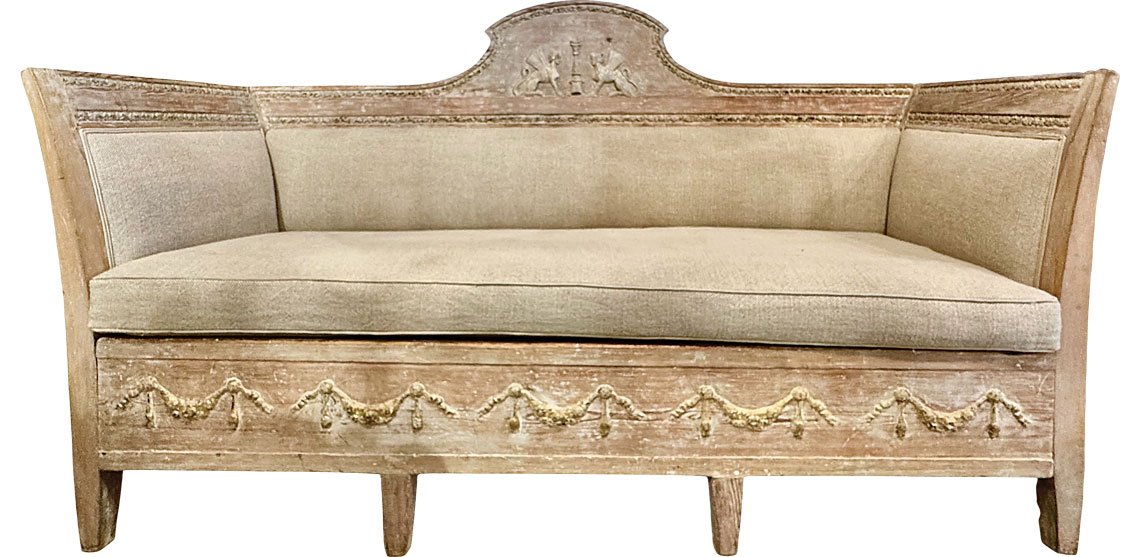
Like Schwartz, Mary Tindukasiri from MJH Design Arts, in Pasadena, California, leans towards more informal Gustavian pieces, ones that retain their original painted surfaces or have been scraped down to their base, the kind of ‘distressed’ look that is popular today. Among her current offerings is an inviting, elegant Gustavian sofa that features “slightly outward curved neoclassical arms with the high back centered by a cartouche displaying an opposing pair of neoclassical sphinxes referencing Napoleon’s Egyptian campaign.”
 | 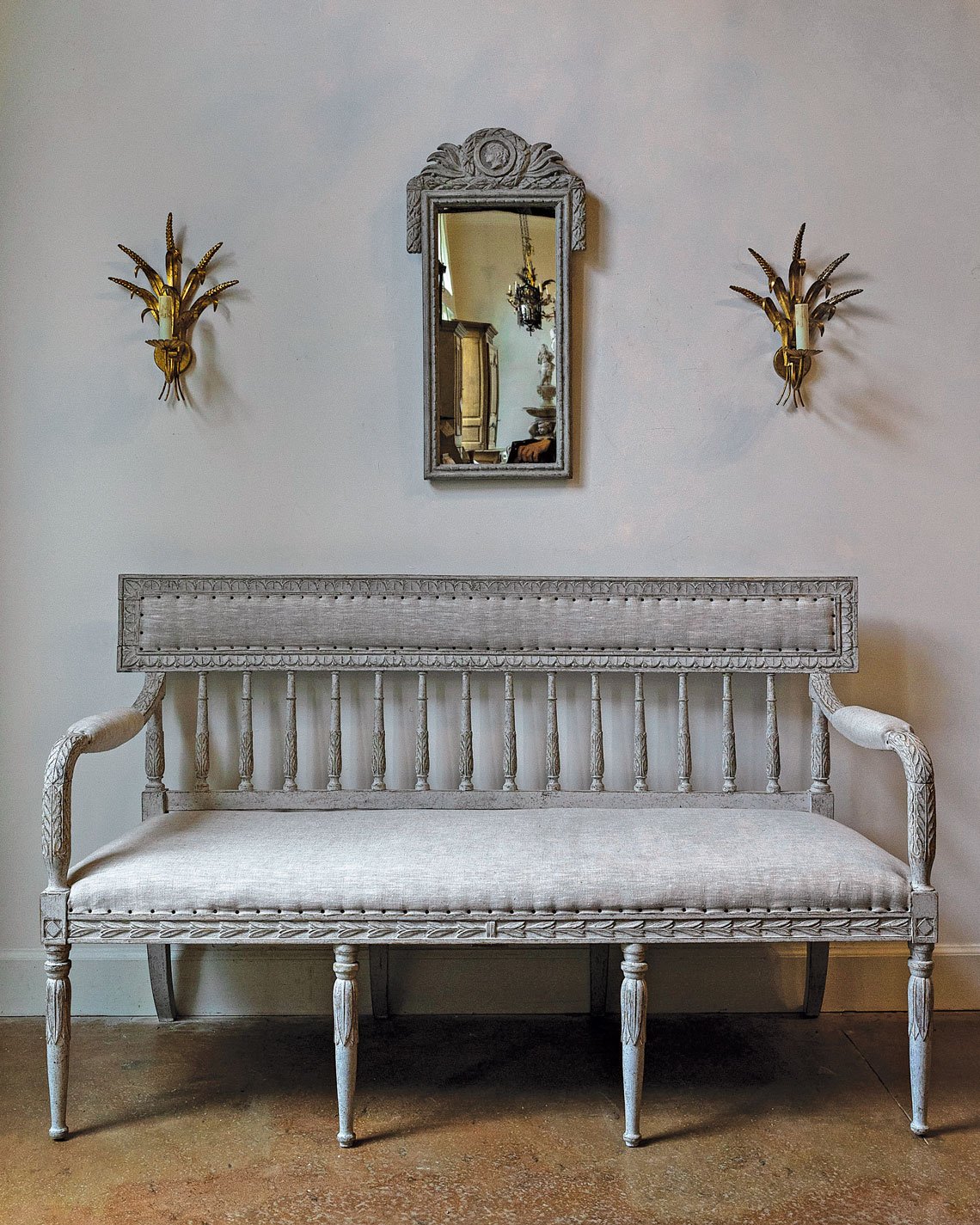 | |
Left: Swedish Gustavian style black-painted pine commode with brass hardware, one of a pair. 1900–1910, Sweden. Right: Swedish Gustavian style settee with carved rails, arms and apron, 1900–1910, Sweden. From Jacqueline Adams Antiques on Incollect.com. Photos by Claudia McDade for Jacqueline Adams Antiques. | ||
Daniel Larsson from D. Larsson, a major dealer in Gustavian style antiques in Sweden, says that while Gustavian style has been in vogue for some time, he’s starting to see more people gravitating toward the higher-end pieces, especially those that still have their original finish. “There’s just something special about these pieces,” he says. “They bring a sense of calm and quiet sophistication to a room that my clients really connect with. The clean lines, soft neutral tones, and that understated charm all work together to create a look that feels rooted in tradition but still totally at home in a contemporary setting.”
Larsson has several exceptional pieces in inventory, among them a pair of 19th-century Gustavian gilt wood chairs with hoof feet signed by Ephraim Stahl (1767–1820), who was a “supplier to the Royal Court and one of the most sophisticated and inventive makers of his period,” Larsson explains. “They are extra special as it's a rare model with hoof feet on both back and front legs. I have only ever seen this one pair,” he says.
Terri Goldsmith of Maison de Provence in New Orleans, a prominent dealer in Gustavian, French, and Italian antiques, is also experiencing increased demand for Gustavian pieces. “You’ll often find Gustavian pieces anchoring interiors where life unfolds slowly and intentionally,” she says, “they work well in homes where the patina of age is celebrated rather than disguised, homes that are filled with natural light. Calm spaces that lean into texture and natural materials rather than color are also a good fit for Gustavian pieces. They live well alongside Provençal, Belgian, and Nordic influences.”
.jpg) |
An exceptional early 19th-century Gustavian sofa, c. 1800–1810. In very good condition and retains its original scraped surface. The raised center back panel features a pair of opposing sphinxes; the arms are out swept. Carved swags decorate the skirt, with carved details rimming the back and sides. Newly upholstered in a high-end nubby linen. From MJH Design Arts on Incollect.com, photo courtesy MJH Design Arts |
 |
Important pieces in her current inventory include a demilune commode that, she says, “captures the timeless elegance at the heart of Swedish design. Its gently bowed front creates a soft, gracious profile, while the carved swags and geometric frieze introduce a note of classical refinement — ornament used thoughtfully, with restraint and sophistication. The marble top adds a beautiful sense of material texture and richness. Its warm veining plays quietly against the painted finish below, which has mellowed over time into a velvety, luminous patina.”
Function and beauty are especially well-balanced in the design of this striking commode, where the two central drawers offer easy, accessible storage, and the flanking cabinets provide space to keep additional items neatly out of view. Goldsmith loves the tapered legs on the piece, which lift the design, “giving it an airier presence, so it sits gracefully within a room rather than dominating it,” she says. “This commode has the versatility to work in any setting — an elegant welcome in the entry, a refined anchor in the dining room, or a beautiful and useful piece beside a bed or in a sitting room. It is a piece that enhances a space quietly but unmistakably through proportion, craftsmanship, and the gentle poetry of lived, loved surfaces.”
Bernadette Truxal of Maison & Co. in Wichita, Kansas, also believes the allure of Gustavian style is tied to its versatility and universal charm. “It is very architectural in form and displays symmetry, so it works with both traditional and modern aesthetics,” she explains. “The carved motifs are decorative, while the shapes and pale paint finishes are understated. It reads as refined elegance and understated beauty.”
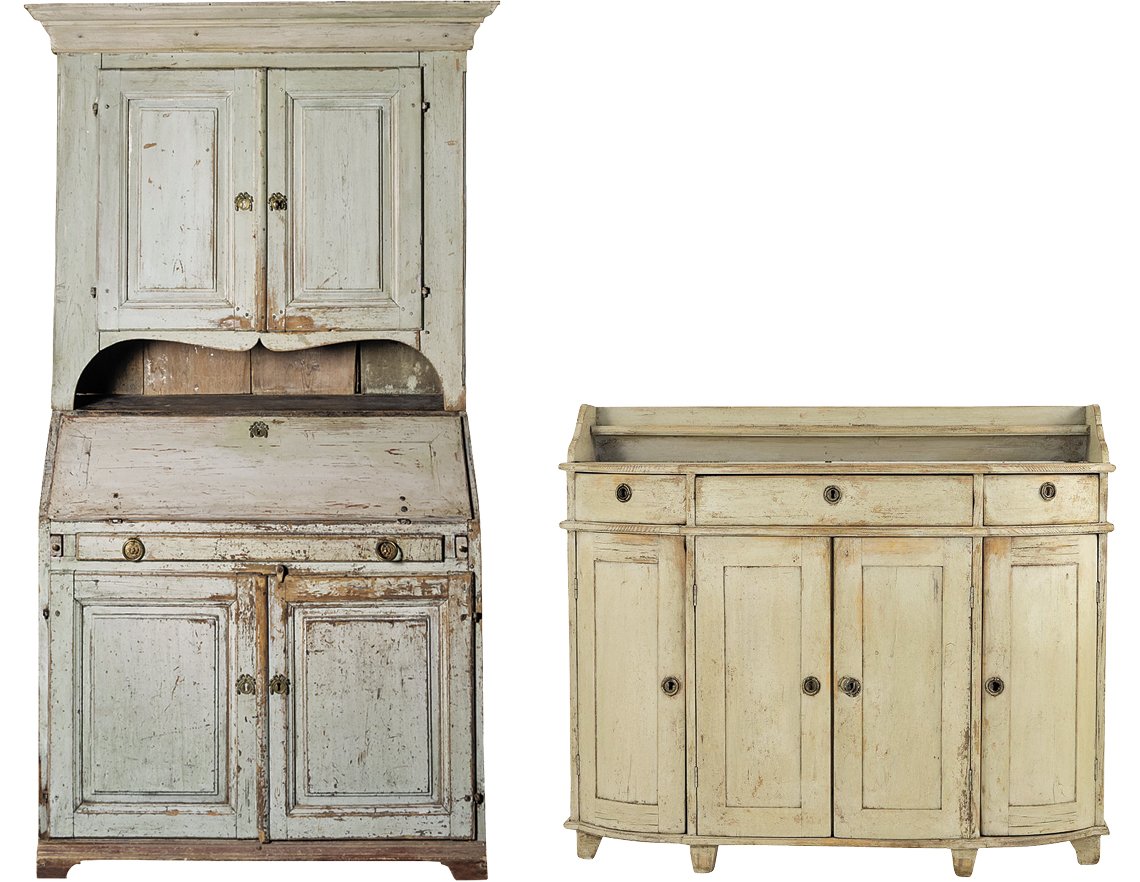 |
| Left: Late 18th-century Swedish secretary cabinet with faded blue historic paint. The drop-down desk opens to a black painted interior with 8 pigeonhole compartments. From Modern Antiquarian on Incollect.com, and at the Gallery at 200 Lex. Photo courtesy Modern Antiquarian Right: 19th-century Gustavian buffet in soft gray paint. From Modern Antiquarian on Incollect.com, and at the Gallery at 200 Lex. Photo courtesy Modern Antiquarian |
Among the pieces Truxal has in inventory is a rare griffin sofa. “Shape and detail help identify the Gustavian style here, such as the barrel back, while the griffin motif nods to neoclassical aesthetics, drawing inspiration from Greco-Roman art,” Truxal says. She also has a Gustavian sofa by the master craftsman Johan Lindgren, which displays the classic clean lines and distinctive carved decoration of the style. “This sofa is rare because it is signed by the maker. Even the paper seal from the Stockholm Chairmaker's Guild remains on the frame.”
Beginning in the early 19th century, Gustavian-style furniture began to take on more varied shapes, forms, and finishes as the style spread to different countries. A 19th-century Gustavian daybed at Maison de Provence, washed in tones of grey, blue, and beige, feels "warm and inviting, with a gently arched crest rail with floral carvings that quietly continue along the apron and legs without disturbing the simplicity of the form and an overall feeling of comfort, ease, and restfulness."
“There’s a longing right now for interior spaces that feel calm, spaces that exhale — I suspect that’s why Gustavian pieces are resonating so deeply again,” Goldsmith says. “They carry a kind of gentleness — an elegance softened by time and light, with a humility that comes from living closely with nature and long northern winters. There’s poetry to be found in that simplicity. Nothing feels showy. It’s just quiet beauty.”