











Franz Arthur Bischoff
American, 1864 - 1929
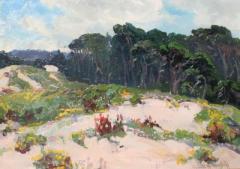
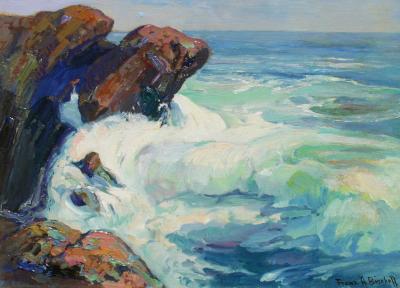
Franz Arthur Bischoff (1864-1929) Franz Bischoff was born in Bomen, Austria on Jan. 14, 1864. Bischoff studied art in Vienna before immigrating to the U.S. in 1885. He worked as a decorator of china in a NYC factory and later continued this line of work in Pittsburgh, PA and Fostoria, OH. In 1892 he moved to Michigan where he produced ceramic works and taught china decorating in Detroit and Dearborn. Franz Bischoff first visited California in 1900, but it was six years later before he and his family moved to Los Angeles. Bischoff established a studio in the Blanchard Bldg and in 1908 built a palatial Italian Renaissance style studio-home in the Arroyo Seco in Pasadena. He brought with him a reputation of one as the nation's greatest china painters; however in California he turned to painting impressionist landscapes of the desert around Palm Springs and the poppy fields near the Arroyo Seco. Franz Bischoff subjects also include floral still lifes, harbor scenes in San Pedro, coastals, and Zion Nat'l Park (done on trip in 1928). His early works were mostly 13" x 19", softer and more muted than his later works which often show the influence of Expressionism and the Fauves. Franz Bischoff died in Pasadena on Feb. 5, 1929. Source: Edan Hughes, "Artists in California 1786-1940"
Franz Bischoff Paintings & Art
Franz Bischoff Paintings & Art
Franz A. Bischoff was born in Bohmen, Austria on January 14, 1864. He received his first art training in the local art school. His artistic aptitude was great and in 1882, decided to continue his studies in Vienna where he studied applied design, watercolor painting and porcelain decoration. Bischoff moved to New York City in 1885 where he worked as a decorator in a china factory. He became one of the most famous porcelain artists of his time specializing in flowers most of which he grew in his own garden. He was best known for his paintings of roses which earned him the name "King of the Roses". In 1906 Bischoff and his family moved to San Francisco, California and began his career as a landscape painter. Soon there after they moved to Pasadena where he opened a studio. Bischoff's paintings were well received by the public and critics alike. In addition to the local landscapes, he painted up the coast in Monterey, and Carmel, in the Sierras, the deserts of Palm Springs and late in his life in Zion National Park in Utah. Bischoff began as a flower painter and evolved into one of America's premier artists. Bischoff died of heart failure in his Arroyo Seco home on February 5, 1929.
Biography courtesy of DeRu's Fine Arts, www.antiquesandfineart.com/derus
Biography courtesy of DeRu's Fine Arts, www.antiquesandfineart.com/derus

 Loading...
