









George Gardner Symons
American, 1863 - 1930
A landscape and marine artist, George Symons was one of America\'s more noted plein-air painters who combined styles of impressionism and realism. His works are cited for their energy and simplicity, and he often did panoramic views.
He was born in Chicago, Illinois in 1861, with the name of George Gardner Simon, but he changed his last name to Symons when he returned from study in England because of concern about anti-semitism. Not much is known about his early life. He first studied at the Chicago Art Institute where he became a close, life-long friend of William Wendt. They painted together in California and then in Cornwall, England in 1898. He also studied in Paris, and Munich and London, and joining a colony of artists at St. Ives, adopted the plein-air techniques of Julius Olsson, Adrian Stokes, and Rudolph Hellwag.
He worked in Chicago as a commercial artist, and about 1903 returned to California with Wendt and built a studio in Laguna Beach and became active in western art societies including the California Art Club. He returned often, but maintained his primary studio in Brooklyn, New York, and also did a lot of painting in Colerain, Massachusetts.
Among the collections where his work can be found is the Brooklyn Institute of Arts and Sciences; the Art Institute of Chicago, and the Fleischer Museum in Scottsdale, Arizona. Associations he was a member of include the National Academy of Design, the National Arts Club, the Institute of Arts and Letters, the Lotos, Century, and Salmagundi Clubs. He was also a member of the Royal Society of British Artists and the Union Internationale des Beaux Arts et des Lettres.
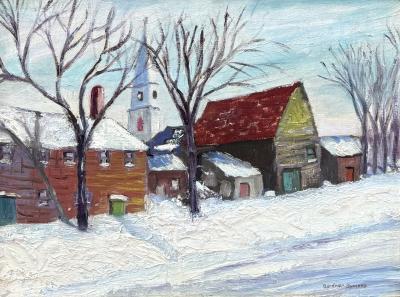
He painted entirely out-of-doors, frequently working in Arizona, doing desert landscape and the Grand Canyon views, which \"were well received\", (Dawdy 424), but he is best known for his New England snow scenes, especially of the Berkshire Mountains. He died in Hillside, New Jersey in 1930.
He was born in Chicago, Illinois in 1861, with the name of George Gardner Simon, but he changed his last name to Symons when he returned from study in England because of concern about anti-semitism. Not much is known about his early life. He first studied at the Chicago Art Institute where he became a close, life-long friend of William Wendt. They painted together in California and then in Cornwall, England in 1898. He also studied in Paris, and Munich and London, and joining a colony of artists at St. Ives, adopted the plein-air techniques of Julius Olsson, Adrian Stokes, and Rudolph Hellwag.
He worked in Chicago as a commercial artist, and about 1903 returned to California with Wendt and built a studio in Laguna Beach and became active in western art societies including the California Art Club. He returned often, but maintained his primary studio in Brooklyn, New York, and also did a lot of painting in Colerain, Massachusetts.
Among the collections where his work can be found is the Brooklyn Institute of Arts and Sciences; the Art Institute of Chicago, and the Fleischer Museum in Scottsdale, Arizona. Associations he was a member of include the National Academy of Design, the National Arts Club, the Institute of Arts and Letters, the Lotos, Century, and Salmagundi Clubs. He was also a member of the Royal Society of British Artists and the Union Internationale des Beaux Arts et des Lettres.
He painted entirely out-of-doors, frequently working in Arizona, doing desert landscape and the Grand Canyon views, which \"were well received\", (Dawdy 424), but he is best known for his New England snow scenes, especially of the Berkshire Mountains. He died in Hillside, New Jersey in 1930.
George Gardener Symons changed his birth name, Simon, because he was worried about anti-Semitism. Symons traveled through Paris Munich and London before settling in Brooklyn. He was a plein-air painter who combines elements of Realism with Impressionism. Symons was best known for his winter landscapes of the Berkshire Hills and Gloucester, MA. He also painted annually in Cornwall England. Later Symons established a studio in California. Symons believed in drawing from inspiration. His large canvases were of sweeping panoramic views with large areas of bright color. "An Opalescent River"
(1908, Metropolitan) shows a thick impasto and course canvases that reveals texture. He achieved critical success in the years immediately following 1909. Symons exhibited widely throughout NYC, California and London.
Biography courtesy of The Caldwell Gallery, www.antiquesandfineart.com/caldwell
Biography courtesy of The Caldwell Gallery, www.antiquesandfineart.com/caldwell
new
 Loading...
