












John R. Grabach
American, 1886 - 1981

John R. Grabach (1886 - 1981)
John Grabach was a highly regarded New Jersey artist, teacher, and author of the classic text, “How to Draw the Human Figure”. He was born in Massachusetts, and with his widowed mother, moved to Newark, New Jersey when he was eleven.
Starting out as a die-cutter for a silverware firm, Grabach also designed important works of sterling silver hollow ware and Art Deco glass designs for several high end retail manufacturers. He designed United States stamps for the Treasury Department and holiday greeting cards for several firms. Grabach enrolled in courses at the Art Students League in his spare time, studying under George Bridgeman, Frank Dumond, Kenyon Cox, and H. August Schwabe.
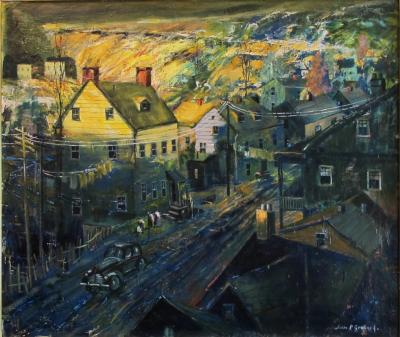
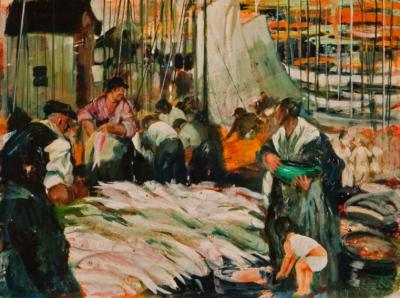
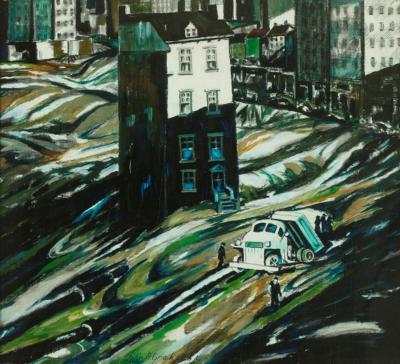
Considered a leading figure in the Newark School of Painters, his powerful Ashcan style paintings depicting scenes of New York City and Newark are truly American masterpieces. He captures the expressions and mood of his subjects in those complex compositions on par with any of the highly regarded Ashcan painters of the period. Similar in many ways to his contemporary, George Bellows, Grabach was gifted in portraying the everyday events of working class folks, and translating their ordinary daily routines into something extraordinary to look at.
Whether it be his native blue-collar Newark neighborhood, a crew of gruff dockworkers or something as regular and uninteresting as men eating soup, John Grabach had the ability to turn virtually any subject into appealing and worthy art.
From the 1920s through the 1960s, Grabach was the subject of numerous one-man exhibitions in prestigious galleries and institutions across the country. In 1980, the Smithsonian Institute in Washington, D.C., honored Grabach with a solo retrospective show of his work. This was an unusual tribute for a still living artist.
Grabach was a dedicated and beloved teacher at the Newark School of Industrial Design for many years and among his favorite students was Henry Gasser.
Grabach’s work is in the permanent collections of the Smithsonian, the Corcoran Gallery of Art, the Art Institute of Chicago, and the Philadelphia Art Alliance, among many others.
john-grabach-paintings-art
John Grabach was a highly regarded New Jersey artist, teacher, and author of the classic text, “How to Draw the Human Figure”. He was born in Massachusetts, and with his widowed mother, moved to Newark, New Jersey when he was eleven.
Starting out as a die-cutter for a silverware firm, Grabach also designed important works of sterling silver hollow ware and Art Deco glass designs for several high end retail manufacturers. He designed United States stamps for the Treasury Department and holiday greeting cards for several firms. Grabach enrolled in courses at the Art Students League in his spare time, studying under George Bridgeman, Frank Dumond, Kenyon Cox, and H. August Schwabe.
Considered a leading figure in the Newark School of Painters, his powerful Ashcan style paintings depicting scenes of New York City and Newark are truly American masterpieces. He captures the expressions and mood of his subjects in those complex compositions on par with any of the highly regarded Ashcan painters of the period. Similar in many ways to his contemporary, George Bellows, Grabach was gifted in portraying the everyday events of working class folks, and translating their ordinary daily routines into something extraordinary to look at.
Whether it be his native blue-collar Newark neighborhood, a crew of gruff dockworkers or something as regular and uninteresting as men eating soup, John Grabach had the ability to turn virtually any subject into appealing and worthy art.
From the 1920s through the 1960s, Grabach was the subject of numerous one-man exhibitions in prestigious galleries and institutions across the country. In 1980, the Smithsonian Institute in Washington, D.C., honored Grabach with a solo retrospective show of his work. This was an unusual tribute for a still living artist.
Grabach was a dedicated and beloved teacher at the Newark School of Industrial Design for many years and among his favorite students was Henry Gasser.
Grabach’s work is in the permanent collections of the Smithsonian, the Corcoran Gallery of Art, the Art Institute of Chicago, and the Philadelphia Art Alliance, among many others.
john-grabach-paintings-art





 Loading...
