








Maurice Brazil Prendergast
American, 1859 - 1923
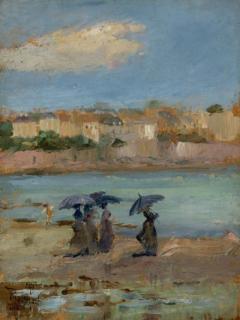
Perhaps the first truly modern American artist, Maurice Brazil Prendergast created a world both charming and sophisticated. His kaleidoscopic view of the pleasures of city leisure--the parade of strollers in the park, the bustle of shoppers along the streets, the holiday atmosphere of summer outings at the beach--belies deeper artistic concerns, as Prendergast, a retiring and unassuming Bostonian, resolutely pioneered a new direction in American art.
Born in St. John's, Newfoundland, Prendergast moved to Boston with his family in 1861. By his early twenties, the young man was apprenticed to a card painter, to which he attributed his life-long interest in flat, boldly-colored patterns and lettering. In 1891, Prendergast traveled to Paris, where he studied and painted for the next four years. His Parisian watercolors focus on the city's cosmopolitan splendors, and invoke the fêtes champêtres of Watteau and the idylls in French parks by Manet, Monet and Renoir.
Unlike these artists, however, Prendergast's technique assimilated the latest advances by Post-Impressionists including Gauguin, Vuillard and the Nabis. This second group of artists revolted against fidelity to nature by permitting artistic expression to dominate subject matter, and their innovations liberated Prendergast from a strictly representational approach in his watercolors. He would replace nature with his own imagination, painting whimsical patterns in bold colors.
During the next twenty years, Prendergast spent time in Boston, Venice and Paris, where he continued to develop his watercolor technique. During the late 1890s, he began exhibiting at the New York Watercolor Club, and by 1900, had his first one-man show at Macbeth Gallery. In 1908, he participated in the exhibition of The Eight, also at Macbeth, and several years later, had seven of his paintings included in the pivotal 1913 Armory Show.
Born in St. John's, Newfoundland, Prendergast moved to Boston with his family in 1861. By his early twenties, the young man was apprenticed to a card painter, to which he attributed his life-long interest in flat, boldly-colored patterns and lettering. In 1891, Prendergast traveled to Paris, where he studied and painted for the next four years. His Parisian watercolors focus on the city's cosmopolitan splendors, and invoke the fêtes champêtres of Watteau and the idylls in French parks by Manet, Monet and Renoir.
Unlike these artists, however, Prendergast's technique assimilated the latest advances by Post-Impressionists including Gauguin, Vuillard and the Nabis. This second group of artists revolted against fidelity to nature by permitting artistic expression to dominate subject matter, and their innovations liberated Prendergast from a strictly representational approach in his watercolors. He would replace nature with his own imagination, painting whimsical patterns in bold colors.
During the next twenty years, Prendergast spent time in Boston, Venice and Paris, where he continued to develop his watercolor technique. During the late 1890s, he began exhibiting at the New York Watercolor Club, and by 1900, had his first one-man show at Macbeth Gallery. In 1908, he participated in the exhibition of The Eight, also at Macbeth, and several years later, had seven of his paintings included in the pivotal 1913 Armory Show.

