











Offered by:
Solomon Treasure
1050 Second Ave
New York City, NY 10022 , United States
Call Seller
917.686.9732
Showrooms
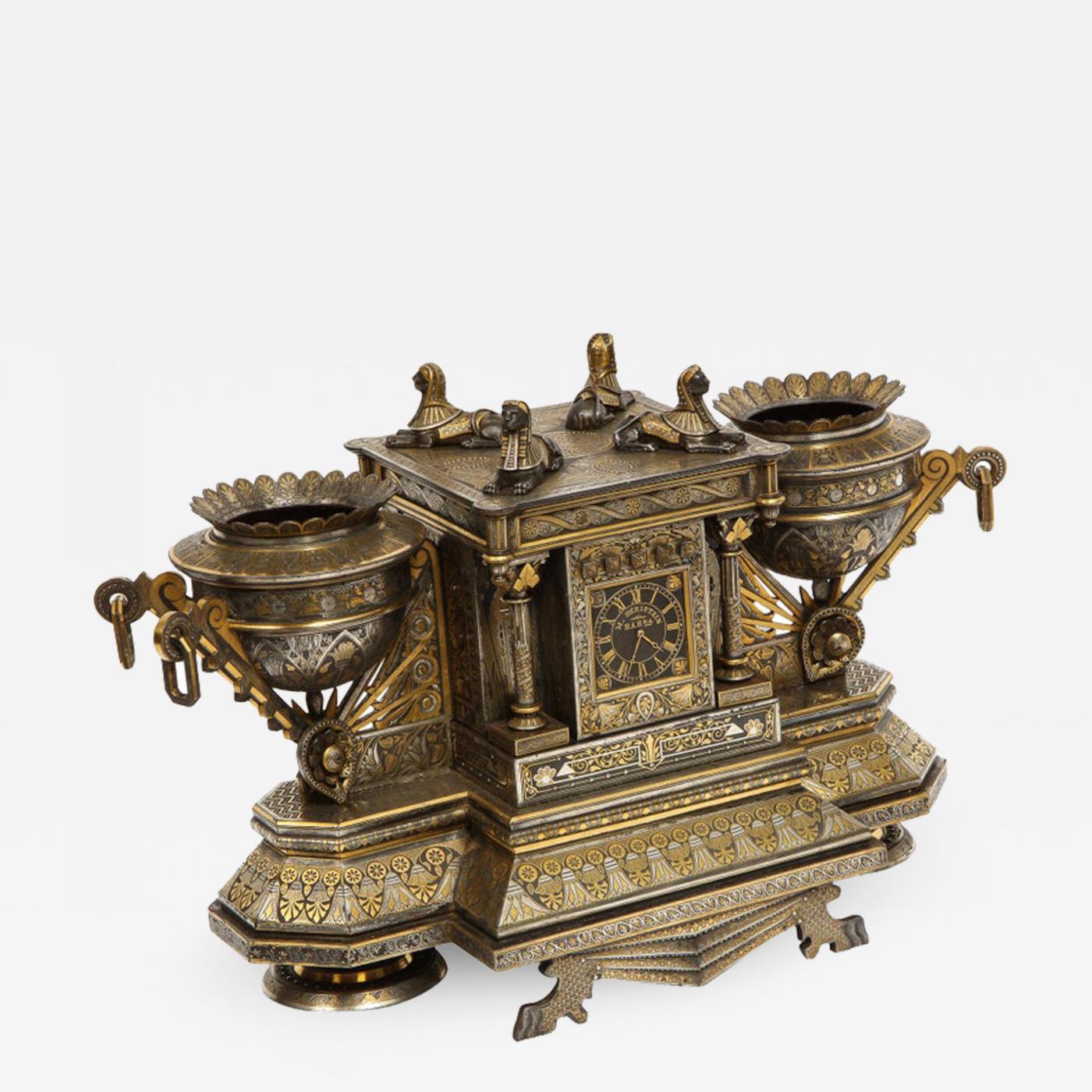
Rare & Important Spanish Damascene, Iron, Steel, Gold Inlaid Clock, Eibar, Spain
-
Description
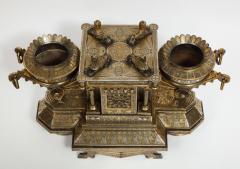
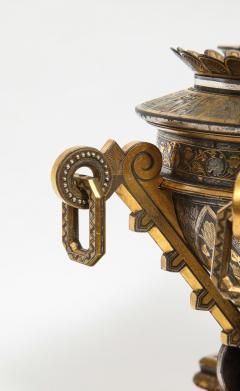
A highly rare and important Spanish damascene, "Egyptian Revival" iron, steel, gold, and silver inlaid clock, circa 1900
Exceptional quality, damascened in gold and silver inlay.
Measures: 10" high x 16" wide x 9" deep.
Definitely made by one of Placido Zuloaga's disciples – such as José Vicente Iriondo or Tomás Guisasola y Guisasola, Spain, Eibar and retailed by Beristain of Barcelona, Spain.
José Vicente Iriondo, known affectionately in Eibar by the nickname ‘Mantxón’, and his brother-in-law Tomás Guisasola y Guisasola, were disciples of Plácido Zuloaga, and towards the turn of the century they became partners.
Because of the number of specialists involved in this clocks manufacture, its great size, and the excellence of its exquisite quality, one may conjecture that it was a major commission coming from a workshop manned by some of the earlier disciples of Plácido Zuloaga.
Furthermore Beristain of Barcelona are recorded to have retailed guns and other damascened works of art in the early 20th century.
Born into a family of Spanish Royal Armourers, Plácido Zuloaga (d. 1910) went on to become one of the greatest masters of the decorative art of damascening, praised in his day as 'a second Benvenuto Cellini'. His first recognition as an artist came in 1855 when, together with his father Eusebio, he inspired the following comments for work shown at the Paris Exposition Universelle: 'One cannot praise too highly the arms and other metal objects presented by the Sres. Zuloaga, father and son; iron-chiselling, damascene, etching and repoussé never had interpreters of such obvious and varied talent' (Anon. Visite à l'Exposition Universelle de Paris, Paris, 1855, p. 121).
In 1859, Plácido took over the management of Eusebio's manufactory at Eibar in the northern Basque province of Guipúzcoa, and what had principally been a gun-making factory for the previous two generations was gradually transformed under his supervision into one for forging and damascening art objects. The switch reflected not only Plácido's personal artistic interests, but also the changing face of a gun-making industry, which by the middle of the century was becoming increasingly machine-driven. Additionally, Zuloaga sought to capitalise on the midcentury fashion for iron decoration, which had its roots in architecture (for example, the pavilions constructed for the 1851 Crystal Palace Exhibition), but which was most prevalent in the form of domestic cast iron furnishings.
On the death of his father in 1856, Eusebio Zuloaga was promoted to the position of Chief Armourer to Isabel II and her consort king, and was given the title of Huntsman to the Royal Family. For the next twelve years, therefore, the firm of Zuloaga was kept busy not only supplying weaponry and armour, but also sumptuous table objects ordered by the monarchy, either for gifts or for their own private use. The latter included a gold and silver-damascened iron inkstand supplied to Isabel II in 1860 (illustrated Lavin, p. 52, fig. 10), and a magnificent table-clock ordered by the queen mother, Marìa Cristina, for presentation to Napoleon III (op. cit., p. 55, fig. 11). However, the fall of Isabel II's government in 1868 not only brought the Royal patronage enjoyed by the Zuloagas over the previous decade to an abrupt end, it left the firm with considerable monetary loss, as 30,000 francs in salary and materials for work sent to the king would now not be reimbursed. Fortunately for Plácido Zuloaga, a new patron, less prone to the precariousness of 19th century European royalty, arrived to replace the Borbóns and became his most important client for the next two decades.
Plácido Zuloaga is believed to have met Alfred Morrison during his visit to London for the International Exhibition of 1862. The son of a wealthy textile magnate, Morrison had inherited the estate of Fonthill, Wiltshire, on the death of his father in 1857. Soon after, he engaged Owen Jones, the celebrated architect, to redesign its interior to complement his already extensive collection of modern objets d'art, commissioned from the most noteworthy European artisans of the day. Jones was an admirer of Islamic, and by extension, Spanish ornamentation, and had even spent some time living in the Alhambra, Granada. These tastes corresponded with those of Morrison, who over the next twenty years was responsible for virtually all of Plácido Zuloaga's major commissions, whether they were intended for Fonthill or for his London home at 16 Carlton House Terrace, acquired in 1865 and decorated by Jones in the same taste. Chief among these commissions were an enormous Renaissance style cassone, executed 1870-1 (sold Christie's, The Remaining Contents of Fonthill House, 1-2 November 1971, lot 9, now in the Khalili collection; see Lavin, cat. 1, pp. 71-81) and a magnificent side-table, completed in 1880 and now in the collection of Her Majesty the Queen (see Lavin, fig. 16, p. 62). -
More Information
Origin: Spain Period: 1900-1919 Materials: Iron, Steel Condition: Good. Creation Date: 1900 Styles / Movements: Other, Traditional Incollect Reference #: 335974 -
Dimensions
W. 16 in; H. 10 in; Diam. 9 in; W. 40.64 cm; H. 25.4 cm; Diam. 22.86 cm;
Message from Seller:
For four generations, Solomon Treasure has built a distinguished reputation for offering rare and important 18th-19th century antiques and fine art, serving museums, collectors, and designers worldwide. Located in the heart of Manhattan, we specialize in exceptional pieces ranging from Napoleon Neoclassical to Art Deco and Middle Eastern Islamic treasures. Contact: Mory Talasazan, Director | mory@solomontreasureny.com | 917.686.9732 |
Sold
More Listings from Solomon Treasure View all 170 listings
-
A Rare Alexis Falize Antique Gold and Cloisonné Enamel Locket, Circa 1867
-
A Massive Museum Pair of Meiji Period Japanese Cloisonne Enamel Chargers Plates
-
1876 Centennial Exhibition, J & L. Lobmeyr Ormolu Mounted Ruby Glass Centerpiece
-
A Large and Exceptional Japanese Meiji Period Tokyo School Bronze Sculpture
-
Rare One-of-a-Kind Buccellati Sterling Silver Polo Trophy for Boca Raton Polo
-
Al Thani Collection, a Mughal Indian Square White Jade Inkwell Cover, circa 1800
-
State of Qatar and Grant Macdonald, a Rare Silver Humidor Box
-
A Rare 1924 ‘King Fouad I’ Box by René Lalique
-
A Rare Monumental Italian Carved Carrara Marble Model of A Cathedral
-
Monumental Meiji Period Japanese Cloisonne Enamel Jardiniere
-
Sanford Robinson Gifford (American 1823-1880), A Rare Portrait Of Mrs. Sanford

-
Rare Pair of Mario Buccellati Italian Silver Marine-Themed Oyster Platters
-
Contemporary Coral, 18k Gold, Diamonds, and Onyx Pipe
-
Isidore-Jules Bonheur, A Rare Gilt and Patinated Bronze Jockey on A Horse