




Showrooms
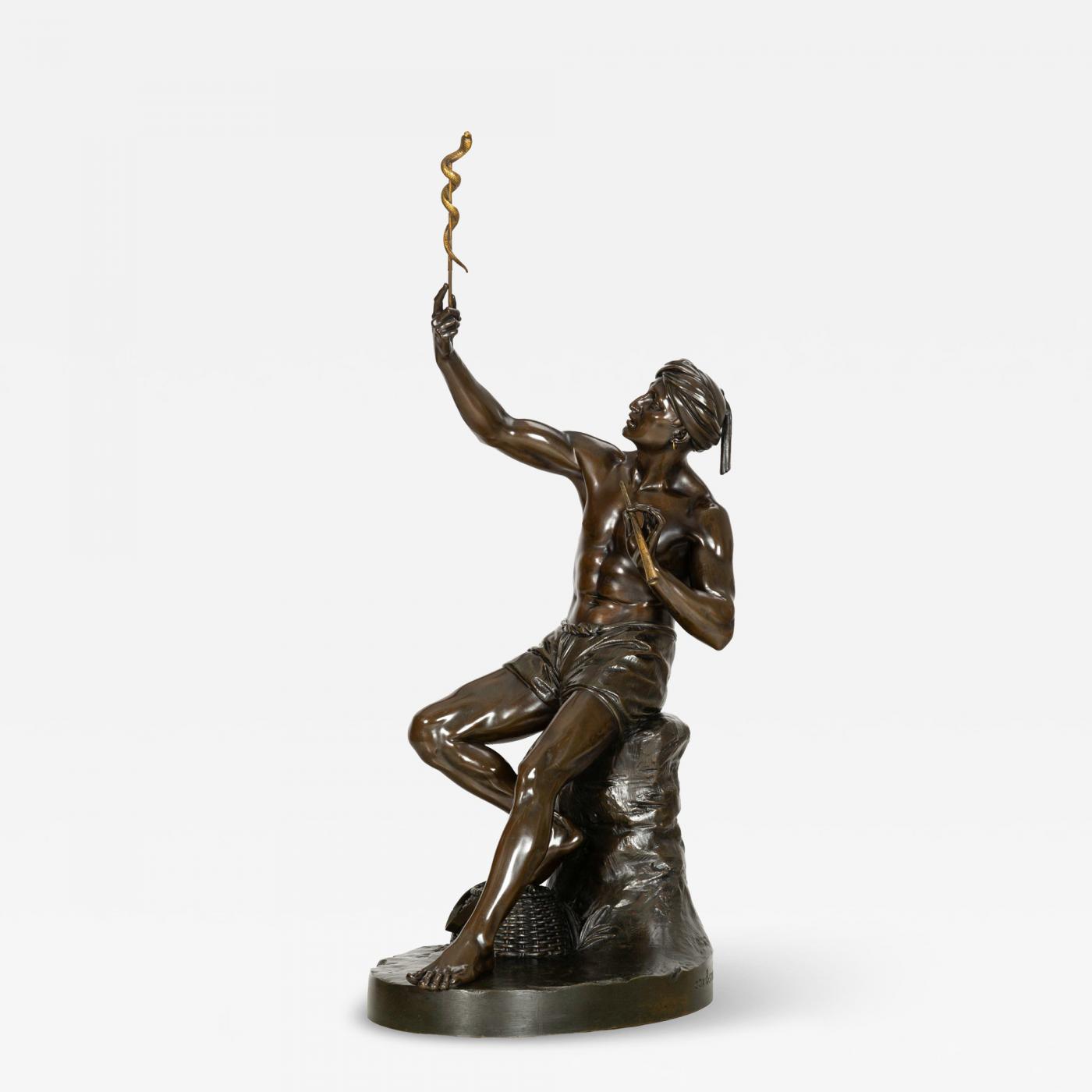
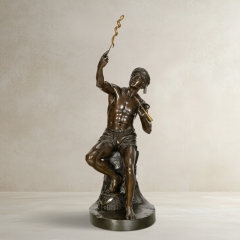
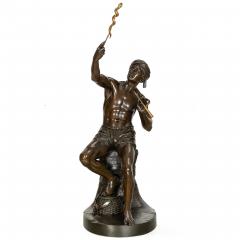
"Snake Charmer" (1876) | Sir Thomas Brock R.A.
-
Description
SIR THOMAS BROCK R.A.
British, 1847-1922
"Snake Charmer" (1876)
Sand-cast and patinated bronze | Unsigned, chiseled foundry mark for COX & SONS FOUNDERS | cast circa 1880
Item # 409RKP23G Exhibited at the 1876 Centennial International Exhibition in Philadelphia by the foundry Cox & Sons, at the Royal Academy in 1877 (no. 1459) and at The Royal Glasgow Institute of the Fine Arts in 1879, Snake Charmer is one of Thomas Brock's earliest Ideal subjects before he became slowly immersed in the New Sculpture movement in Britain.
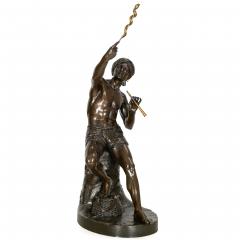
Brock's open-minded approach to modeling and an eagerness to break away from tradition is perhaps best showcased in this early model. Eschewing the Rome School approach to classicism, glory and heroism, Brock infuses an emotional association in his Snake Charmer that is highly refreshing. It has an almost spiritual and ethereal quality, the seated mystic dressed only in a simple pair of woven shorts while he props his leg on the crisply woven basket from which his serpent most likely appeared. He raises the writhing snake into the air on a thin reed while loosely holding his flute between his fingers in the other hand.
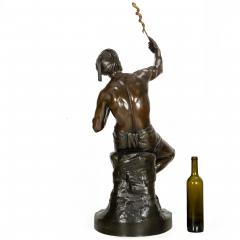
The modeling is extraordinary and the casting quality is superb, the surface being very finely finished in a medium and dark brown translucent patina. It is unsigned and is only marked by COX & SONS FOUNDERS on the vertical edge of the base.
A most scarce model. SIR THOMAS BROCK R.A.
Thomas Brock was a prominent British sculptor who achieved fame in his day for his many important public monuments, most notably his monument to Queen Victoria. He specialized in portrait sculptures and is remembered for his significant contributions to the New Sculpture movement.
Born in Worcester in 1847, Brock began his artistic training as an apprentice at Worscester Royal Porcelain where he did modeling for their ceramic work while studying at the Government School of Design in Worcester before moving to London to study at the Royal Academy Schools. Here he studied under John Henry Foley starting in 1866, one of the leading academic sculptors of the time and a figure that would have a significant influence on his modeling. He enrolled at the Royal Academy School in 1868 and in 1869 he had won a gold medal for "Hercules Strangling Antaeus".
This exhibit caught the attention of Lord Frederic Leighton, the highly influential painter and sculptor, and would lead to a lifelong friendship that had no small influence on the shape his career took. Leighton served as a mentor to Brock, guiding him in both artistic technique and professional development. His emphasis on naturalism, dynamism and truth-telling in sculpture led Brock to become a part of the New Sculpture movement in London, refocusing his modeling on empathy, fluid movement and a carefully observed connection with his subjects.
Brock's reputation and position in the sculptor community was firmly secured with his completion of the monumental statue of Prince Albert for the Albert Memorial. In 1876 he won another gold medal at the Royal Academy.
His early work was firmly rooted in the classical tradition with a firm rooting in his academic training. As his eye matured and he became more in tune with the essence of the New Sculpture movement, his handling of subjects evolved to create a more dynamic image, expressive and sympathetic to the true nature of the topic. This movement, which emerged in the 1880s, aimed to bring sculpture closer to life through more fluid poses and a greater sense of realism. Brock embraced these ideas, particularly in his treatment of the human form, while still maintaining the precision and attention to detail for which he was known.
Among his most notable works are "Moment of Peril" in the Leighton House Garden, the "Statue of Queen Victoria" unveiled in 1911, "Eve" (1898) and the Royal Artillery Memorial at Hyde Park Corner (1925). Brock was also well-known for his portrait busts, which not only capture the form and features of his sitters but also their character and personality.
Brock's style evolved over his career, incorporating elements of the New Sculpture movement without abandoning his classical training. He focused on creating sculptures that were both technically masterful and emotionally resonant, embodying the values of dignity and heroism in his public monuments. He was elected a full member of the Royal Academy in 1897 and remained a respected figure in British art throughout his life.
Today, his works continue to be held in major collections, including the National Portrait Gallery, the Tate Collection, the Royal Academy of Arts and the Victoria and Albert Museum. COX & SONS
Originally founded as a firm of clerical tailors in 1838 by Thomas Cox, the firm became known as Cox & Son in 1853 and Cox & Sons in 1868. They took place in London's 1856 Architectural Exhibition with machine carved examples and advertised as "Church Furnishers" in 1859, highlighting their stained glass production. They began producing carved woodworks for domestic households, expanding their market beyond clerical and church furnishings. They participated in the 1862 International Exhibition in London, showing furniture, decorative objects and many carved goods that were included in the company's catalog. By 1871 they were known as maker's of cabinet and artistic furniture as well as Patent Carving Works.
Starting in 1874, Cox & Sons built a highly specialized foundry at Thames Ditton in Surrey with a hand-operated gantry lift that could raise or lower the warehouse floor for monumental sculpture. Despite being sold to M.J.C Buckley and A.S. Thomson in 1880, becoming Cox, Sons, Buckley & Co, they continued to operate under the name Cox & Sons and were recorded in the Classified List of Furniture, Upholstery and Allied Trades (1886) as "Cox & Sons". In 1897 the foundry was acquired by Arthur Bryan Burton who had apprenticed in the foundry of Cox & Sons when he was sixteen. It thereafter took on Burton's name through its closure in 1933. (Source: The Furniture History Society: British and Irish Furniture Makers: Cox & Son(s); Cox, Sons, Buckley & Company 1853-1935) Artist Listings & Bibliography: The New Sculpture, Beattie, 1983, extensive discussion of Brock throughout the text in the context of the other elements of the movement, biography p. 241 "A Dictionary of Exhibitors at the Annual Exhibitions of the Royal Glasgow Institute of the Fine Arts, The Royal Glasgow Institute of the Fine Arts, 1861-1989" The Royal Academy of Arts; a Complete Dictionary of Contributors and their Work from its Foundation in 1769 to 1904, Graves, 1970, p. 290 E. Benezit Dictionary of Artists, vol. II, Gründ, 2006, p. 1276 Nineteenth-Century Romantic Bronzes: French, English and American Bronzes 1830-1915, Cooper, 1975
Measurements: 42 1/8" H x 14" D x 17 1/2" W Provenance: Private US collection - acquired from a collection in the United Kingdom in the 1930s while serving as an officer in the US Navy during World War I and World War II. Condition Report:
Very fine condition, carefully cleaned and sealed in conservator's wax. Trace wear to elements throughout, some rubbing to the patina of his back, a small scratch to his thigh. Rubbing wear and loss to the lacquered-gilt patina of the flute. Flute and hand have some rubbing where the flute moved back and forth against his palm - the flute was affixed to his palm with a tiny pin, a carefully executed renovation to eliminate further rubbing wear. Other minor scuffs and surface history. An exquisite presentation, ready to place. -
More Information
Period: 19th Century Styles / Movements: Traditional Dealer Reference #: 409RKP23G Incollect Reference #: 836144 -
Dimensions
W. 17.5 in; H. 42.125 in; D. 14 in; W. 44.45 cm; H. 107 cm; D. 35.56 cm;
Message from Seller:
Silla, Ltd. is a family-owned antique gallery located at 117 W Burd St., Shippensburg, PA 17257, specializing in 19th and early 20th century bronze sculptures and unique period furniture. For more information or to schedule a visit, contact us at sales@sillafineantiques.com or call 717.708.9017.
Sold
More Listings from SILLA View all 375 listings
-
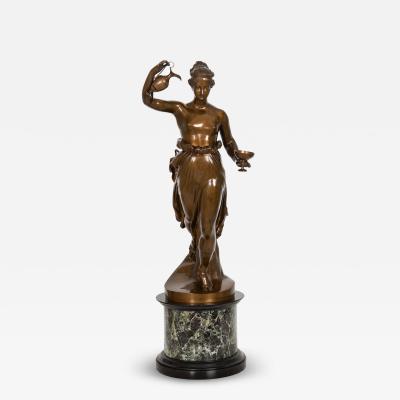
Italian Bronze Sculpture of “Hebe” after Antonio Canova by Boschetti
-
Large Antique French Louis Philippe Arched-Top Giltwood Pier Mirror ca. 1870
-
Pair of Classical Solid Marble Stop-Fluted Columns Pedestals
-
French Louis XVI Mahogany Writing Desk Tric-Trac Game Table circa 1785
-
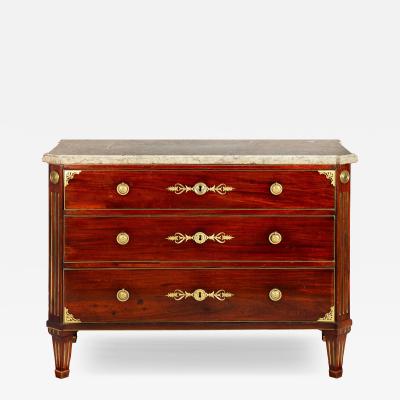
Fine Swedish Gustavian Mahogany Antique Chest of Drawers Commode ca. 1780
-
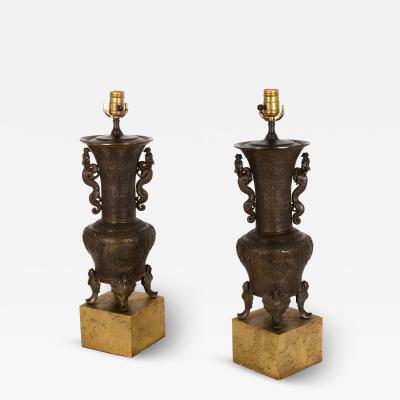
Pair of Antique Japanese Bronze Vasiform Table Lamps
-
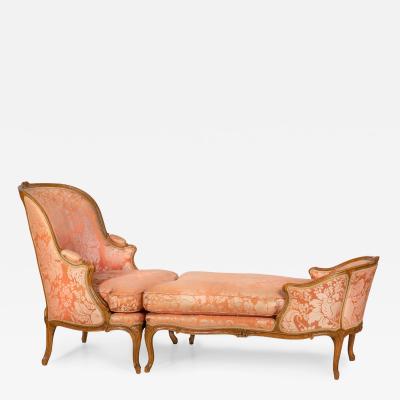
French Louis XV Beechwood Duchesse Brisee Chaise by P. Remy ca. 1765
-
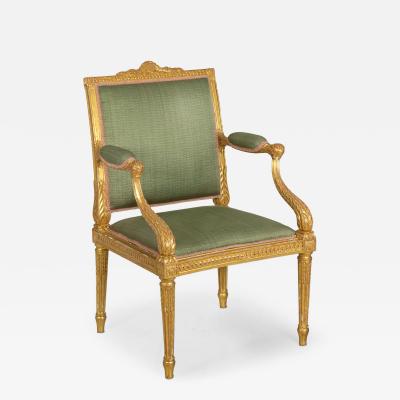
French Louis XVI Period Carved Giltwood Arm Chair Fauteuil ca. 1775
-
Fine Japanese Meiji Period Bronze Sculpture Okimono of Fire Watchman
-
Rare French Bronze Sculpture “Return of Prodigal Son” by Ernest Dubois
-
English George III Carved Mahogany Pie Crust Tilt Top Table ca. 1780
-
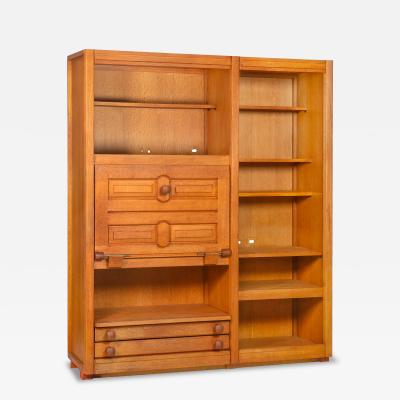
French Modernist Oak Bar Cabinet Bookshelf by Guillerme and Chambron
-
Fine Rare Pair of 19th Century English Antique Rosewood Games Tables
-
Guillerme et Chambron Oak Secretary Desk Bookcase, France circa 1960