














Offered by:
Jeff R. Bridgman Antiques, Inc.
Historic York County
York, PA , United States
Call Seller
717.502.1281
Showrooms
13 Star Parade Flag in and 3-2-3-2-3 Pattern, Unusually Large
-
Description
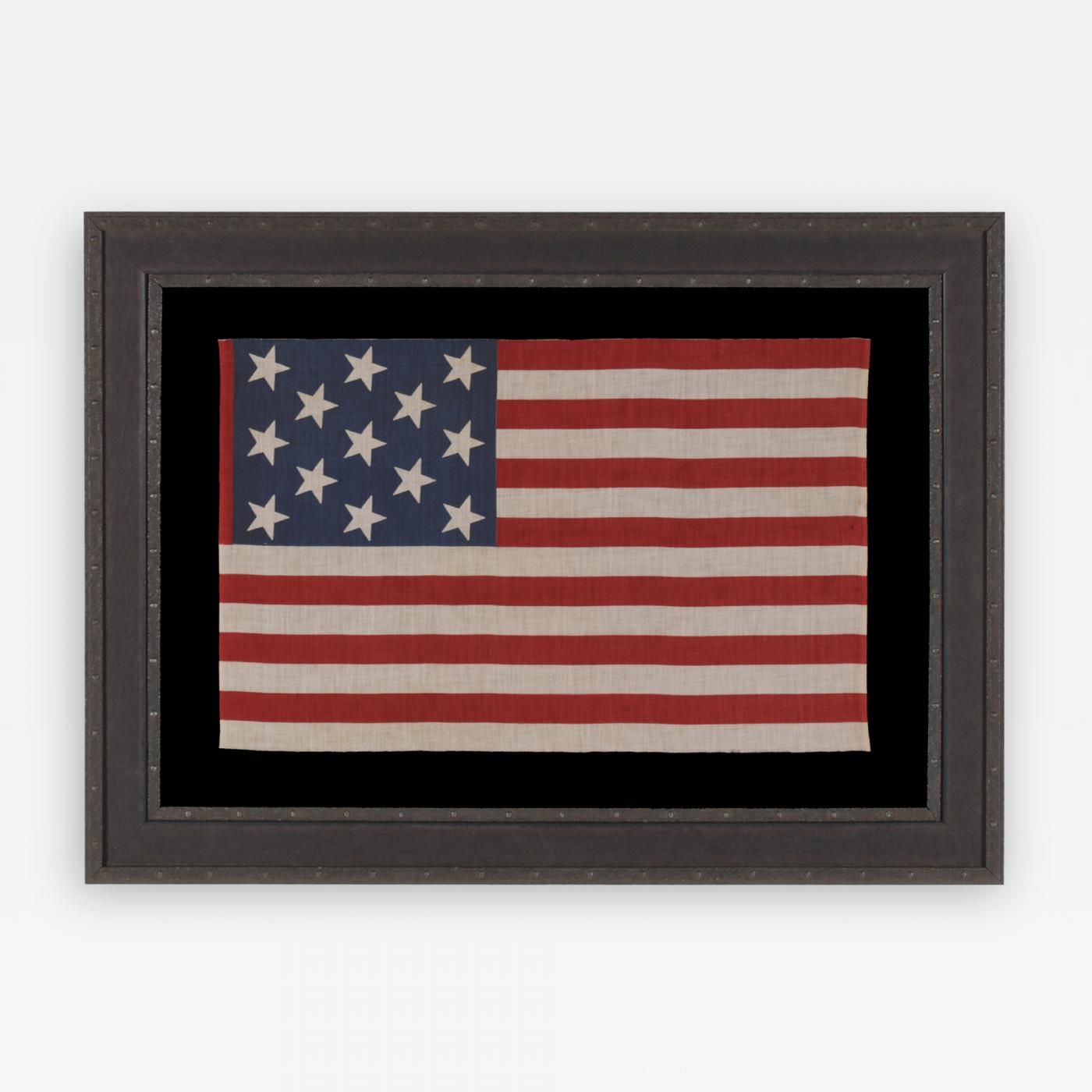
13 STAR PARADE FLAG IN A 3-2-3-2-3 PATTERN, MADE CA 1876-1898, UNUSUALLY LARGE AND WITH AN UNUSUAL STAR PATTERN AMONG ITS COUNTERPARTS OF THE 19TH CENTURY
13 star American national parade flag, printed on cotton, made sometime in the period between 1876 and 1898. This is a very rare size for the 13 star count in a printed flag. Most are very small (less than 10”). Before purchasing a small group of about eight of these flags some years ago, I had never before seen an example that bore any resemblance. The group was found in Canada, and were almost certainly made there for the American market, or made in the States for the Canadian market for an event where there was U.S. involvement. Whatever the case may be, others in the same style have since been found there and Canadian manufacture would explain the scarcity.
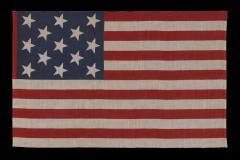
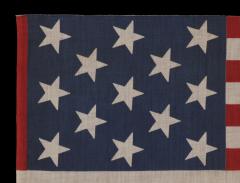
The stars are quite large in scale. Each is canted at a slight angle such that one point is directed in the 1:00 position. These are arranged in staggered lineal rows in counts of 3-2-3-2-3, which is the most common configuration found in 19th century flags with 13 stars that have pieced-and-sewn construction, but is highly unusual among printed parade flags.
In most cases the 3-2-3-2-3 design can also be viewed as a diamond of stars, with a star in each corner and a star in the very center. It can also be interpreted as a combination of the crosses of St. Andrew and St. George, which some experts feel could have been the design of the very first American flag, serving as a link between this star pattern and the British Union Jack.
On this particular example, note the unusual coloration of the hoist area, adjacent to the canton, which is red instead of the typical white. This adds a distinctly unusual feature to the flag's visual presentation and is a nice compliment to the field of large, canted stars.
The presence of so much white fabric beyond the last red stripe is also not typical of parade flag production. This was done so that there would be room for error when trimming between one flag and the next. Parade flags were printed on a bolt of fabric, like other printed textiles, and were clipped from the bolt at the point of sale, or perhaps afterwards, if the buyer bought multiple flags. When printed horizontally across the bolt, or when small flags were printed next to one-another vertically in multiples, Most parade flags had only a tiny amount of space between them, and some print runs allowed no space at all. It is extremely unusual to encounter horizontally printed flags, with selvedge (finished, woven edges) along the hoist and fly, that have enough white fabric beneath and above them to actually look as if the maker intended American flags to have 14 stripes. In fact, I can't think of another variety that shares this feature.*
13 star flags have been flown throughout our nation’s history for a variety of purposes. They were hoisted at patriotic events, including Lafayette’s visit in 1824-25, the celebration of the nation’s centennial in 1876, and the sesquicentennial in 1926. They were displayed during the Civil War, to reference past struggles for American liberty and victory over oppression, and were used by 19th century politicians in political campaigning for the same reason. The U.S. Navy used the 13 star count on small boats until 1916, because it was easier to discern fewer stars at a distance on a small flag. Commercial flag-makers mirrored this practice and some private ships flew 13 star flags during the same period as the Navy. The use of yachting ensigns with a wreath of 13 stars surrounding a fouled anchor, which allowed pleasure boats to bypass customs between 1848 and 1980, persists today without an official purpose.
Mounting: The flag was mounted and framed within our own conservation department, which is led by expert staff. We take great care in the mounting and preservation of flags and have framed thousands of examples.
The background fabric is 100% cotton twill, black in color. The extraordinary, 3-part molding is constructed of wood, but has a finish that presents like antique iron. Spacers keep the textile away from the glass, which is U.V. protective. Feel free to contact us for more details.
Condition: There is extremely minor foxing and staining, accompanied by a tiny hole near the fly end of the 4th red stripe, and extremely minor fraying along the bottom edge, but there are no significant condition issues.
* Note that some parade flags are printed vertically on the bolt, and on occasion have lots of fabric on one or both sides. This is also unusual and is typically seen on very early examples, pre-dating the American Civil War (1861-65). -
More Information
Origin: United States Period: 19th Century Condition: Good. See Item Descripiton Creation Date: 1876-1898 Styles / Movements: Folk Art, Americana, Traditional Dealer Reference #: 13j-1490 Incollect Reference #: 260759 -
Dimensions
W. 35 in; H. 26 in; D. 2.5 in; W. 88.9 cm; H. 66.04 cm; D. 6.35 cm;
Sold
