











Offered by:
L' Antiquaire & The Connoisseur, Inc.
36 East 73rd Street
New York City, NY 10021 , United States
Call Seller
212.517.9176
Showrooms
A Battle Scene
-
Description
A French battle painter active in Rome in the mid seventeenth century, Jacques Courtois enjoyed a contemporary reputation equaled only by that of Poussin. After receiving his initial artistic training from his father in the Franche-Comté, Courtois, at the age of fifteen, departed in 1636 for Italy, where he remained for the rest of his life. Soon after arriving in Milan, he was befriended by Baron de Vatteville, a commander of the Spanish army, whom he followed in battle for the next two years, observing and documenting the military campaigns. After a subsequent period of travel and study in Bologna, Florence and Siena, Courtois arrived in Rome in 1638, where he met Pietro da Cortona and Michelangelo Cerquozzi, who encouraged his interest in battle pictures. Throughout the next decade, Courtois worked as a battle painter under the patronage of Rome’s noblest families, including the Carpegna, Pamphilj and Sacchetti. Courtois’ reputation as the leading battle painter in Rome prompted Prince Matthias de’Medici to call the artist to Florence, where, from 1651 to 1655, he completed frescoes in the Villa di Lappeggi and a series of monumental paintings, all of military theme. Following his Florentine period, Courtois returned briefly to Saint-Hippolyte, tending to family business, before returning to Rome in 1657. At this point, he entered the Jesuit Order at San Andrea al Quirinale, and initially painted a few religious works before returning to his favored subject matter. His largest commission, completed with his brother Guglielmo, was a vast fresco cycle, painted between 1658 and 1661, in the oratory of the Congregazione Prima Primaria at Il Gesù. In around 1670, Courtois is believed to have been summoned to Florence by Grand Duke Cosimo III to decorate the Villa Castello. Upon completion of this project, the artist returned to the Jesuit convent, where he later died.
According to letter written by Courtois in 1667, he never executed drawings, “except for brief sketches … and these are of no use to anyone but myself because they are only ideas, and I cannot be bothered to finish them,” (see E. Holt, “The British Museum’s Phillips-Fenwick Collection of Jacques Courtois Drawings and a Partial Reconstruction of the Bellori Volume,” Burlington Magazine, 1966, 108, p. 349). So typical of Courtois’ unique graphic oeuvre, this rapidly executed sketch depicts a battle scene, or more accurately its bloody aftermath. Throughout his career, the artist employed these rudimentary drawings as initial composition studies. The fact that so few of his battle drawings, such as this one, can be linked to finished paintings is not surprising since Courtois is known to have used the canvas itself as a ground for further compositional experimentation. Characteristic of his style, this drawing exhibits the use of quick, almost scribble-like stokes of the pen to establish shape, countered by broad sweeps of wash to more fully model the figures. Dramatic chiaroscuro effects are also used to add spatial depth in his typically eye level compositions. The rounded form of the clouds and use of hatching to create shadow on the figures helps to date this drawing to the late 1640s. These distinctive aspects can be seen in a comparable battle sketch by Courtois in the British Museum (inv. 1934.5.28.1). -
More Information
Documentation: Ample Provenance Notes: Provenance: Colnaghi Gallery Origin: France Period: Pre 18th Century Materials: Pen and black ink, brush and black and gray wash on two joined sheets of cream laid paper Condition: Good. Creation Date: 1621-1676 Styles / Movements: Other Incollect Reference #: 305063 -
Dimensions
W. 9.75 in; H. 16 in; W. 24.77 cm; H. 40.64 cm;
Message from Seller:
L' Antiquaire & The Connoisseur, Inc. specializes in European works of art, antiques, and paintings, with a rich history dating back to 1935. For more information, contact us at 212.517.9176 or info@lantiquaire.us.
More Listings from L' Antiquaire & The Connoisseur, Inc. View all 183 listings
-
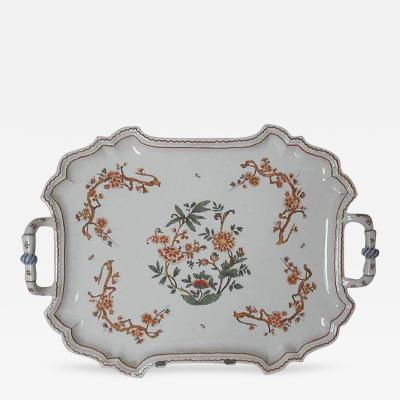
A Glazed Earthenware Tray with Two Handles and Floral Decoration
-
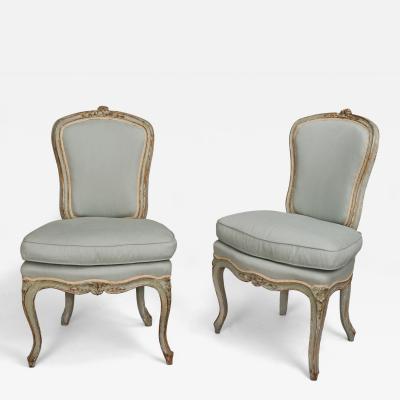
A Pair of Painted Wood Chairs (chaises en cabriolet)
-
A Pair of Bouquet of Colorful Flowers in Florentine Vases Both in Original Frame

-
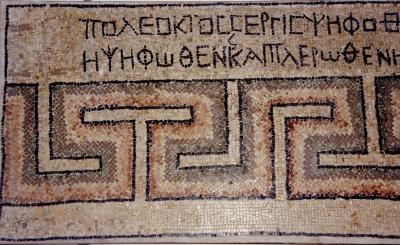
A Mosaic Floor Section with a Greek Key Design and Inscription
-
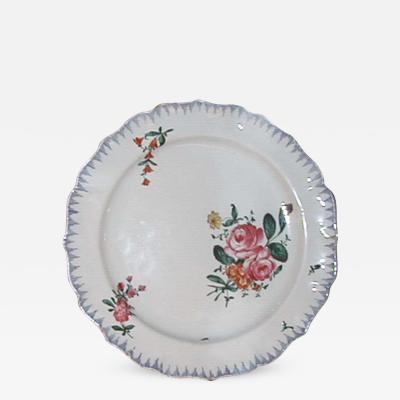
A Ceramic Plate with Painted Floral Decoration
-
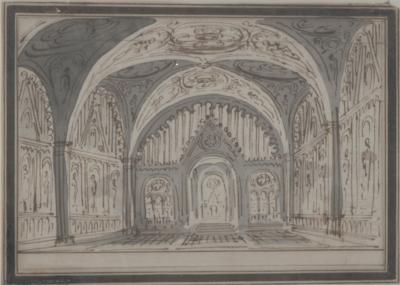
Study for a Stage Set
-
A Sicilian Maiolica Albarello with Polychrome Painted Foliage Decoration

-
River Landscape with Figures

-
A Young Woman Playing the Viola
-
Extensive Landscapes

-
Cherry Wood (bois de Sainte Lucie) Casket with Bronze Hardware

-
The Baths of Caracalla

-
A Conical Shaped Albarello with Blue and White Floral Motif
-
Christ Blessing

