












Offered by:
Jeff R. Bridgman Antiques, Inc.
Historic York County
York, PA , United States
Call Seller
717.502.1281
Showrooms
48 Stars In Dancing Rows, A Rare Variety Of A Antique American Parade Flag
-
Description
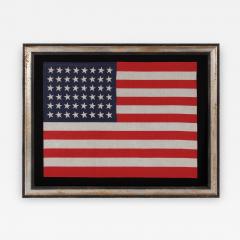
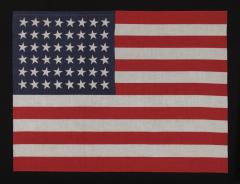
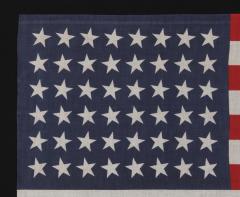
48 STARS IN DANCING ROWS, A RARE VARIETY OF ANTIQUE AMERICAN PARADE FLAG IN A LARGE SCALE, 1912-1918 OR PERHAPS EARLIER, ARIZONA & NEW MEXICO STATEHOOD:
In 1912, President Taft passed an executive order that dictated, for the first time, an official design for the star field for American flags produced for the Department of the Government. This consisted of 6 rows of 8 stars, perfectly lined up, with all stars pointing upward (one point skyward) and having a specified shape (5-pointed).
Before 1912, 48 star flags were sometimes produced in anticipation of the future addition of New Mexico and Arizona. These flags typically have 6 staggered rows of 8 stars, all pointing upward. Between 1912 and WWI (U.S. involvement 1917-18), the same, unofficial, staggered row arrangement can often be seen as well, but after this period it fades into history and most all flag-makers adopted the official, rectilinear, 6x8 pattern.
This large scale parade flag, printed on cotton, does not have either one of the two typical star configurations. It has 6 rows of 8 stars, each with 5 points, but the position of the stars on their vertical axis varies from one row to the next. In the first row, the stars all have one point facing towards 11:00. In the next row they have one point facing toward 1:00, alternating back-and-forth from one row to the next throughout the formation. Because the overall effect is similar to lines of dancers, I have termed this configuration "dancing rows," though it may also accurately be referred to as tilting or "canted" rows. This is a very scarce variety and before I found a group of these together on the original bolt, I had never before encountered the pattern in such a large size.
Based on my extensive experience with printed parade flags, and comparison to many other known examples, my educated guess is that this variety may well pre-date the addition of the 47th and 48th states. Some 48 star flags have been found with hand-written and printed dates ranging as early as 1896, a full 16 years before we actually reached that number. At this time there were 4 more Western Territories yet to be added and it was well known that they would eventually gain statehood. From the Civil War onward, it was actually common for flag-makers to produce flags with anticipatory counts like this, including more stars with hopes to influence people to buy new flags.
While dissimilar to the fabric and printing employed in the production of most 45 star parade flags, this 48 star flag is quite similar to some 46 star varieties. I believe this particular design was most likely produced either in the 46 star era (1907-1912), or just following, in the beginning of the 48-star period through WWI. This was a typical size for one-room school houses, to display indoors for general patriotism and the reciting of the pledge of allegiance. They could also be used uncut, as bunting for patriotic events.
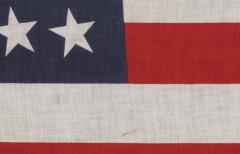
Note how the bottom red stripe is wider than the others. This is a product of both the printing and the flag's position on the bolt. Quirky traits like this make early flags more interesting visually and raise desirability among novices and collectors alike.
The 48 star flag became official on July 4th, 1912, and was generally used until the addition of Alaska in 1959. It was the official flag during WWI, WWII (U.S. involvement 1941-45) and the Korean War (1950-53).
A Survey of Other Unusual 48 Star Parade Flags:
Among printed cotton and silk parade flags, a number of others are known that vary from the norm, all of which fall between very scarce and exceptionally rare.
A silk variety is known that has stars that tilt to one side. Well more than 100 of these are known, but they are certainly very scarce.
A cotton variety is known with staggered rows of upside-down stars. Their position may be unintentional, the maker having mistakenly placed the print block in an upside-down position. Whatever the case may be, the feature is rare in printed parade flags with 48 stars.
Another style, known as the Whipple pattern, has an elaborate variation of a medallion design with a 6-pointed "Great Star" configuration in the center, formed from 13 stars, surrounded by a tightly spaced wreath of 25 stars, surrounded by a widely spaced wreath of 10 stars. This style is rare, beautiful, and highly sought-after. Both silk and cotton examples exist.
Other cotton varieties are known with circular patterns, all of which are extremely rare.
One variety is presently unique among known examples. It has 6 rows of 8 stars, each of which have 8 points.
These interesting deviations from the official 48 star design create a great scavenger hunt for the advanced collector, even though the prices generally range in the beginner to intermediate range.
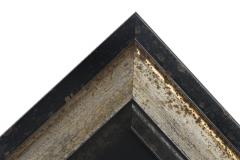
Mounting: We employ staff with masters level training in textile conservation. The flag has been hand-stitched to 100% cotton, black in color, which was washed to reduce excess dye. An acid-free agent was added to the wash to further set the dye and the fabric was heat-treated for the same purpose. The flag was then placed in a black-painted, hand-gilded and distressed Italian molding. The glazing is U.V. protective Plexiglas.
Condition: There is very minor staining, but there are no serious condition issues.
Frame Size (H x L): 34.5" x 42.75"
Flag Size (H x L): 24.25" x 32.75" -
More Information
Origin: United States Period: 1900-1919 Condition: Good. See Item Description. Creation Date: 1912-1918 Styles / Movements: Americana Dealer Reference #: 48j-988 Incollect Reference #: 116115 -
Dimensions
W. 42.75 in; H. 34.5 in; W. 108.59 cm; H. 87.63 cm;
Sold
