











Carrington & Company
British
Carrington & Company was a prominent American jewelry firm that operated from 1887 to 1957. The company was founded by Theodore B. Starr, a silversmith who had previously worked for Tiffany & Co., and Herman Marcus, a businessman who had experience in the retail industry.
Under Starr and Marcus's leadership, Carrington & Company quickly gained a reputation for its high-quality jewelry and silverware. The company was known for its use of innovative techniques and materials, such as enamelwork and gemstone settings, and for its collaborations with prominent artists and designers of the time.
In addition to producing its own designs, Carrington & Company also worked with clients to create custom pieces and produced jewelry and silverware for a number of important events and organizations. The company created the silver trophies for the 1912 Olympic Games in Stockholm, for example, and designed a silver centerpiece for the U.S. Capitol to commemorate the 150th anniversary of the signing of the Declaration of Independence.
After Marcus's death in 1914, the company was sold to J. B. Heminway, who continued to expand the business and maintain its reputation for quality and craftsmanship. However, in the mid-20th century, the demand for high-end jewelry declined, and in 1957, Carrington & Company closed its doors for good.
Today, Carrington & Company is remembered as one of the most important American jewelry firms of the late 19th and early 20th centuries, and its products are highly sought after by collectors and enthusiasts.
Under Starr and Marcus's leadership, Carrington & Company quickly gained a reputation for its high-quality jewelry and silverware. The company was known for its use of innovative techniques and materials, such as enamelwork and gemstone settings, and for its collaborations with prominent artists and designers of the time.
In addition to producing its own designs, Carrington & Company also worked with clients to create custom pieces and produced jewelry and silverware for a number of important events and organizations. The company created the silver trophies for the 1912 Olympic Games in Stockholm, for example, and designed a silver centerpiece for the U.S. Capitol to commemorate the 150th anniversary of the signing of the Declaration of Independence.
After Marcus's death in 1914, the company was sold to J. B. Heminway, who continued to expand the business and maintain its reputation for quality and craftsmanship. However, in the mid-20th century, the demand for high-end jewelry declined, and in 1957, Carrington & Company closed its doors for good.
Today, Carrington & Company is remembered as one of the most important American jewelry firms of the late 19th and early 20th centuries, and its products are highly sought after by collectors and enthusiasts.
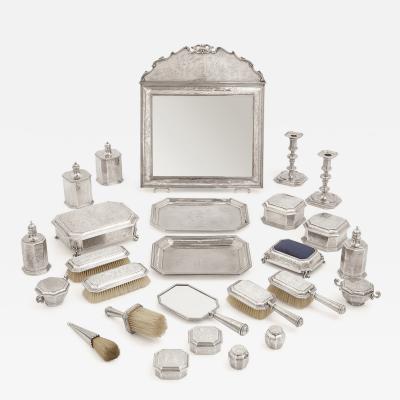
Carrington & Company
English Chinoiserie style twenty-six-piece silver toilet service
H 20.08 in W 12.99 in D 11.02 in
$ 56,250


 Loading...
