








Offered by:
Jeff R. Bridgman Antiques, Inc.
Historic York County
York, PA , United States
Call Seller
717.502.1281
Showrooms
44 Stars in Zigzagging Rows on a Press-Dyed Wool American Flag
-
Description
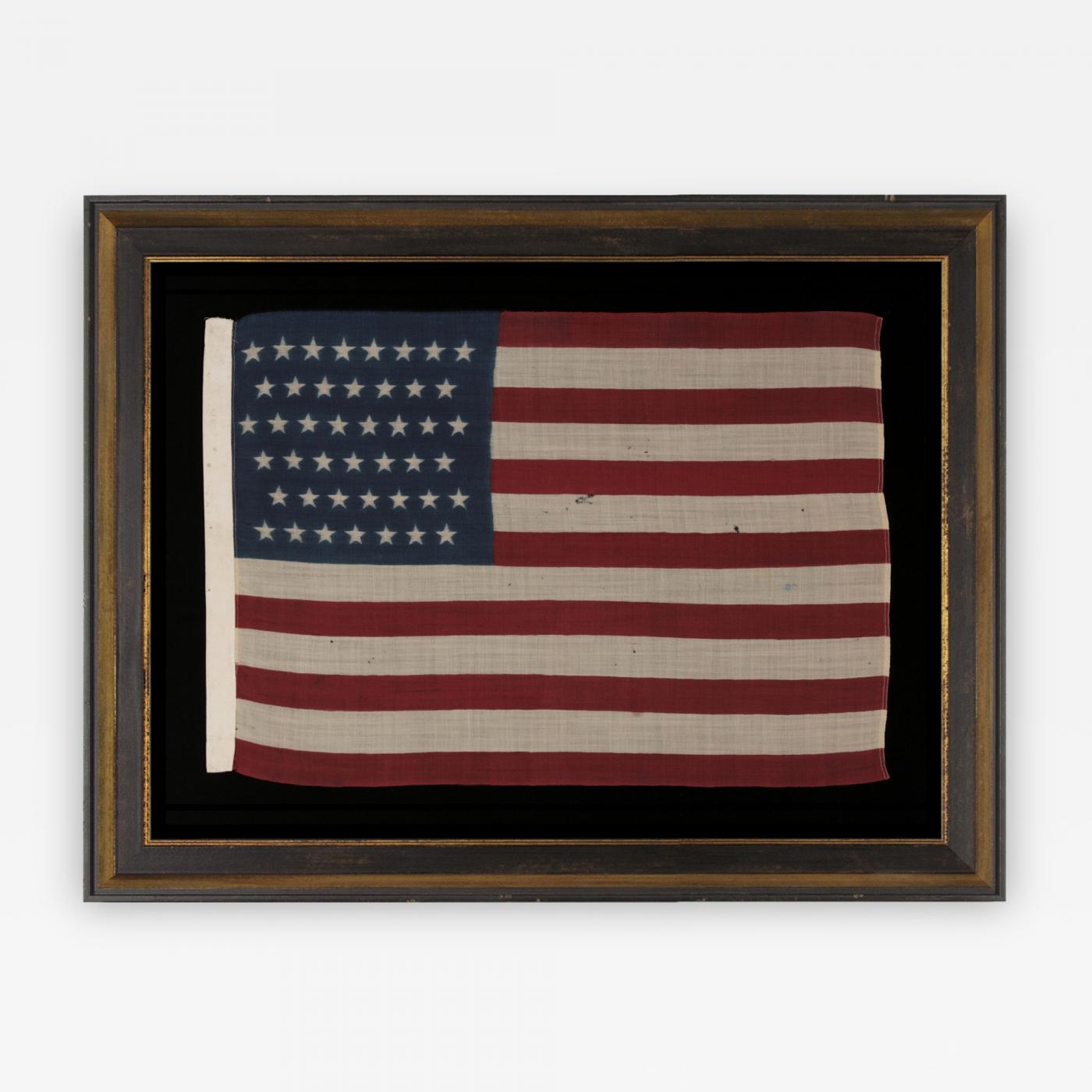
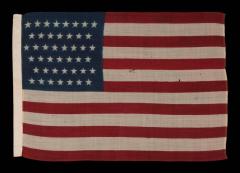
44 STARS IN ZIGZAGGING ROWS ON A PRESS-DYED WOOL AMERICAN FLAG, PROBABLY MADE BY THE HORSTMANN COMPANY IN PHILADELPHIA, POSSIBLY FOR USE AS A MILITARY CAMP COLORS, 1890-1896, REFLECTS WYOMING STATEHOOD:
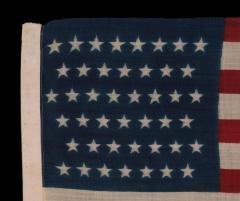
44 star American national flag, press-dyed on wool bunting. The stars are configured in zigzagging lineal rows of 8-7-8-7-7-7, which is a pattern sometimes seen in this star count. There is an open, twill tape sleeve along the hoist, through which a wooden staff could be threaded and tacked into place. "2 x 3 ft" is stamped along the sleeve in black to indicate size. The way this is applied is consistent with other press-dyed flags that I have owned that were produced and sold by the Horstmann Company in Philadelphia. Horstmann was a major military goods manufacturer and dealer. The firm, which opened in 1816, is well known for the significant role it played in the outfitting of soldiers in the American Civil War. Horstmann is known to have made printed wool flags, in a smaller scale, that were sold as military camp colors. They were still producing these as late as the 46 star period (1907-1912). In terms of scale, however, and the construction of the sleeve, this flag is more congruent with 38 star examples made by Horstmann for general patriotic display at the 1876 Centennial International Exposition in Philadelphia. These could have simply been sold for any purpose the user may have desired, however, in which case they may have been employed in either military or private function.
Wyoming became the 44th state on July 10th, 1890. Even though the 44 star flag was not official until July 4th, 1891, most flag-makers would have begun to add a 44th star to their flags as soon as Wyoming declared statehood, or perhaps even before the state was actually added. Because flag-making was a competitive venture, flag-makers did not want to be producing 43 star flags, for example, when their competitors were selling 44’s. The 44 star flag would have generally seen use until the addition of Utah in 1896.
Some notes on the Press-Dying Process:
First patented in 1849, the press-dying process was thought to be a novel idea that would improve flag-making efficiency. In this case, for example, it could potentially alleviate the chore of hand-appliquéing 88 stars (44 on each side). In reality, however, the result must have been less efficient than sewing. To achieve white stars, for example, metal plates in the shape of stars had to be clamped to either side of a length of woolen fabric, in the desired configuration, so they were back-to-back. These may have been lightly brushed beforehand with a solution that would resist dye, or perhaps with a thin coat of wax. The stars were clamped together tightly, the bunting was dyed blue, and the areas where the metal stars were positioned would be left white. To produce the stripes, the same task was repeated with different clamps.
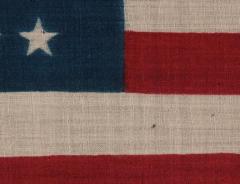
A form of resist-dyeing, this method often resulted in crude characteristics, such as stripes with irregular lines, in various widths, and stars with inconsistent shapes, in slightly varying sizes. It is likely that this resulted in some lost product and wasted time, from flags that had bleeding or misprint issues and were of too poor quality to sell. This may perhaps explain why it never became a become a popular method of flag production.
Wool was preferred because it sheds water, making it the fabric of choice for all maritime flags and, in fact, most flags produced by professional flag-makers for long-term outdoor use. Printing on wool is costly and difficult. Even today, only about 1% of wool fabric is printed**, because it generally needs to be washed afterward and wool cannot easily be treated with water.
Mounting: The flag was mounted and framed within our own conservation department, which is led by masters degree trained staff. We take great care in the mounting and preservation of flags and have framed thousands of examples; more than anyone worldwide.
The background is 100% cotton twill, black in color. The mount was placed in a black-painted, hand-gilded and distressed Italian molding. The glazing is U.V. protective plexiglass.
Condition: There is minor mothing throughout. fabric of similar coloration was placed behind the 3rd red stripe for masking purposes. There is very minor bleeding and there is a small blue stain in the 4th red stripe. There is minor staining along the hoist binding and the stamp has faded.Many of my clients prefer early flags to show their age and history of use.
About Jeff R. Bridgman Antiques, Inc.:
As an advisor to top museums and collectors alike, Jeff Bridgman is the world's leading expert and source for antique American flags and political textiles. In this field there are many fakes, forgeries, and misrepresented items, and there is no substitute for experience. As the nation's leading buyer and seller, Jeff R, Bridgman Antiques, Inc. has handled more material than anyone in the field. Jeff has also operated a textile conservation business for 18 years, where expert staff have conservation mounted, framed and restored thousands of examples, more than anyone world-wide. -
More Information
Origin: United States Period: 19th Century Materials: Wool, twill background. See description for further detail. Condition: Good. There is minor mothing throughout. Very minor bleeding with small blue stain in the 4th red stripe. Minor staining along the hoist binding and the stamp has faded. Creation Date: 1890-1896 Styles / Movements: Americana Dealer Reference #: 44j-897 Incollect Reference #: 248512 -
Dimensions
W. 48.5 in; H. 37.5 in; D. 2.5 in; W. 123.19 cm; H. 95.25 cm; D. 6.35 cm;
Sold
