
















Offered by:
Jeff R. Bridgman Antiques, Inc.
Historic York County
York, PA , United States
Call Seller
717.502.1281
Showrooms
42 Stars in an Hourglass Pattern on an Antique American Flag
-
Description
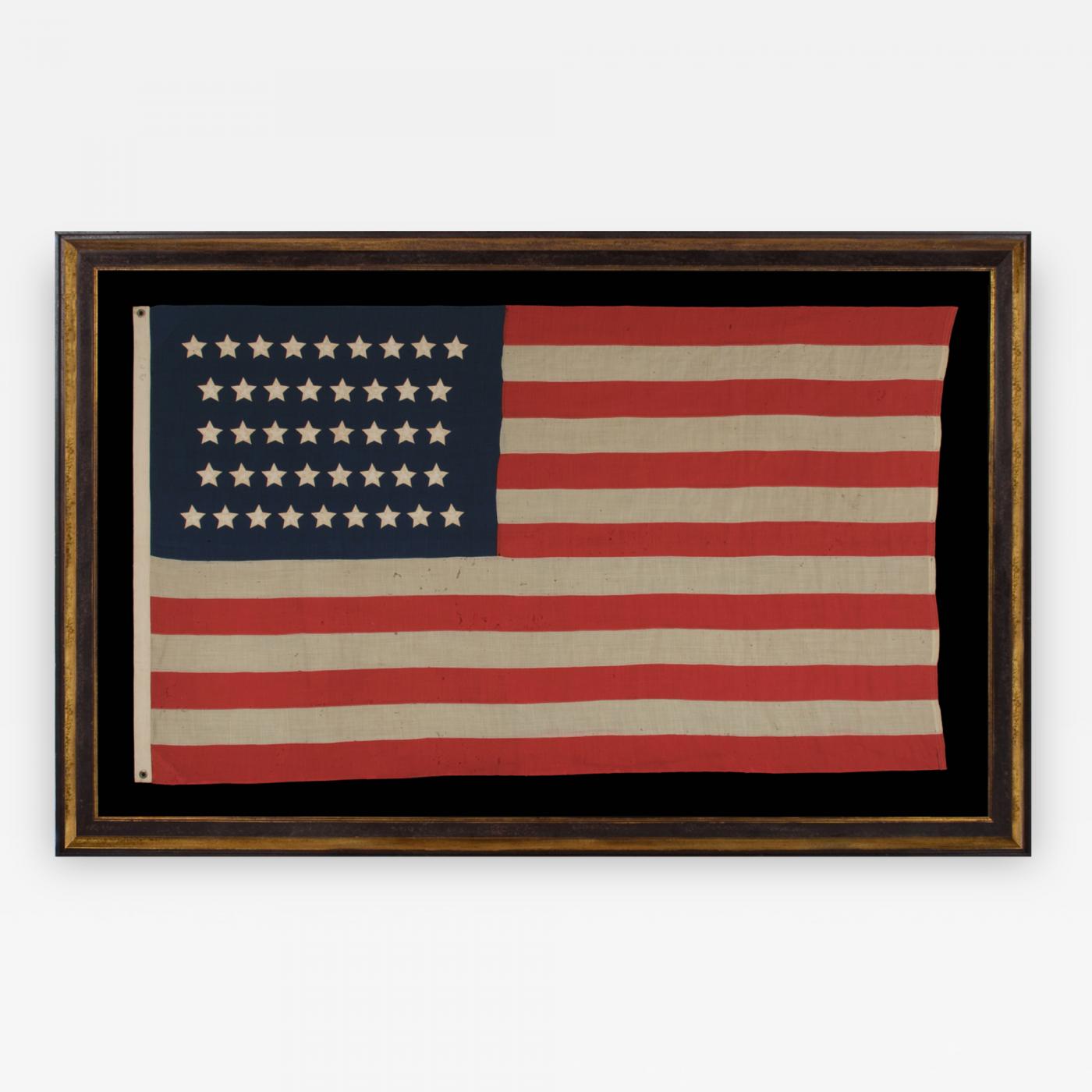
42 STARS IN AN HOURGLASS PATTERN ON AN ANTIQUE AMERICAN FLAG, AN UNOFFICIAL STAR COUNT, WASHINGTON STATEHOOD, 1889-1890:
Early American national flag with 42 stars, configured in rows of 8-7-7-7-7-8. Note how the top and bottom rows offset in such a way that they resemble a broad hourglass. Though commonly encountered in flags in the 44 star count, this attractive star design is unusual among known 42 star flags and I cannot recall having previously seen one in this design. Because 42 laid out so logically on a rectangular canton in 6 rows of 7, most 42 star examples display a simple, rectilinear arrangement.
The 42 star flag is interesting from a historical perspective, both because 42 was never an official star count, and because 42 star flags were only produced for about 8 months (November, 1889 – July 4th, 1890). The flag represents the addition of the Dakotas, Montana and Washington State, between November 2nd and November 11th, 1889. The 42nd state was officially Washington, but the four states gained their statehood only nine days apart, and flag makers added 4 stars, accordingly, to the count of 38 that was official at the time.
After 1818, star counts became official on the 4th of July each year. A new star was therefore officially added on Independence Day for every state that had been added over the preceding “flag year”. Flag makers, however, did not wait for July 4th and official star counts. Flag making was a competitive industry and no one wanted to be making 38 star flags, for example, when their competitors were making 42 star flags and there were 42 states. Idaho received statehood on July 3rd, 1890, taking the star count to 43 just one day before 42 would have become the official number. This fact makes 42 star flags an interesting part of our heritage and a Classic display of American capitalism.
Despite their unusual story, printed 42 star flags (called parade flags or handwavers) are quite common. Many were made because flag makers were so excited to offer something new after 13 years with no reason to produce new star counts. But 42 star flags with pieced-and-sewn construction, like this one, are scarce. Why this is true is unclear.
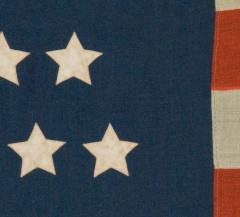
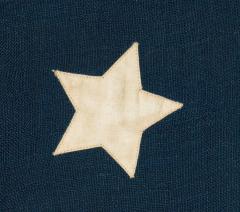
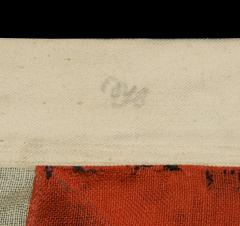
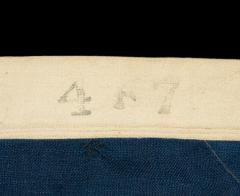
Construction: The stripes and canton of the flag are made of wool bunting that has been joined with treadle stitching. The triangular patches in each corner of the hoist end are called gussets. These are original to the flag's construction and were added for support at the points where the flag received the most stress when it was flown. The stars of the flag are made of cotton and are double-appliquéd (applied to both sides of the flag) with lineal treadle stitching. There is a twill cotton binding along the hoist with two brass grommets. A blank-inked stamp near the top of the obverse (front) contains the numbers "4" and "7", separated by a Maltese cross, which indicates that the original size was 4 x 7 feet. Small, penciled script along the hoist end might read "2ys" for "2 yards," and while this dimension doesn't make sense in light of the size of the flag, it is most certainly a maker's notation of some sort.
Mounting: The flag was mounted and framed within our own conservation department, which is led by masters degree trained staff. We take great care in the mounting and presentation of flags and have preserved thousands of examples.
The background is 100% cotton twill, black in color. The black-painted, hand-gilded and distressed molding is Italian. The glazing is U.V. protective plexiglass. Feel free to contact us for more details.
Condition: There is minor mothing throughout, accompanied by extremely minor foxing and staining. Fabric of similar coloration was placed behind the flag during the mounting process for masking purposes. many of my clients prefer early flags to show their age.
Frame size (H x L): Approx. 61 x 96 inches
Flag size (H x L): 49 x 84.75 inches -
More Information
Origin: United States Period: 19th Century Materials: Wool bunting Condition: Good. Minor foxing, mothing, and staining. See more detail in description. Creation Date: 1889-1890 Styles / Movements: Americana Dealer Reference #: 42j-868 Incollect Reference #: 248545 -
Dimensions
W. 96 in; H. 61 in; D. 2.5 in; W. 243.84 cm; H. 154.94 cm; D. 6.35 cm;
Sold
