












Offered by:
Jeff R. Bridgman Antiques, Inc.
Historic York County
York, PA , United States
Call Seller
717.502.1281
Showrooms
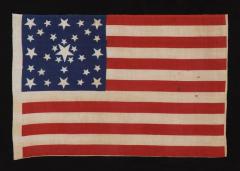
31 Star Flag with Stars in a Starburst or "Great Star-In-A-square" Pattern
-
Description
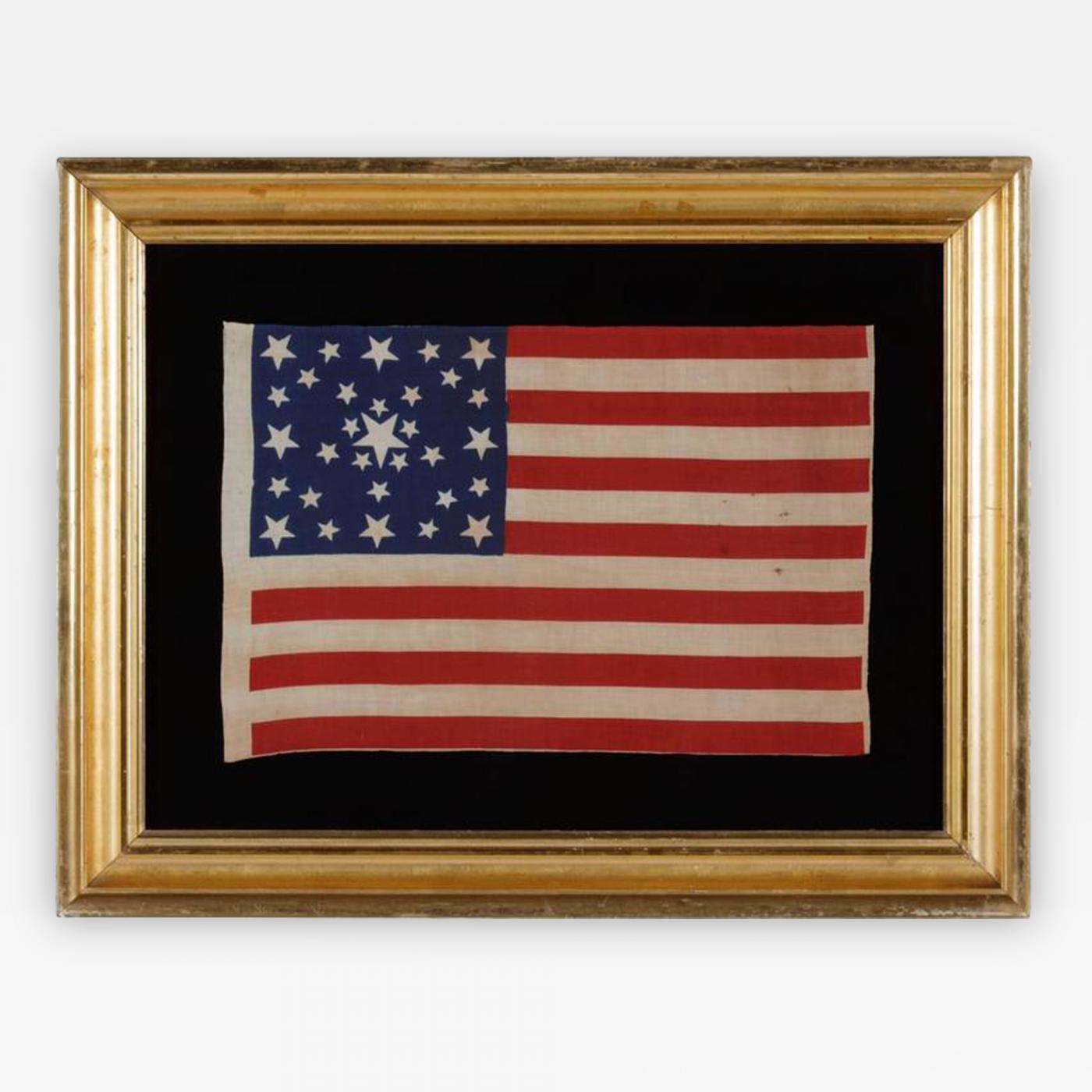
31 stars in a fanciful starburst or "Great Star-In-A-Square", one of the most rare and interesting configurations that a collector can encounter, on a Pre-civil war parade flag, California statehood, 1850-1858:
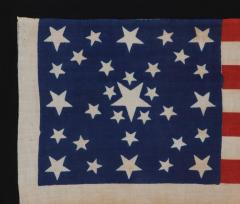
31 star American national parade flag, printed on cotton, with its stars arranged in a configuration that falls among the best that one may ever encounter on a 19th century example. This fanciful design can perhaps be placed into the general category of what I have termed "starbursts", meaning that there is dynamic pattern that seems to spring forth from the center, in a manner similar to the explosion of a firework. This particular starburst features what is called the "Great Star" or "Great Luminary" configuration (a large star made out of smaller stars) in the center. Great Star patterns vary widely in the way that they are assembled. In this case the pattern is comprised of a huge center star, with 5 small stars placed about it, one between each arm, so that they form a pentagon. Beyond these are 5 slightly larger stars, placed so that they complete the star-shaped profile.
9 large stars, slightly smaller than the one in the center, flank the Great Star on every side, laterally and diagonally, to form a rectangle. Groups of 3 stars flank each interior corner in convex arches, connecting points along the perimeter. Because the five-pointed Great Star does not connect with the stars outside it in a consistent fashion, one could certainly argue that a more precise term for the configuration might be a Great Star-in-a-square, with bracketed corners. But the inner stars do connect with the outer in various distinct ways. Note the prominent, narrow "V" shape, for example, that forks upward from the large star in the bottom center, as well as others that work off of this pattern at distinct angles to either side. For this reason, as well as the overall appearance, classification among other known starbursts seems logical.
Note how the large center star, the Great Star pattern, and the 9 large stars, all appear upside-down with respect to how we typically expect to see a five-pointed star today, having two points up instead of one. No one knows if this orientation had any purpose. It is entirely possible that the designer did not feel that any particular position was “right-side-up”, but whatever the case may be, the circumstance is more interesting to collectors and the resulting graphics are more unusual to the eye.
In the world of antique American flags there are nearly countless star patterns, but most have lineal rows or columns. Some have circular designs, which are further down the rarity scale. The Great Star is much more scarce and highly coveted, and can be among the very best visually, but there are rarer configurations still. Among these are circles within squares, pentagons, ovals, and completely random patterns. There are flags where the stars actually spell something with alphabetic or numeric characters, some of which are among the rarest of all, but with regard to geometric configurations, the rarest--and arguably the most beautiful--are diamonds, shields, snowflakes, and starbursts (with occasional, unique exceptions). From a folk art perspective, these can excel beyond all others. Bold and whimsical, note how the utilization of stars in four different sizes on this particular flag contributes to its dynamic presentation.
California became the 31st state in 1850, ushered in on the heels of the 1849 Gold Rush. The 31 star flag became official on July 4th, 1851, and remained so until July 3rd of 1858. Flags made prior to the Civil War are extremely rare, comprising less than one percent of 19th century flags that exist in the 21st century. Prior to the Confederate attack on Fort Sumter in 1861, the Stars & Stripes was simply not used for most of the same purposes we employ it in today. Private individuals did not typically display the flag in their yards and on their porches. Parade flags didn't often fly from carriages and horses. Places of business rarely hung flags in their windows. Even the military did not use the national flag in a manner that most people might think. Most people are surprised to learn that the infantry wasn’t authorized to carry the Stars & Stripes until the 1830s and even then did not often exercise the right, because it was neither required nor customary. The primary purpose before the Mexican War (1846-48) was to mark ships on the open seas. While the flag was used to mark garrisons and government buildings, the flags of ground troops were often limited to the flag of their own regiment and a federal standard.
Political campaigns seem to have fueled most of the use of printed parade flags, such as this one, prior to the Civil War. This was a major turning point and private use rose swiftly with wartime patriotism, then exploded in 1876 with the celebration of our nation's 100-year anniversary of independence from Great Britain.
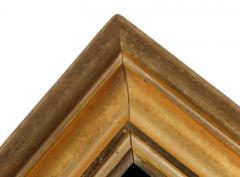
Mounting: The gilded American molding dates to the period between 1840 and 1860. The flag has been hand-stitched to 100% cotton, black in color, which was washed to reduce excess dye. An acid-free agent was added to the wash to further set the dye and the fabric was heat-treated for the same purpose. Spacers keep the textile away from the glazing, which is U.V. protective glass.
Condition: There is minor foxing and staining and minor misprinting, but the flag presents beautifully and is exceptional for the period. Many of my clients prefer early flags to show their age and history of use.
Frame size (H x L): 21.75" x 27.5".
Flag size (H x L): 12.25" x 18.25". -
More Information
Origin: United States Period: 19th Century Materials: Cotton. Condition: Fair. See Item Description. Creation Date: 1850 - 1858 Styles / Movements: Americana Incollect Reference #: 248751 -
Dimensions
W. 27.5 in; H. 21.75 in; D. 2 in; W. 69.85 cm; H. 55.25 cm; D. 5.08 cm;
Sold
