






Roy Cleveland Nuse
American, 1885 - 1975
A twist of fate can sometimes change the course of an entire life. So it was with Roy C. Nuse, who was born in Springfield, Ohio, on February 23, 1885, and was trained from an early age to join his father in the family barbershop. When the elder Nuse suffered an illness, his son left high school to work in a factory, where he painted lampshades to help support the family. Nuse's talent at painting became apparent and, in 1905, he enrolled in the nearby Art Academy of Cincinnati as a part-time student. He earned a scholarship to the school and excelled under the teaching of several important instructors, among them the renowned Frank Duveneck. An influence on many young American artists, Duveneck was schooled in the so-called Munich style of painting, characterized by a palette of strong, dark colors, and an emphasis on expert draftsmanship, especially in portraiture.
Nuse thrived in the atmosphere of the Cincinnati academy, where he remained for seven years. When his parents relocated to Pennsylvania, he took the opportunity, in 1915, to transfer to the nation's premier art school, the Pennsylvania Academy of the Fine Arts in Philadelphia. Devoted to his parents, Nuse, with his own young family in tow, eventually moved to the parental home and farm in nearby Bucks County.
At the Pennsylvania Academy, he studied with Daniel Garber, who became, after Duveneck, the second most powerful influence on Nuse's art. Garber skill at portraiture reinforced the lessons Nuse had learned in Cincinnati, but it was Garber's poetic landscapes that earned Nuse's highest admiration. His student years at the Pennsylvania Academy (1915-1918) were crowned with many awards: the Toppan Prize (1918), the First Thouron Prize (1918), and the coveted William Emlen Cresson Traveling Scholarship - not once but twice (1917 and 1918). After his return from studying the old masters in the museums of Europe, Nuse was invited to join the faculty of the academy, a position he held for twenty-nine years (1925-1954). He taught portraiture and figure study at the academy and at its summer school in Chester Springs, Pennsylvania. Nuse's teaching style was clear and direct, and he quickly became a popular instructor. When he resigned in 1954, sixty-two students signed a petition to the director to express their hope that he could be dissuaded from leaving.
His ability to succinctly explain the theories and principles of painting also resulted in a commission to write an instruction manual on the subject. Published by F. Weber, Philadelphia, in 1936, A Treatise on Pastel Painting included general information on color theory, perspective, and plein air painting, as well as the techniques of the pastel medium. Far from being a dry academic text, the book, like his classes, invited students to use their emotions to find their unique artistic voice once they had mastered the academic principles. In Nuse's own words, "Every great painter has had academic training, either in the studio of a master or in a school." However, he also stated, "The painter feels ... vividly, but with his eyes and emotional responses."'
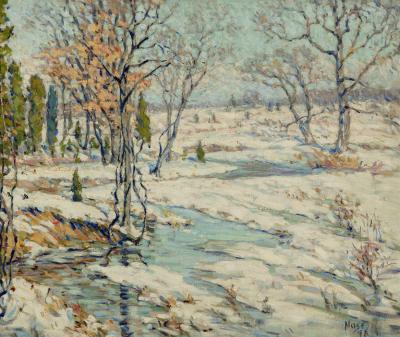
Nuse painted prolifically in the impressionist style that was heartily embraced both by the artist himself and by his contemporaries in Bucks County. He portrayed the changing seasons, especially snow on the nearby hills and quarry, and once remarked to his son, Robert, that he especially loved to paint sycamore trees because they shed their bark, leaving a changing texture for the artist to paint. Nuse was equally proficient at portraiture, and received many commissions throughout his career. He participated in exhibitions at the Corcoran Gallery of Art, Washington, D.C.; the Art Institute of Chicago; the National Academy of Design, New York; and, for nearly thirty years, the Pennsylvania Academy (1920-1950).
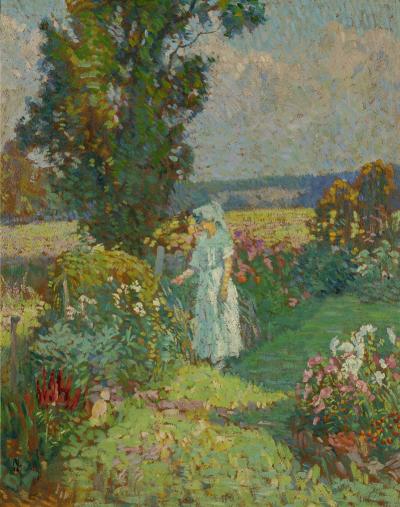
Besides landscapes and portraits, Nuse painted several series that set him apart from his peers in the Pennsylvania impressionist school. While other painters depicted figures in the landscape, Nuse, in his children-in-the-glen images, portrayed his own young offspring, nymph-like in shimmering natural settings. He created a lengthy series of self-portraits that display a compelling sensitivity to facial expressions. Nuse also painted many scenes of family and neighbors engaged in such humble chores as feeding chickens, collecting apples, and gathering wood.
His most enduring subject matter echoed his childhood devotion to family. His own six children, his wife, and a few dear neighbors populate the majority of his portraits and other figurative canvases. Similarly, Nuse's landscapes depict the farm country, bridges, and quarry near his home in Rushland. In fact, after his return from Europe, he never again traveled more than a few miles from his own hearth, finding more than enough inspiration in his own backyard. Nuse once told his granddaughter, "I have not had to, and would not choose to leave my own peaceful Rushland Valley, where both the Neshaminy and Mill Creeks pass through the rolling farmland and steep hills for many a canvas subject."
Nuse was nearly ninety years old when he died in 1975.
Biography courtesy of Roughton Galleries, www.antiquesandfineart.com/roughton
Nuse thrived in the atmosphere of the Cincinnati academy, where he remained for seven years. When his parents relocated to Pennsylvania, he took the opportunity, in 1915, to transfer to the nation's premier art school, the Pennsylvania Academy of the Fine Arts in Philadelphia. Devoted to his parents, Nuse, with his own young family in tow, eventually moved to the parental home and farm in nearby Bucks County.
At the Pennsylvania Academy, he studied with Daniel Garber, who became, after Duveneck, the second most powerful influence on Nuse's art. Garber skill at portraiture reinforced the lessons Nuse had learned in Cincinnati, but it was Garber's poetic landscapes that earned Nuse's highest admiration. His student years at the Pennsylvania Academy (1915-1918) were crowned with many awards: the Toppan Prize (1918), the First Thouron Prize (1918), and the coveted William Emlen Cresson Traveling Scholarship - not once but twice (1917 and 1918). After his return from studying the old masters in the museums of Europe, Nuse was invited to join the faculty of the academy, a position he held for twenty-nine years (1925-1954). He taught portraiture and figure study at the academy and at its summer school in Chester Springs, Pennsylvania. Nuse's teaching style was clear and direct, and he quickly became a popular instructor. When he resigned in 1954, sixty-two students signed a petition to the director to express their hope that he could be dissuaded from leaving.
His ability to succinctly explain the theories and principles of painting also resulted in a commission to write an instruction manual on the subject. Published by F. Weber, Philadelphia, in 1936, A Treatise on Pastel Painting included general information on color theory, perspective, and plein air painting, as well as the techniques of the pastel medium. Far from being a dry academic text, the book, like his classes, invited students to use their emotions to find their unique artistic voice once they had mastered the academic principles. In Nuse's own words, "Every great painter has had academic training, either in the studio of a master or in a school." However, he also stated, "The painter feels ... vividly, but with his eyes and emotional responses."'
Nuse painted prolifically in the impressionist style that was heartily embraced both by the artist himself and by his contemporaries in Bucks County. He portrayed the changing seasons, especially snow on the nearby hills and quarry, and once remarked to his son, Robert, that he especially loved to paint sycamore trees because they shed their bark, leaving a changing texture for the artist to paint. Nuse was equally proficient at portraiture, and received many commissions throughout his career. He participated in exhibitions at the Corcoran Gallery of Art, Washington, D.C.; the Art Institute of Chicago; the National Academy of Design, New York; and, for nearly thirty years, the Pennsylvania Academy (1920-1950).
Besides landscapes and portraits, Nuse painted several series that set him apart from his peers in the Pennsylvania impressionist school. While other painters depicted figures in the landscape, Nuse, in his children-in-the-glen images, portrayed his own young offspring, nymph-like in shimmering natural settings. He created a lengthy series of self-portraits that display a compelling sensitivity to facial expressions. Nuse also painted many scenes of family and neighbors engaged in such humble chores as feeding chickens, collecting apples, and gathering wood.
His most enduring subject matter echoed his childhood devotion to family. His own six children, his wife, and a few dear neighbors populate the majority of his portraits and other figurative canvases. Similarly, Nuse's landscapes depict the farm country, bridges, and quarry near his home in Rushland. In fact, after his return from Europe, he never again traveled more than a few miles from his own hearth, finding more than enough inspiration in his own backyard. Nuse once told his granddaughter, "I have not had to, and would not choose to leave my own peaceful Rushland Valley, where both the Neshaminy and Mill Creeks pass through the rolling farmland and steep hills for many a canvas subject."
Nuse was nearly ninety years old when he died in 1975.
Biography courtesy of Roughton Galleries, www.antiquesandfineart.com/roughton

 Loading...
