







John Sloan
American, 1871 - 1951
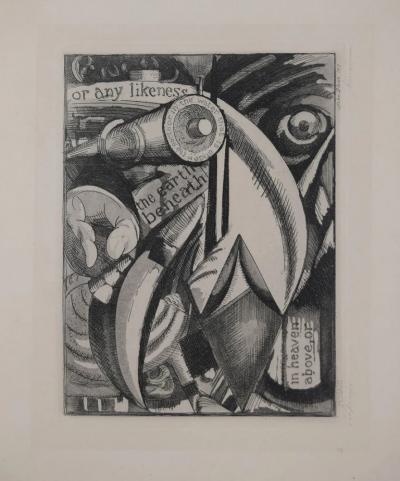
Born in Lock Haven, Pennsylvania, Sloan was raised in Philadelphia. Although not from an affluent family, Sloan grew up in a house filled with books and prints, watercolors and oil paints, and parents who encouraged his creativity. Working from A Manual of Oil Painting by John Collier, Sloan taught himself the basics of oil painting when he was around nineteen years old. Late in life he recalled this early foray: “My first serious oil painting was a self-portrait . . . It is a very earnest, plain piece of work; shows no facility or brilliance. The work of a plodder.” 2 In the painting (Fig. 1), a serious young man in a dark coat and tie emerges from the dark background: his pose is resolutely frontal and his expression is bland. The most memorable element may be his gold-framed eyeglasses. And though the artist’s mature assessment may be unduly harsh, “earnest” does seem the ideal descriptor for the small canvas and its young maker.
Sloan left Central High School early to help support his family and soon found work as a newspaper illustrator for the Philadelphia Inquirer, and later, the Philadelphia Press. He took classes at the Spring Garden Institute and the Pennsylvania Academy of the Fine Arts, and developed friendships with the young artists and illustrators of the city, who often gathered in Robert Henri’s studio at 806 Walnut Street. Henri encouraged the assembled group—which sometimes included fellow newspaper illustrators Glackens, Luks, and Shinn—to begin painting seriously and to see themselves as artists.
Henri encouraged these emerging artists to paint the world around them, and by the late 1890s, Sloan was heeding his friend’s advice. Sloan painted Philadelphia from Walnut Street to the Schuylkill in canvasses that focus on architecture and atmosphere (Fig. 2). His portraits generally depict individuals in the artist’s immediate circle; one of Sloan’s finest early paintings, Violinist, Will Bradner (1903, Fig. 3), portrays a friend who was the first violinist of the Philadelphia Symphony Society. In city scenes and portraits, Sloan employed a dark and muted palette brightened only by flesh tones, highlights of white and yellow, and dabs of orange and red. His color choices reflect the direct influence of Henri and their shared admiration for historical and modern masters, including Frans Hals, Diego Velázquez, Édouard Manet, and J. A. M. Whistler.
Source: https://www.incollect.com/articles/an-american-journey-the-art-of-john-sloan
Sloan left Central High School early to help support his family and soon found work as a newspaper illustrator for the Philadelphia Inquirer, and later, the Philadelphia Press. He took classes at the Spring Garden Institute and the Pennsylvania Academy of the Fine Arts, and developed friendships with the young artists and illustrators of the city, who often gathered in Robert Henri’s studio at 806 Walnut Street. Henri encouraged the assembled group—which sometimes included fellow newspaper illustrators Glackens, Luks, and Shinn—to begin painting seriously and to see themselves as artists.
Henri encouraged these emerging artists to paint the world around them, and by the late 1890s, Sloan was heeding his friend’s advice. Sloan painted Philadelphia from Walnut Street to the Schuylkill in canvasses that focus on architecture and atmosphere (Fig. 2). His portraits generally depict individuals in the artist’s immediate circle; one of Sloan’s finest early paintings, Violinist, Will Bradner (1903, Fig. 3), portrays a friend who was the first violinist of the Philadelphia Symphony Society. In city scenes and portraits, Sloan employed a dark and muted palette brightened only by flesh tones, highlights of white and yellow, and dabs of orange and red. His color choices reflect the direct influence of Henri and their shared admiration for historical and modern masters, including Frans Hals, Diego Velázquez, Édouard Manet, and J. A. M. Whistler.
Source: https://www.incollect.com/articles/an-american-journey-the-art-of-john-sloan


 Loading...
