











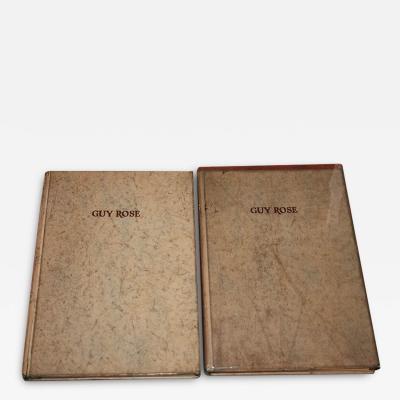
Guy Rose
American, 1867 - 1925
Guy Rose was born in San Gabriel, California and studied at the San Francisco Art Association before traveling to France in 1888. Shortly thereafter Rose exhibited at the Paris Salon and in 1890most likely at the suggestion of the artist Theodore Robinsonhe visited Giverny. Rose became a member of the local American art colony, painting with other impressionists such as Frederick Frieseke, Richard Miller and Lawton Parker. By 1904 the artist and his wife Ethel purchased a house, and for the next eight years Rose immersed himself in painting the Giverny landscape.
In 1912 Rose returned to the United States where he lived briefly in New York and Rhode Island. By the time he returned home to California in 1915 his reputation as an Impressionist painter was well known, and he was greeted with critical acclaim. In a review of Rose's 1916 exhibition at the Los Angeles Museum the critic Antony Anderson wrote, "He is a stronger painter today, you will admitand a more American one, certainly a more western one. His recent pictures from La Jolla and Laguna Beach will tell you exactly what I mean.... Charming, as are the pictures from Giverny and Toulon, they have not the grasp on the solidities that we find in those from Laguna and La Jolla. They are not so translucently poetic. Perhaps the painter has always needed the sunlight of his boyhood" (Antony Anderson, "Art and Artists: Paintings by Guy Rose," Los Angeles Times, February 20, 1916).
It is noteworthy that at about the same time, Childe Hassam and William Merrit Chase were both in California: Hassam to participate in the PanamaPacific International Exposition and Chase to conduct his summer school in Carmel. Indeed, Carmel became a place not only where Rose found inspiration, but also where a number of artists' colonies began and remain today.
Ilene Fort notes, "The coastal views of Carmel rank among Rose's most powerful paintings. In the sunlight scenes, the light is less diffuse, sharper than in the warm Southern California atmosphere. Rose heightened the intensity of his huesdeep ultramarine blues and greens often dominateand painted with a fully loaded brush of bold, forceful strokes. Surely he knew the views of the rocky cliffs of Etretat, Fecamp, and BelleIsle that Monet painted in the 1880s, and while their invigorated brushwork and strong coloration found no echo in Rose's French work, they were surely an important source for his paintings of the Carmel coast" (Irene Fort, "The Cosmopolitan Guy Rose," California Light, Laguna Beach, California, 1990, p. 107).
Biography courtesy of Roughton Galleries, www.antiquesandfineart.com/roughton
In 1912 Rose returned to the United States where he lived briefly in New York and Rhode Island. By the time he returned home to California in 1915 his reputation as an Impressionist painter was well known, and he was greeted with critical acclaim. In a review of Rose's 1916 exhibition at the Los Angeles Museum the critic Antony Anderson wrote, "He is a stronger painter today, you will admitand a more American one, certainly a more western one. His recent pictures from La Jolla and Laguna Beach will tell you exactly what I mean.... Charming, as are the pictures from Giverny and Toulon, they have not the grasp on the solidities that we find in those from Laguna and La Jolla. They are not so translucently poetic. Perhaps the painter has always needed the sunlight of his boyhood" (Antony Anderson, "Art and Artists: Paintings by Guy Rose," Los Angeles Times, February 20, 1916).
It is noteworthy that at about the same time, Childe Hassam and William Merrit Chase were both in California: Hassam to participate in the PanamaPacific International Exposition and Chase to conduct his summer school in Carmel. Indeed, Carmel became a place not only where Rose found inspiration, but also where a number of artists' colonies began and remain today.
Ilene Fort notes, "The coastal views of Carmel rank among Rose's most powerful paintings. In the sunlight scenes, the light is less diffuse, sharper than in the warm Southern California atmosphere. Rose heightened the intensity of his huesdeep ultramarine blues and greens often dominateand painted with a fully loaded brush of bold, forceful strokes. Surely he knew the views of the rocky cliffs of Etretat, Fecamp, and BelleIsle that Monet painted in the 1880s, and while their invigorated brushwork and strong coloration found no echo in Rose's French work, they were surely an important source for his paintings of the Carmel coast" (Irene Fort, "The Cosmopolitan Guy Rose," California Light, Laguna Beach, California, 1990, p. 107).
Biography courtesy of Roughton Galleries, www.antiquesandfineart.com/roughton