







Colin Campbell Cooper
American, 1856 - 1937

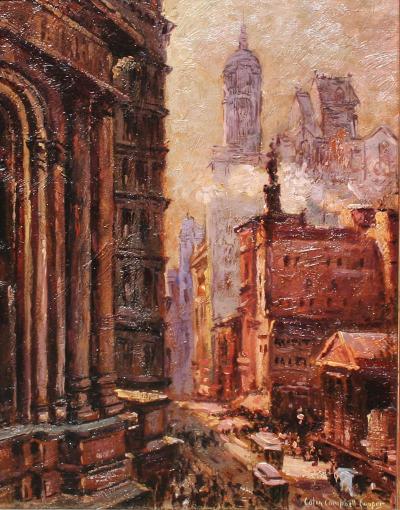
A resident and distinguished impressionist painter of both the East and West Coasts, Colin Campbell Cooper earned an international reputation with his depictions of landscapes, florals, portraits, gardens, interiors and figures. He was especially noted for street scenes and skyscrapers of New York and Philadelphia, and his impressionist palette was inspired by Childe Hassam, whom he met in New York beginning in the 1890s.
In the later part of his life, he focused on West Coast subject matter and espoused The California Style of watercolor painting, a bold, aggressive new oil-painting look to a medium that had traditionally been used more modestly.
He was born in Philadelphia to an upper class family where the father was a surgeon, and he, the son, was encouraged by his educated family to pursue art. He was also inspired by the art he saw at the 1876 Philadelphia Exposition. He studied at the Pennsylvania Academy of the Fine Arts with Thomas Eakins and in Paris at the Academies Julian, Vitti, and Delecluse. During that time, he traveled throughout Europe and painted picturesque architectural scenes, which gained him widespread recognition. Sadly many of these paintings were lost in a fire of 1896.
From 1895 to 1898, he was instructor of watercolor at the Drexel Institute in Philadelphia and then moved to New York City from where he and his artist wife, Emma Lampert, traveled throughout the world in search of subject matter.
They first went to California in 1915, spending the winter in Los Angeles and in 1921, settled in Santa Barbara, where he served as Dean of Painting at the Santa Barbara Community School of the Arts.
He was a member of numerous associations including the California Art Club, Salmagundi Club, and the National Academy of Design. His work is in many museums including the Cincinnati Art Museum, the St. Louis Museum, and the Oakland Museum.
Cooper died in Santa Barbara.
In the later part of his life, he focused on West Coast subject matter and espoused The California Style of watercolor painting, a bold, aggressive new oil-painting look to a medium that had traditionally been used more modestly.
He was born in Philadelphia to an upper class family where the father was a surgeon, and he, the son, was encouraged by his educated family to pursue art. He was also inspired by the art he saw at the 1876 Philadelphia Exposition. He studied at the Pennsylvania Academy of the Fine Arts with Thomas Eakins and in Paris at the Academies Julian, Vitti, and Delecluse. During that time, he traveled throughout Europe and painted picturesque architectural scenes, which gained him widespread recognition. Sadly many of these paintings were lost in a fire of 1896.
From 1895 to 1898, he was instructor of watercolor at the Drexel Institute in Philadelphia and then moved to New York City from where he and his artist wife, Emma Lampert, traveled throughout the world in search of subject matter.
They first went to California in 1915, spending the winter in Los Angeles and in 1921, settled in Santa Barbara, where he served as Dean of Painting at the Santa Barbara Community School of the Arts.
He was a member of numerous associations including the California Art Club, Salmagundi Club, and the National Academy of Design. His work is in many museums including the Cincinnati Art Museum, the St. Louis Museum, and the Oakland Museum.
Cooper died in Santa Barbara.
Collin Campbell Cooper was born in Philadelphia in 1856 and died in Santa Barbara, California on November 6, 1937. He began his formal training at the Pennsylvania Academy of the Fine Arts with Thomas Eakins. In 1885, Cooper traveled to Paris to study Academie Julien and the Ecole Delecluse in Paris. Traveling to Belgium, Holland and France, Cooper painted numerous picturesque scenes of European architectural treasures. These paintings gained him wide recognition, and he continued to travel in search of unusual landscape and architectural subjects throughout his career. Unfortunately, most of his early works were destroyed in a fire in 1896.
In 1897, Cooper married painter Emma Lampert (1855-1920). In 1902, he began a series of important oil paintings of New York City skyscrapers. He became particularly well known for his depictions of skyscrapers in New York City and Philadelphia. Cooper's use of impressionist palette and brushstrokes in his oil paintings of American urban life was inspired by Childe Hassam, who painted impressionist views of New York as early as 1890. Equally competent at watercolor painting, Cooper developed a technique of applying watercolors on canvas in a way that makes the finished work look like an oil painting.
After spending some time in Philadelphia and abroad, Cooper settled in California in 1921, and became dean of the School of Painting at the Santa Barbara School for the Arts.
MEMBERSHIPS
American Federation of Arts
American water Color Society
Associate of the National Academy of Design
New York National Arts Club
New York Society of Painters
New York water Color Club
Pennsylvania Academy of the Fine Arts
Philadelphia Art Center
Philadelphia water Color Club
PUBLIC COLLECTIONS
Art Club of Philadelphia
Boston Art Club
Cincinnati Art Museum
Dallas Art Association
Lotus Club, New York City
Pennsylvania Academy of the Fine Arts, Philadelphia
Reading Museum, New York
St Louis Museum of Fine Arts
Biography courtesy of Roughton Galleries, www.antiquesandfineart.com/roughton
In 1897, Cooper married painter Emma Lampert (1855-1920). In 1902, he began a series of important oil paintings of New York City skyscrapers. He became particularly well known for his depictions of skyscrapers in New York City and Philadelphia. Cooper's use of impressionist palette and brushstrokes in his oil paintings of American urban life was inspired by Childe Hassam, who painted impressionist views of New York as early as 1890. Equally competent at watercolor painting, Cooper developed a technique of applying watercolors on canvas in a way that makes the finished work look like an oil painting.
After spending some time in Philadelphia and abroad, Cooper settled in California in 1921, and became dean of the School of Painting at the Santa Barbara School for the Arts.
MEMBERSHIPS
American Federation of Arts
American water Color Society
Associate of the National Academy of Design
New York National Arts Club
New York Society of Painters
New York water Color Club
Pennsylvania Academy of the Fine Arts
Philadelphia Art Center
Philadelphia water Color Club
PUBLIC COLLECTIONS
Art Club of Philadelphia
Boston Art Club
Cincinnati Art Museum
Dallas Art Association
Lotus Club, New York City
Pennsylvania Academy of the Fine Arts, Philadelphia
Reading Museum, New York
St Louis Museum of Fine Arts
Biography courtesy of Roughton Galleries, www.antiquesandfineart.com/roughton
Colin Campbell Cooper was born in Philadelphia, Pennsylvania on March 8, 1856 into an upper class family. Encouraged to pursue and art career, Cooper was further motivated by the art exposition at the Philadelphia Expo of 1876. He initially studied at the Philadelphia Academy of Fine Arts under Thomas Eakins followed by further studies in Paris at Academies Julian, Vitti and Delecluse. After working from 1895-1898 as instructor of watercolor at the Drexel Institute in Philadelphia, he moved to New York City. An inveterate traveler, he made many trips to Europe, India and throughout the United States in search of subject matter. He first came to California to attend the Panama Pacific International Exposition and spent the winter in Los Angeles. In 1921 he settled in Santa Barbara where he taught painting at the School of Fine Arts. An Impressionist, his style shows the influence of Monet. He is best known for his landscapes, garden scenes and figures. Colin Campbell Cooper died in Santa Barbara on November 6, 1937.
Biography courtesy of DeRu's Fine Arts, www.antiquesandfineart.com/derus
Biography courtesy of DeRu's Fine Arts, www.antiquesandfineart.com/derus
A noted Impressionist who worked throughout the United States, Europe, and India, Colin Campbell Cooper made a name for himself with his modern street scenes and architectural cityscapes. Born in Philadelphia, Cooper studied under Thomas Eakins at the Pennsylvania Academy of the Fine Arts before moving to Paris for further training at the Academie Julian, the Academie Delecluse, and the Academie Viti. He spent several years traveling through Europe, depicting the monuments, harbors, gardens, and streets of France, Italy, and Spain. When he returned to the United States in the 1890s, he moved between New York, Philadelphia, Santa Barbara, and Taos, painting, teaching, and lecturing on art. Notably, he served as a watercolor instructor at Drexel Institute in Philadelphia and was named the dean of the Santa Barbara School of Art.
Cooper exhibited widely, showing his work at the Paris Salon, the National Academy of Design, the Corcoran Gallery, the Boston Art Club, and the Art Institute of Chicago, among other leading venues. He won prizes from the American Watercolor Society, the New York Watercolor Club, the Pennsylvania Academy of the Fine Arts, the Art Club of Philadelphia, the Atlanta Exposition of 1895, the Buenos Aires Exposition of 1910, and the San Francisco Pan-Pacific Exposition of 1915. His work is now featured in the White House, the Metropolitan Museum of Art, the Brooklyn Museum of Art, the San Diego Museum of Art, and the Luxembourg Museum in Paris.
Biography courtesy of Questroyal Fine Art LLC, www.antiquesandfineart.com/questroyal
Biography courtesy of Questroyal Fine Art LLC, www.antiquesandfineart.com/questroyal

 Loading...
