









Charles Rosen
American, 1878 - 1950

Charles Rosen was born on a farm in 1878 in Reagantown, Westmoreland County, Pennsylvania. He opened a photographic studio at the age of sixteen in West. Newton, in the coal mining region of western Pennsylvania. Upon moving to Salem, Ohio, to work in a photography shop, he became interested in becoming a newspaper illustrator. This challenge drew him to New York in 1898 to enroll in classes at the National Academy of Design, where he studied with Francis Coates Jones. While in New York, Rosen took classes at the New York School of Art, where he studied with William Merritt Chase and Frank Vincent DuMond and became interested in landscape painting. Rosen also became acquainted with landscape painters Robert. Spencer and Rae Sloan Bredin, who would later join him in New Hope, Pennsylvania. In 1903 the artist married Mildred Holden. The couple moved to the New Hope area, where they lived for the next seventeen years.
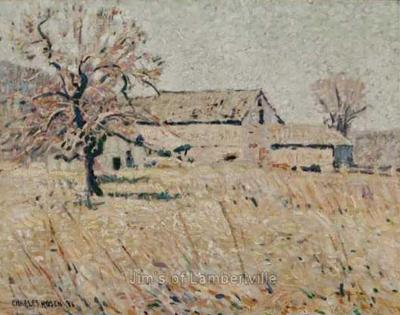
During his residence in New Hope, Rosen enjoyed close relationships with Daniel Garber and Edward Redfield and became known for his large, vigorously painted Pennsylvania snow scenes. Unlike Redfield, Rosen did not feel challenged to finish his canvases in one day. He painted them both on the spot in nature and in the studio. His compositions were simple, consisting of close-up views and high horizon lines. By 1915 Rosen's interpretations of nature became less vigorous and more sensitive. His decorative approach to painting appears to have been influenced by Garber's stitch like interweaving of daubs of paint as well as Spencer's broken and flecked brushwork.
In 1912 Rosen became an associate member of the National Academy of Design, and by 1915 he was awarded life membership in the Salmagundi and National Arts Clubs. His landscape paintings received two Hallgarten Prizes from the National Academy of Design, in 1910 and in 1912, and he was awarded a silver medal at the Panama-Pacific International Exposition in San Francisco in 1915.
Spring Branch, a landscape painted along the Delaware River in 1916, exhibits the artist's flecked brush strokes as well as a strong influence of Japanese prints. Rosen placed a large blossoming tree branch in the foreground over a receding landscape to create a work with a dynamic, novel effect - much like the style of Japanese printmaker Ando Hiroshige in Plum Estate, Kameido (from the series One Hundred Famous Views of Edo, published in 1857). In 1916 tonalist landscape painter Birge Harrison remarked on the virility, sincerity, and power of Rosen's Pennsylvania landscapes:
By 1916 Rosen had achieved his mature impressionist style, which often combines a sense of the decorative patterning found in nature with its more dynamic, vigorous aspects. Icebound River, dating to around 1915, reflects the artist's experimentation with the abstract, decorative qualities of natural forms. In 1916 Rosen earned the National Academy of Design's Inness Gold Medal for Winter Sunlight (Butler Institute of American Art, Youngstown, Ohio), which portrays the playful effect of turquoise and violet shadows as they spread across a brilliant expanse of snow. By this time the artist had become increasingly dissatisfied with the impressionist style of landscape painting. He told fellow Bucks County painter John Folinsbee, "That's the last picture of that kind that I shall ever paint."
From 1919 until 1921, when the artist began working in a more modern style, he served as an instructor and later as director of the Art Students League summer school in Woodstock, New York. He moved permanently to Woodstock in 1920 and adopted a cubist-realist style, which would characterize his work until his death in 1950.
Biography courtesy of Roughton Galleries, www.antiquesandfineart.com/roughton
During his residence in New Hope, Rosen enjoyed close relationships with Daniel Garber and Edward Redfield and became known for his large, vigorously painted Pennsylvania snow scenes. Unlike Redfield, Rosen did not feel challenged to finish his canvases in one day. He painted them both on the spot in nature and in the studio. His compositions were simple, consisting of close-up views and high horizon lines. By 1915 Rosen's interpretations of nature became less vigorous and more sensitive. His decorative approach to painting appears to have been influenced by Garber's stitch like interweaving of daubs of paint as well as Spencer's broken and flecked brushwork.
In 1912 Rosen became an associate member of the National Academy of Design, and by 1915 he was awarded life membership in the Salmagundi and National Arts Clubs. His landscape paintings received two Hallgarten Prizes from the National Academy of Design, in 1910 and in 1912, and he was awarded a silver medal at the Panama-Pacific International Exposition in San Francisco in 1915.
Spring Branch, a landscape painted along the Delaware River in 1916, exhibits the artist's flecked brush strokes as well as a strong influence of Japanese prints. Rosen placed a large blossoming tree branch in the foreground over a receding landscape to create a work with a dynamic, novel effect - much like the style of Japanese printmaker Ando Hiroshige in Plum Estate, Kameido (from the series One Hundred Famous Views of Edo, published in 1857). In 1916 tonalist landscape painter Birge Harrison remarked on the virility, sincerity, and power of Rosen's Pennsylvania landscapes:
By 1916 Rosen had achieved his mature impressionist style, which often combines a sense of the decorative patterning found in nature with its more dynamic, vigorous aspects. Icebound River, dating to around 1915, reflects the artist's experimentation with the abstract, decorative qualities of natural forms. In 1916 Rosen earned the National Academy of Design's Inness Gold Medal for Winter Sunlight (Butler Institute of American Art, Youngstown, Ohio), which portrays the playful effect of turquoise and violet shadows as they spread across a brilliant expanse of snow. By this time the artist had become increasingly dissatisfied with the impressionist style of landscape painting. He told fellow Bucks County painter John Folinsbee, "That's the last picture of that kind that I shall ever paint."
From 1919 until 1921, when the artist began working in a more modern style, he served as an instructor and later as director of the Art Students League summer school in Woodstock, New York. He moved permanently to Woodstock in 1920 and adopted a cubist-realist style, which would characterize his work until his death in 1950.
Biography courtesy of Roughton Galleries, www.antiquesandfineart.com/roughton


 Loading...
