




Marion Kavanagh Wachtel
American, 1876 - 1954
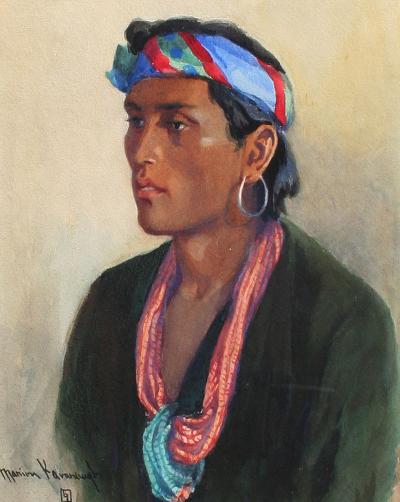
Marion Kavanagh Wachtel
Born Wisconsin, 1876
Died California, 1954
Marion Wachtel was born in Milwaukee, Wisconsin in 1876. She developed an interest in art very early in her youth due to the influence of her family. Her mother was an artist and her great grandfather was a member of the Royal Academy in London. Wachtel attended the Art Institute of Chicago where she studied with John Vanderpoel and then went on to New York City to study with Merritt Chase. She taught at the Art Institute and at numerous public schools in Chicago for two years, before moving to California.
In 1903, one of her landscapes caught the eye of the Vice-President of the Santa Fe Railroad. He found her work so impressive that he proposed they trade a free ticket to California in exchange for paintings for the ticket offices. Wachtel accepted the offer and soon traveled to San Francisco. In San Francisco, she studied with William Keith and began exhibiting watercolors at the San Francisco Art Association exhibitions. Due to Keith's encouragement, Marion traveled to Los Angeles to study with artist Elmer Wachtel. The two artists developed an incredible relationship and were married in 1904. They settled in an art community near the Arroyo in Pasadena (a popular location for landscape painters).
As their popularity increased, the two artists decided that Elmer would paint in oils and Marion in watercolors to avoid any competition. Due to their mutual careers as full-time fine art painters, Marion and Elmer were able to frequently travel to remote areas of California. They often traveled to the coast and to inland valleys, seeking picturesque landscapes and unique natural light. Much of the works that were produced at this time sold in art galleries in Los Angeles. For 25 years, the couple painted together, traveling to Arizona, the High Sierras and Mexico.
Marion took an active role in the California Water Color Society as its founding member in 1921. Her works were the subject of numerous reviews many of which were published in the Los Angeles Times.
After Elmer's death in 1929, Marion stopped exhibiting for several years. She remained in solitude at their Arroyo Seco home producing very little and steering clear of any public attention. By the early 1930's she was painting and exhibiting again. Marion remained active in the art community, as she was a member of the Academy of Western Painters and the Pasadena Society of Painters. Toward the end of her career, her works were exhibited in both New York and in California, which influenced her nationwide notoriety. Marion Wachtel died in her California home on May 22, 1954.
Works held: Friday Morning Club, Los Angeles; Women's Club, Hollywood; Vanderpoel Art Association, Chicago; Vanderpoel Collection; Fremont High School, Los Angeles; Gardena High School, California; State Building, Los Angeles; Cedar Rapids Art Museum; Santa Fe Railroad Collection.
Exhibitions: Los Angeles County Museum of Art, 1915, 1917; Stanford University, 1936; Art Institute of Chicago.
Further Reading: Who Was Who in American Art 1564-1975: 400 Years of Artists in America, Vol. 1. Peter Hastings Falk, Georgia Kuchen and Veronica Roessler, eds., Sound View Press, Madison, Connecticut, 1999. 3 Vols. (Original Listing 1940).; An Encyclopedia of Women Artists of the American West, Phil Kovonick, Marian Yoshiki-Kovnick, University of Texas Press, Austin, 1999, 3rd Edition.; Artists in California (1786-1940), Edan Milton Hughs, Hughs Publishing Company, San Francisco, 1986, 1st edition.
Biography courtesy of David Cook Galleries, www.antiquesandfineart.com/davidcook
Born Wisconsin, 1876
Died California, 1954
Marion Wachtel was born in Milwaukee, Wisconsin in 1876. She developed an interest in art very early in her youth due to the influence of her family. Her mother was an artist and her great grandfather was a member of the Royal Academy in London. Wachtel attended the Art Institute of Chicago where she studied with John Vanderpoel and then went on to New York City to study with Merritt Chase. She taught at the Art Institute and at numerous public schools in Chicago for two years, before moving to California.
In 1903, one of her landscapes caught the eye of the Vice-President of the Santa Fe Railroad. He found her work so impressive that he proposed they trade a free ticket to California in exchange for paintings for the ticket offices. Wachtel accepted the offer and soon traveled to San Francisco. In San Francisco, she studied with William Keith and began exhibiting watercolors at the San Francisco Art Association exhibitions. Due to Keith's encouragement, Marion traveled to Los Angeles to study with artist Elmer Wachtel. The two artists developed an incredible relationship and were married in 1904. They settled in an art community near the Arroyo in Pasadena (a popular location for landscape painters).
As their popularity increased, the two artists decided that Elmer would paint in oils and Marion in watercolors to avoid any competition. Due to their mutual careers as full-time fine art painters, Marion and Elmer were able to frequently travel to remote areas of California. They often traveled to the coast and to inland valleys, seeking picturesque landscapes and unique natural light. Much of the works that were produced at this time sold in art galleries in Los Angeles. For 25 years, the couple painted together, traveling to Arizona, the High Sierras and Mexico.
Marion took an active role in the California Water Color Society as its founding member in 1921. Her works were the subject of numerous reviews many of which were published in the Los Angeles Times.
After Elmer's death in 1929, Marion stopped exhibiting for several years. She remained in solitude at their Arroyo Seco home producing very little and steering clear of any public attention. By the early 1930's she was painting and exhibiting again. Marion remained active in the art community, as she was a member of the Academy of Western Painters and the Pasadena Society of Painters. Toward the end of her career, her works were exhibited in both New York and in California, which influenced her nationwide notoriety. Marion Wachtel died in her California home on May 22, 1954.
Works held: Friday Morning Club, Los Angeles; Women's Club, Hollywood; Vanderpoel Art Association, Chicago; Vanderpoel Collection; Fremont High School, Los Angeles; Gardena High School, California; State Building, Los Angeles; Cedar Rapids Art Museum; Santa Fe Railroad Collection.
Exhibitions: Los Angeles County Museum of Art, 1915, 1917; Stanford University, 1936; Art Institute of Chicago.
Further Reading: Who Was Who in American Art 1564-1975: 400 Years of Artists in America, Vol. 1. Peter Hastings Falk, Georgia Kuchen and Veronica Roessler, eds., Sound View Press, Madison, Connecticut, 1999. 3 Vols. (Original Listing 1940).; An Encyclopedia of Women Artists of the American West, Phil Kovonick, Marian Yoshiki-Kovnick, University of Texas Press, Austin, 1999, 3rd Edition.; Artists in California (1786-1940), Edan Milton Hughs, Hughs Publishing Company, San Francisco, 1986, 1st edition.
Biography courtesy of David Cook Galleries, www.antiquesandfineart.com/davidcook
Marion Kavanagh was born in Milwaukee, Wisconsin on June 10, 1876 into an artistic family. Marion's mother was an artist and her great-grandfather was a Royal Academician in London. She studied at the Art Institute of Chicago under Vanderpoel and in New York City with William Merritt Chase. For several years Marion taught at the Art Institute of Chicago and established a reputation as a competent portrait painter. A commission from the Santa Fe Railway Company to paint scenes in their ticket offices brought her to California. Arriving in San Francisco in 1903, she became a pupil of William Keith. Learning of her proposed move to Southern California, Keith urged her to contact an artist he knew and respected for further instruction. The artist he recommended was Elmer Wachtel. A romance blossomed and the two married in 1904. After her marriage, she dropped the "u" in her surname and spelled it Kavanagh. After Elmer's death in 1929 Marion was inactive for a few years but continued to live in their Arroyo Seco home. By the Early 1930's she was painting and exhibiting again. Regular exhibitions with both New York and California clubs made her work popular on both coasts. Marion died in her home on May 22, 1954.
Biography courtesy of DeRu's Fine Arts, www.antiquesandfineart.com/derus
Biography courtesy of DeRu's Fine Arts, www.antiquesandfineart.com/derus
 Loading...
