


Listings / Fine Art / Photographs / Abstract

Showrooms
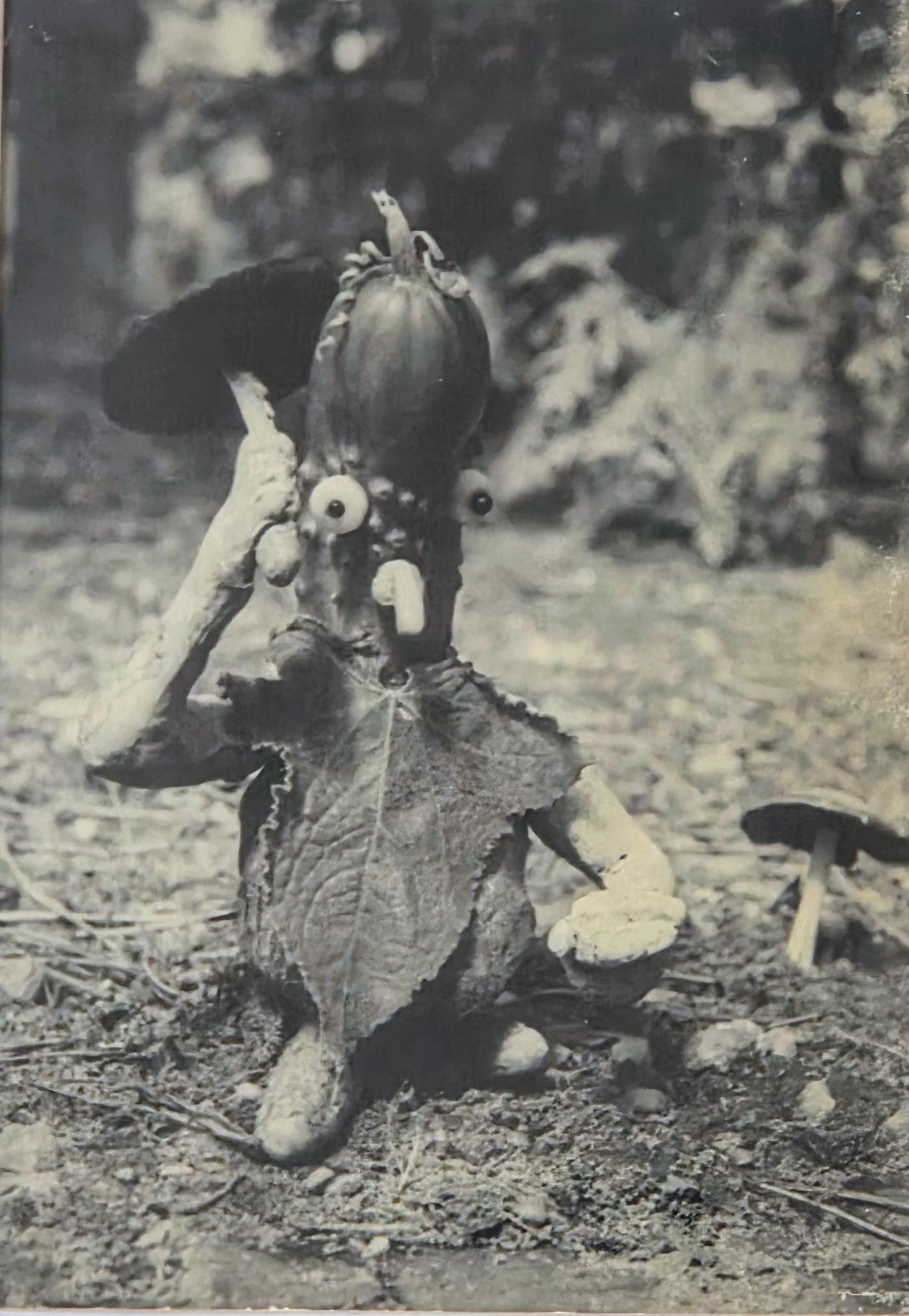
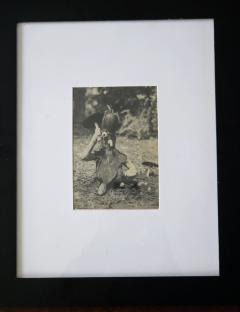
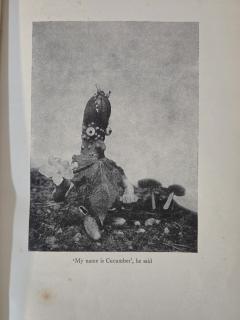
Henry Rox "My Name is Cucumber, He Said" Silver Print c. 1940
-
Description
Henry Rox (1899–1967)
“My Name is Cucumber,” He Said
From Tommy Apple and His Adventures in Banana-Land
by James Laver
Jonathan Cape, London, 1935
Opposite p. 24
Negative 1934; printed c. 1935–1940
Vintage silver gelatin print
5.875 × 4.75 inches
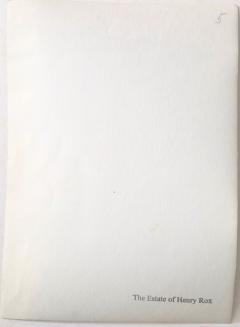
Estate stamp verso; pencil notation “5” upper right verso
No known negatives extant
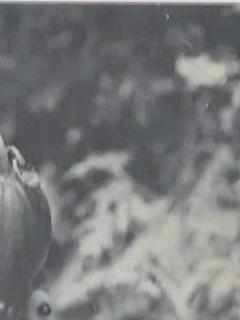
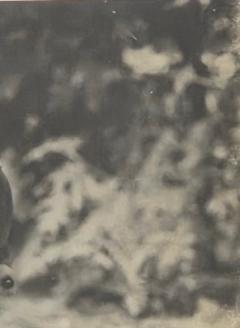
This vintage silver gelatin print is one of the original photographic “photo-sculptures” created by Henry Rox for Tommy Apple and His Adventures in Banana-Land, published in London in 1935. The image appears opposite page 24 and forms part of the earliest sustained body of work in which Rox fully realized his constructed photographic method.
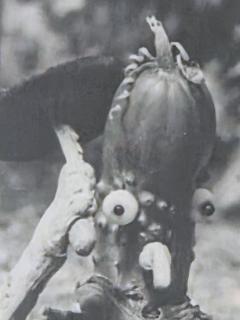
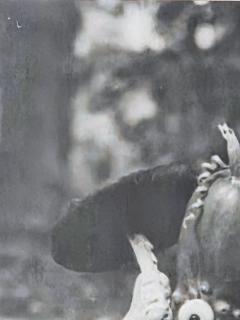
The composition centers on a fully constructed three-dimensional figure assembled from organic material. A cucumber forms both the elongated head and body, with applied seeds and vegetable fragments articulating facial features. The arms are modeled in plasticine, allowing for expressive gesture, while a large leaf—likely skunk cabbage—functions as a rain cloak or poncho. A mushroom serves as an umbrella, reinforcing the internal logic of the scene.
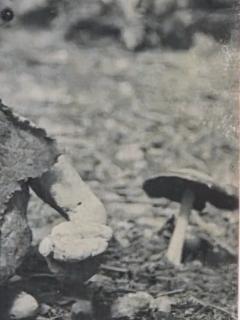
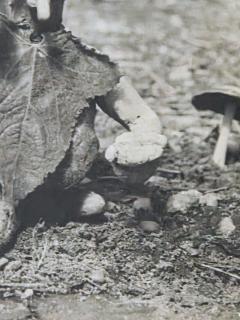
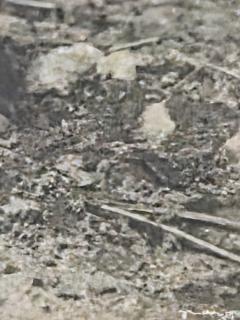
The figure is set within a carefully constructed terrain of soil, grasses, stones, and mushroom forms, all scaled and arranged to produce a convincing environment. The neutralized background corresponds directly to the published image, isolating the figure within a controlled pictorial field and emphasizing its sculptural presence. Rox’s handling of foreground detail—particularly the granular soil, small stones, and plant elements—anchors the figure within a believable spatial setting while maintaining the clarity required for reproduction.
The composition is organized as a shallow, frontal stage in which the figure occupies the foreground. The low vantage point and close framing reinforce the figure’s presence, while the surrounding elements establish spatial rhythm and continuity. The balance between vertical growth forms and the horizontal ground plane creates a stable visual field in which posture and gesture carry expressive weight.
Rox’s method is entirely constructive. Rather than recording an existing subject, he assembled both figure and environment from organic and fabricated materials, staging them specifically for photographic realization. Lighting is controlled and directional, producing tonal depth and spatial recession so the scene reads as a coherent stage. The photograph—not the physical model—constitutes the finished artistic object, in which sculpture, staging, and photography are inseparable.
Context and Development
Rox’s constructed photographs emerge from the late Weimar photographic environment in which experimental approaches to lighting, object study, and staged imagery were actively developing. His photographic training in 1933 at the Berliner Fotoschule placed him within this context shortly before leaving Germany. Following his arrival in London in May 1934, he translated this foundation and his sculptural training into what he termed “photo-sculpture”: carefully constructed three-dimensional tableaux created specifically for photographic realization.
A documented 1930 photograph of Rox’s Berlin studio confirms the scale and sophistication of his sculptural practice prior to exile. His subsequent photographic training in 1933 took place within this same advanced design and photographic milieu.
In London, Rox’s work entered publication through his collaboration with James Laver, resulting in Tommy Apple and His Adventures in Banana-Land (1935) and Tommy Apple and Peggy Pear (1936).
General Overview
Henry Rox (born Heinz Rosenberg, Berlin, 1899) was trained as a sculptor in Berlin and Paris before exile in 1934 necessitated a transformation in his working method. Operating first in London and later in the United States, he developed a hybrid practice in which sculptural construction, theatrical staging, and photography were fully integrated. His images appeared widely in mid-20th century publications associated with Condé Nast and Time Inc., while his sculpture continued to be exhibited in American museum contexts, including the Whitney Annual exhibitions.
Beginning in 1992, Rox’s photographs were reintroduced through a series of Modernism exhibitions in the United States, where they were presented within a broader design and material culture context rather than as a defined photographic corpus. These exhibitions, while not academic in structure, were instrumental in reintroducing Rox’s work to collectors and establishing an initial market presence in the United States.
In recent years, Rox’s work has undergone renewed European institutional reassessment through the research of Wolfgang Vollmer (Cologne). This includes exhibition at Fotohof, Salzburg (2021); participation in the European Month of Photography; presentations in Paris; and inclusion in the exhibition at Bonartes Photo Institute, Vienna (December 2025 – February 2026). These presentations have begun to situate Rox more fully within the history of 20th-century constructed and staged photography.
Rox’s career bridges European avant-garde sculpture, émigré reinvention, British publishing culture, American commercial modernism, and postwar academic practice. His photo-sculptures stand as hybrid works—simultaneously sculptural, performative, and photographic—reflecting a practice shaped by displacement, adaptation, and sustained formal inquiry.
Rox illustrated three books: Tommy Apple and His Adventures in Banana-Land (1935), Tommy Apple and Peggy Pear (1936), and Banana Circus (1940).
No known negatives survive, and Rox’s photographs do not appear to have been produced in formal editions. Individual images exist in varying and often limited numbers, with some examples appearing to be unique or known in only a small number of prints. As a result, each photograph functions less as part of an editioned corpus and more as an individual artifact within the artist’s working process.
Provenance and Survival
This print originates from a larger group of photographs preserved from Henry Rox’s final residence in South Hadley, Massachusetts, where a substantial body of material—comprising photo-sculptures, documentation of his sculpture, and self-portraits—remained stored following the deaths of the artist and his wife. The material was preserved in situ until the eventual dispersal of the property, after which it entered private hands. No known negatives are extant, and these prints constitute a primary material record of the artist’s photographic practice.
Condition
Vintage print with even tonality. Minor edge wear and light surface marks consistent with age. Verso with estate stamp and handwritten notation. -
More Information
Documentation: Signed Origin: United States, Massachusetts Period: 1920-1949 Materials: silver gelatin print Condition: Good. Condition: Even tonal range with minor edge wear and light surface handling consistent with period printing. Estate stamp and pencil notation “5” clear and legible verso. Very good vintage condition Creation Date: c. 1940 Styles / Movements: Conceptualism, Modernism, Black & White Incollect Reference #: 849687 -
Dimensions
W. 4.675 in; H. 8.75 in; W. 11.87 cm; H. 22.23 cm;
Shipping Information:
Ask about competitive S&H rates.
Message from Seller:
Established in 1984, Appleton offers a curated selection of 20th Century furniture, tables, chairs, and décor, featuring works by iconic designers like Frank Lloyd Wright and Edward Wormley. For inquiries, contact us at appletonarts@gmail.com.
More Listings from Appleton View all 223 listings
-
Paul Frankl Six Drawer Sideboard Cork Johnson Furniture 1950s
-
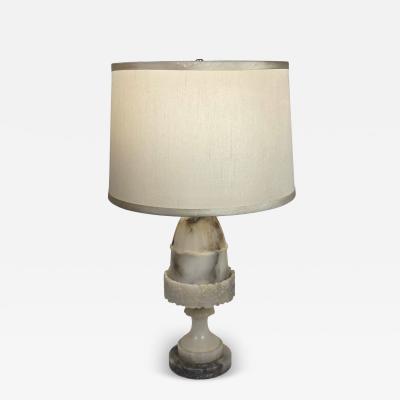
Italian Neoclassical Carved Alabaster & Marble Table Lamp, c. 1930s
-
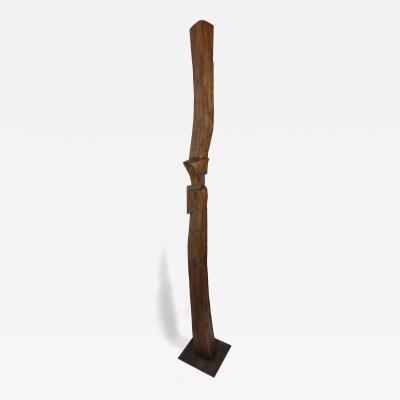
1960s California Brutalist Hand-Carved Interlocking Old-Growth Douglas Fir Totem
-
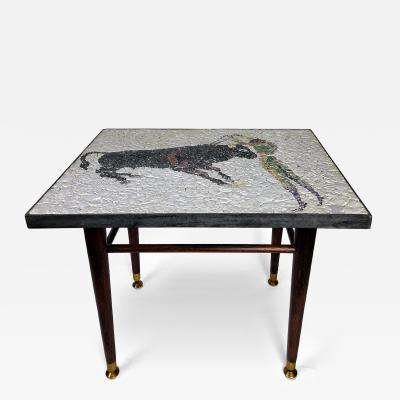
1950s Eduardo Alvarado Mexican Mosaic Banderillero Rosewood Table Castillo Taxco
-
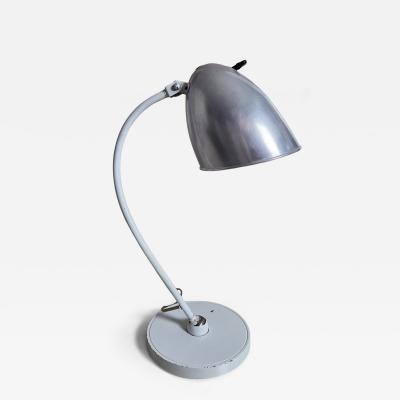
1950s Mid-Century German Hala Zeeland Model 110 White & Polished Aluminum Lamp
-
MAgriTTA Chair
-
1933 Pre-War Bauhaus Kaiser Idell Natural Steel Model 6551 Desk Lamp Germany
-
Frank Lloyd Wright Mahogany Desk Heritage Henredon 1955/56

-
Pair Mid-Century Brancusi Cerused Oak Lamps W/ Original Red Fiberglass Shades
-
Streamlined Chinoiserie Twin-Column Temple Gate Table Lamp, c. 1950s
-
1950s California Mid-Century Sculptural Manzanita Floor Lamp
-
1952 Tye of California "Aboriginal" Ceramic Table Lamp
-
Vintage French Le Dauphin Style Glass Lamp with Hand Gilt Foliage c1950
-
Pair Vintage Gerald Thurston for Lightolier Brass & Lucite Lamps, Circa 1950s