




David Davidovich Burliuk
Ukrainian, 1882 - 1967
David Burliuk is not only the father of Russian Futurism (budetlyane - people of the future) and one of the founders of the Cubo-Futurist movement in France and Germany (Der Blaue Reiter) in 1910, he is also one of the pioneers of the NEW UNIVERSAL ART, which included Pablo Picasso, Archipenko, Ferdinand Leger, Joseph Stella, Kandinski, Charles Sheeler, Alfred Steiglitz, Georgia O'Keeffe, John Marin, Nicoli Feshin, John Sloan, and others.
David Davidovich Burliuk was born in Semirotovshchina village, Kharkov Province, Russia in 1882 and died in New York City in 1973. He was a prolific painter as well as a poet, author, and a great promoter of modern art. He was well educated, proficient in French, German, and to some extent Greek, and was exposed to the great poets, painters, and writers of the time. Burliuk began his formal studies at art colleges in Kazan (1898-99, 1901) and Odessa (1899-1900, 1909). He studied at the Academy in Munich (1902-03), in the studio of Fernand Cormon in Paris (1904) and at the Moscow Institute of Painting, Sculpture, and Architecture (1910-14), where he would eventually be expelled.
The political turmoil within Russia following World War I would force Burliuk to immigrate to New York City by way of Japan and Canada in 1922. Throughout his career as an artist and intellectual Burliuk continued to paint a variety of subjects from abstract works to landscapes.
In addition to his painting, David Burliuk actively created poetry throughout his artistic life. While in Russia, Burliuk envisioned a movement (eventually called Russian Futurism) that could express itself through multiple media, thereby making the movement more universal and less isolated as simply a visual development. Burliuk also had an essential role in nurturing the Russian Futurist poet Vladimir Mayakovsky. Burliuk wrote extensive critical pieces such as "Cubism" and poetry that were presented throughout Russia in public forums and published in futurist manifestos like A Trap for Judges and a Slap in the Face of Public Taste. Burliuk's interest in poetry continued well into the 20th century.
Two of the most consistent characteristics of all Burliuk's works are his extreme interest in the act of painting and his assimilation of various styles from other artistic movements. He applied paint in thick impasto, often applying it directly to the canvas, either from the tube or with the palette knife. In his own words, "A painting is the result of movement . . . Drawings or paintings are seismographic recordings." Burliuk's theory of painting preceded the much celebrated theory and style of action painting Jackson Pollock devised around 1943.The other hallmark of David Burliuk's works is his "kaleidoscope" of styles. Expressionist painters of this movement did not have a uniform artistic theory but they shared an ". . . intense assertion of the painter's own vision" often manifested by vivid and exuberant colors. Burliuk participated in their first exhibition in 1911. Wassily Kandinsky, the leader of the movement, spoke passionately about the physical and psychological effects that arise from looking at colors, ". . . color awakens a corresponding physical sensation, which undoubtedly works poignantly upon the soul."
As an artist, Burliuk was extremely aware of his audience and adjusted his style to meet the demand of the viewer. Burliuk toured Australia in 1962 and is quoted in a newspaper article, "These are the paintings people buy, so I do plenty of them." Yet these paintings also have a complex origin in Burliuk's artistic process. The unique blend of contemporary artistic styles such as Surrealism and Expressionism broke down the traditional portrait and required an individual versed in twentieth-century art to understand the significance each movement referenced has had on subsequent styles. Burliuk was represented by the ACA Galleries, NY and was a friend of Geri Pine and her husband. David Burliuk was a chameleon, changing his style and subject to fit the demand of the moment in order to please the audience. Geri Pine was a woman involved in the privileged art society of the 1940s which elevated their status among the New York avant-garde.
Member: National Institute of Arts and Letters.
Exhibited: Participant in exhibitions from 1906: Union of Russian Artists(1906-07), Wreath (1908), Link (1908), Knave of Diamonds (1910-13, 1916,1917), World of Art (1911), Union of Youth (1911-14), Der Blaue Reiter (Munich, 1911-12), Der Sturm (Berlin, 1912-13), Salon des Independents (Paris, 1914) etc. First of many one-man shows held in Samara, 1917, USA. Societe Anonyme, 1924; WMAA, 1926-1946; Corcoran Gallery from 1939-47, and the PAFA from 1943-46.
Work: Metropolitan Museum of Art; Whitney Museum of Art; Brooklyn and Boston and Philadelphia Museums of Fine Arts; Yale University.
References:
Who Was Who in American Art (21 lines)
Concise Oxford Dictionary of Art &Artists, 2nd ed. p.80
Mantle Fielding
ADEC 98
Studied at art colleges in Kazan (1898-99, 1901) and Odessa (1899-1900, 1909), at the Academy in Munich (1902-03), in the studio of Fernand Cormon in Paris (1904)
Biography courtesy of Roughton Galleries, www.antiquesandfineart.com/roughton
David Davidovich Burliuk was born in Semirotovshchina village, Kharkov Province, Russia in 1882 and died in New York City in 1973. He was a prolific painter as well as a poet, author, and a great promoter of modern art. He was well educated, proficient in French, German, and to some extent Greek, and was exposed to the great poets, painters, and writers of the time. Burliuk began his formal studies at art colleges in Kazan (1898-99, 1901) and Odessa (1899-1900, 1909). He studied at the Academy in Munich (1902-03), in the studio of Fernand Cormon in Paris (1904) and at the Moscow Institute of Painting, Sculpture, and Architecture (1910-14), where he would eventually be expelled.
The political turmoil within Russia following World War I would force Burliuk to immigrate to New York City by way of Japan and Canada in 1922. Throughout his career as an artist and intellectual Burliuk continued to paint a variety of subjects from abstract works to landscapes.
In addition to his painting, David Burliuk actively created poetry throughout his artistic life. While in Russia, Burliuk envisioned a movement (eventually called Russian Futurism) that could express itself through multiple media, thereby making the movement more universal and less isolated as simply a visual development. Burliuk also had an essential role in nurturing the Russian Futurist poet Vladimir Mayakovsky. Burliuk wrote extensive critical pieces such as "Cubism" and poetry that were presented throughout Russia in public forums and published in futurist manifestos like A Trap for Judges and a Slap in the Face of Public Taste. Burliuk's interest in poetry continued well into the 20th century.
Two of the most consistent characteristics of all Burliuk's works are his extreme interest in the act of painting and his assimilation of various styles from other artistic movements. He applied paint in thick impasto, often applying it directly to the canvas, either from the tube or with the palette knife. In his own words, "A painting is the result of movement . . . Drawings or paintings are seismographic recordings." Burliuk's theory of painting preceded the much celebrated theory and style of action painting Jackson Pollock devised around 1943.The other hallmark of David Burliuk's works is his "kaleidoscope" of styles. Expressionist painters of this movement did not have a uniform artistic theory but they shared an ". . . intense assertion of the painter's own vision" often manifested by vivid and exuberant colors. Burliuk participated in their first exhibition in 1911. Wassily Kandinsky, the leader of the movement, spoke passionately about the physical and psychological effects that arise from looking at colors, ". . . color awakens a corresponding physical sensation, which undoubtedly works poignantly upon the soul."
As an artist, Burliuk was extremely aware of his audience and adjusted his style to meet the demand of the viewer. Burliuk toured Australia in 1962 and is quoted in a newspaper article, "These are the paintings people buy, so I do plenty of them." Yet these paintings also have a complex origin in Burliuk's artistic process. The unique blend of contemporary artistic styles such as Surrealism and Expressionism broke down the traditional portrait and required an individual versed in twentieth-century art to understand the significance each movement referenced has had on subsequent styles. Burliuk was represented by the ACA Galleries, NY and was a friend of Geri Pine and her husband. David Burliuk was a chameleon, changing his style and subject to fit the demand of the moment in order to please the audience. Geri Pine was a woman involved in the privileged art society of the 1940s which elevated their status among the New York avant-garde.
Member: National Institute of Arts and Letters.
Exhibited: Participant in exhibitions from 1906: Union of Russian Artists(1906-07), Wreath (1908), Link (1908), Knave of Diamonds (1910-13, 1916,1917), World of Art (1911), Union of Youth (1911-14), Der Blaue Reiter (Munich, 1911-12), Der Sturm (Berlin, 1912-13), Salon des Independents (Paris, 1914) etc. First of many one-man shows held in Samara, 1917, USA. Societe Anonyme, 1924; WMAA, 1926-1946; Corcoran Gallery from 1939-47, and the PAFA from 1943-46.
Work: Metropolitan Museum of Art; Whitney Museum of Art; Brooklyn and Boston and Philadelphia Museums of Fine Arts; Yale University.
References:
Who Was Who in American Art (21 lines)
Concise Oxford Dictionary of Art &Artists, 2nd ed. p.80
Mantle Fielding
ADEC 98
Studied at art colleges in Kazan (1898-99, 1901) and Odessa (1899-1900, 1909), at the Academy in Munich (1902-03), in the studio of Fernand Cormon in Paris (1904)
Biography courtesy of Roughton Galleries, www.antiquesandfineart.com/roughton

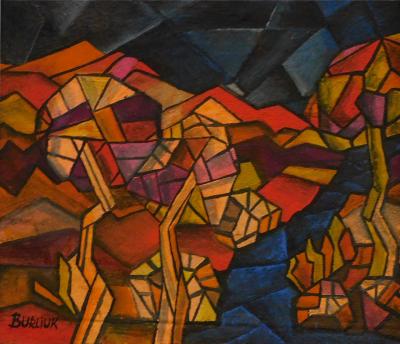
David Davidovich Burliuk
David Burliuk Watercolor on paper Untitled
H 8 in W 11 in D 1 in
$ 2,400
Access Trade Price
 Loading...
