




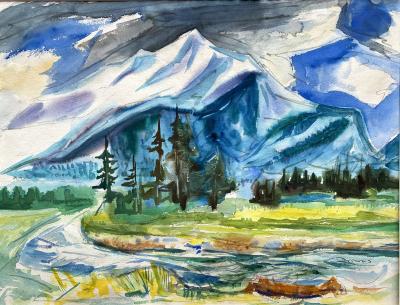
Werner Drewes
American, 1899 - 1985

Werner Drewes Born Germany, 1899 Died Virginia, 1985 Werner Drewes received his first instruction in art as a child in the village of Conig, East Germany. He served in World War I, after which he had his first formal training at Stuttgart, where he studied architecture and design. He later studied under Paul Klee, Oskar Schlemmer, Wassily Kandinsky, and Johannes Itten at the Bauhaus in Weimar. In 1923, Drewes traveled throughout Europe studying the work of the old masters. He and his wife then ventured on, crossing the United States and then on to Korea, Japan, Manchuria, and Russia. The couple ended their travels in Berlin, and Drewes resumed studies at the Bauhaus and Dessau. He also studied privately with Wassily Kandinsky and attended Hinnerk Sheper's mural tutorials. In 1930, Drewes and his family relocated to New York, where he continued to work simultaneously in representational and abstract styles. The following year, Kandinsky introduced him to a cofounder of the Societe Anonyme, Katherine Dreier. The introduction proved to be fruitful, resulting in the first of several exhibitions with the Societe. The artist instructed in drawing and printmaking at the Brooklyn Museum School from 1934-1936. He joined the American Artists' Congress and became a founding member of the American Abstract Artists in 1937. That same year, he obtained United States citizenship. In 1940 and 1941, Drewes was the director of the Works Progress Administration (WPA) Graphic Arts Division in New York. Drewes returned to teaching at the Brooklyn Museum School in 1944. He also produced experimental intaglio prints as a member of Stanley William Hayter's Atelier 17. In 1945, the artist taught at the Institute of Design in Chicago. His longest held teaching position was at the School of Fine Arts at Washington University in St. Louis between 1946 and 1965. Throughout this time and into the 1970's Drewes continued his work with printmaking as well as painted extensively. Exhibited: Salons of America, 1933-34; Pennsylvania Academy of Fine Art, 1933-34, 1944-51; Museum of Modern Art, 1939 (prize); Societe Anonyme, 1930's; Museum of Costume Art, 1941 (prize); Carnegie Institute, 1945-47; St. Louis Art Museum, 1959 (prize); Cleveland Museum of Art, 1961 (solo); Legion of Honor, San Francisco, 1962 (solo); Washington University, St. Louis, 1965 (retrospective); National Museum of American Art, 1969 (retrospective); Art Institute of Chicago; Whitney Museum of American Art. Works Held: Addison Gallery of American Art; Art Institute of Chicago; Bennington College; Boston Museum of Fine Arts; Brooklyn Museum; Busch-Reisinger Museum, Cambridge, Massachusetts; Fogg Museum of Art; Frankfurt Museum, Germany; Honolulu Academy of the Arts; National Museum of American Art; New York Public Library; Newark Public Library; Pennsylvania Academy of the Fine Arts; Philadelphia Museum of Art; Phillips Memorial Gallery, Washington, D.C.; Societe Anonyme; St. Louis Art Museum; Yale University Artists Guild. Further Reading: The Second Wave: American Abstraction of the e1930's and 1940's, Susan E. Strickler and Elaine D. Gustafson, Worcester Art Museum, Worcester, Massachusetts, 1991.; Who Was Who in American Art 1564-1975: 400 Years of Artists in America, Vol. 1. Peter Hastings Falk, Georgia Kuchen and Veronica Roessler, eds., Sound View Press, Madison, Connecticut, 1999. 3 Vols.Biography courtesy of David Cook Galleries
 Loading...
