









Alexander Dzigurski
Serbian, 1911 - 1995

Alexander Dzigurski did not set up his easel on the Pacific Coast or in the Grand Tetons or any of the other majestic American locales for which he was famous until after his 38th birthday. He and his young family, like the rest of Europe, first had to endure World War II. Alexander's artistic talents were apparent early on, and as a boy he studied art courtesy of the Orthodox church. Consequently, many of his earlier works adorn the walls of Orthodox churches. His early career as a painter was going well. But then came the war.
As the Nazis invaded his native land, he was assigned to communications in the Yugoslav army. In 1941, most of his unit was taken prisoner, but Alex escaped, fleeing back to his young wife Lenka and his eight year old daughter Jelena.
War caused extreme hardships on the Serbian people and Alex and his young family were no exception. He had to give up his prosperous portrait studio. To survive, Alexander, Lenka, and Jelena hoped to lie low near the home of his parents in Stari Becej. But as the Nazis dominated Yugoslavia, Alexander received advance warning that he was to be arrested and shipped to Norway or to the Russian Front, where he would probably meet his end in forced labor. He fled with Lenka and Jelena to Belgrade, and there signed contracts to work in Germany. While traveling to Germany, the family escaped again, finding their way to Vienna where Alex found work as a housepainter. His skill with a brush was was not to be hidden, and he was fortunate to supplement his house painting by restoring murals and doing some commissioned pieces. He welcomed this work, for it fed and protected his family until the end of the war.
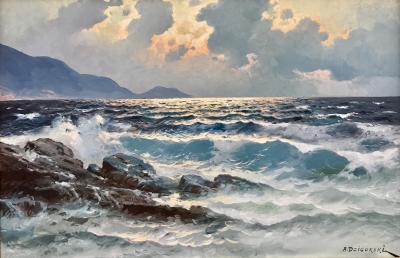
After the war, he made his way from Vienna back to Yugoslavia, and then on to Italy. There, he reestablished his peacetime career and reputation as an artist. He made contacts with the Orthodox Church in the US, and, in 1949, was able to bring his family to America. In America, he initially occupied himself with ecclesiastical art, painting in Orthodox churches in Pennsylvania, Ohio, and Wisconsin. By 1952, he vacationed in the West, and began painting landscapes. After his European beginnings and having survived the war, Alex was thrilled with his new life of freedom and opportunity. Many times he said that the majesty of the scenery he painted was a metaphor for the freedom he now enjoyed.
And for movie fans, Alexander Dzigurski's work made it into Sergio Leoni's 1968 film, Once Upon a Time in the West. In this scene Henry Fonda (Frank) looks on as Gabriele Ferzetti (Morton) speaks of his love of the sea while looking at a Dzigurski painting.
After Lenka died, Alexander lost interest in painting. His long held deep grief finally came to an end through due an unplanned event. He broke his painting arm, and needed medical attention. While in the Stanford hospital recovering, he met a nurse, Dorothy T. Travis, whom he later married. The Art of Alexander Dzigurski, notes that Dorothy's "personal charm and devoted encouragement" helped him recover the strength of his painting arm and his passion for painting. The newlyweds were soon blessed with the birth of a son, young Alex. The joy derived from Alex's arrival can be seen in the exuberance and vitality which appears in his work.
Today, little Alex has grown to become a famed artist in his own right, Alex Dzigurski II , carrying on a second generation of the work begun by his father.
As the Nazis invaded his native land, he was assigned to communications in the Yugoslav army. In 1941, most of his unit was taken prisoner, but Alex escaped, fleeing back to his young wife Lenka and his eight year old daughter Jelena.
War caused extreme hardships on the Serbian people and Alex and his young family were no exception. He had to give up his prosperous portrait studio. To survive, Alexander, Lenka, and Jelena hoped to lie low near the home of his parents in Stari Becej. But as the Nazis dominated Yugoslavia, Alexander received advance warning that he was to be arrested and shipped to Norway or to the Russian Front, where he would probably meet his end in forced labor. He fled with Lenka and Jelena to Belgrade, and there signed contracts to work in Germany. While traveling to Germany, the family escaped again, finding their way to Vienna where Alex found work as a housepainter. His skill with a brush was was not to be hidden, and he was fortunate to supplement his house painting by restoring murals and doing some commissioned pieces. He welcomed this work, for it fed and protected his family until the end of the war.
After the war, he made his way from Vienna back to Yugoslavia, and then on to Italy. There, he reestablished his peacetime career and reputation as an artist. He made contacts with the Orthodox Church in the US, and, in 1949, was able to bring his family to America. In America, he initially occupied himself with ecclesiastical art, painting in Orthodox churches in Pennsylvania, Ohio, and Wisconsin. By 1952, he vacationed in the West, and began painting landscapes. After his European beginnings and having survived the war, Alex was thrilled with his new life of freedom and opportunity. Many times he said that the majesty of the scenery he painted was a metaphor for the freedom he now enjoyed.
And for movie fans, Alexander Dzigurski's work made it into Sergio Leoni's 1968 film, Once Upon a Time in the West. In this scene Henry Fonda (Frank) looks on as Gabriele Ferzetti (Morton) speaks of his love of the sea while looking at a Dzigurski painting.
After Lenka died, Alexander lost interest in painting. His long held deep grief finally came to an end through due an unplanned event. He broke his painting arm, and needed medical attention. While in the Stanford hospital recovering, he met a nurse, Dorothy T. Travis, whom he later married. The Art of Alexander Dzigurski, notes that Dorothy's "personal charm and devoted encouragement" helped him recover the strength of his painting arm and his passion for painting. The newlyweds were soon blessed with the birth of a son, young Alex. The joy derived from Alex's arrival can be seen in the exuberance and vitality which appears in his work.
Today, little Alex has grown to become a famed artist in his own right, Alex Dzigurski II , carrying on a second generation of the work begun by his father.
 Loading...
