










Kerr Eby
American, 1889 - 1946
Eby was born on October 19, 1889 in Tokyo, Japan and died on November 18, 1946, in Norwalk. Eby was in Cos Cob, c. 1913-1917; and later settled in Westport after World War I.
Born in Japan of Canadian Methodist missionaries, Kerr Eby did not come to the United States until 1907, when he was eighteen years old. The maternal grandson of print dealer Frederick Keppel, Eby (who never used his first name, Harold) studied at Pratt Institute and the Art Students League. In the summer of 1915, and probably for two years before and after that time, he had a studio in a waterfront warehouse just across the road from the Holley House.
In Cos Cob the young printmaker not only produced such etchings as Backyards but - perhaps more important - offered Childe Hassam the technical advice that helped make the older artist's first serious venture into etching so successful. The twenty-five prints Hassam produced in Cos Cob in 1915 include a portrait of Eby in his studio, a self-portrait of Hassam there, and two views of the building's exterior.
Eby was also a source of first-hand information about Japan. The Cos Cob colony had admired Japanese art ever since the years of Twachtman's and Weir's summer classes. A Japanese artist had been a member of the colony at the turn of the century, and Hassam's Cos Cob models had dressed in kimonos as early as 1902. Eby's dinner-table accounts of Japanese life undoubtedly renewed the Holley House group's interest in Oriental art. Two of Hassam's 1915 etchings depict a young Cos Cob woman dressed in a white kimono.
Eby enlisted in the Army in 1917, serving as a sergeant in the Corps of Engineers. He returned to the front lines in the Second World War as an artist-war correspondent with the Marines in the Pacific. Ironically, the pacifist artist was to become as well known for his grimly realistic depictions of war as for his peaceful Connecticut landscapes.
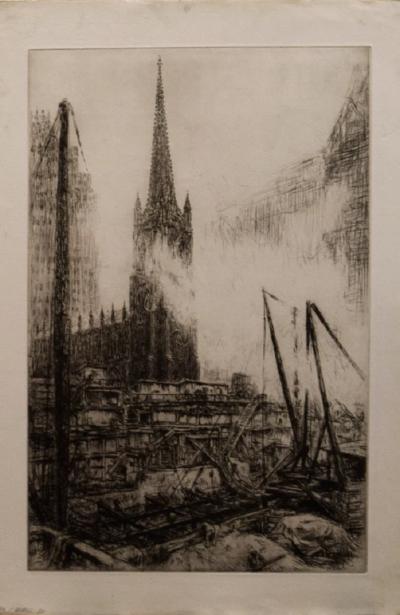
Between the wars Eby lived in Westport, where he captured on the etching plate views of that area when it was still largely farmland. Like many of the Gus Cob artists, Eby seemed to prefer winter landscapes, but unlike the painters, who were challenged by white, he was concerned with line: the intricate mesh of bare branches against the sky, the zigzag of a rail fence across a snowy field. His Connecticut landscapes often include houses, as do Hassam's, but whereas Hassam enjoyed architecture for itself, Eby often used buildings to evoke a mood just short of sentimentality. He was a popular artist during his lifetime. His prints commanded as high a price the year after his death as they do today.
Further reading:
The Stamp of Whistler Exh. cat., Allen Memorial Art Museum, Oberlin College, 1977.
Biography courtesy of Roughton Galleries, www.antiquesandfineart.com/roughton
Born in Japan of Canadian Methodist missionaries, Kerr Eby did not come to the United States until 1907, when he was eighteen years old. The maternal grandson of print dealer Frederick Keppel, Eby (who never used his first name, Harold) studied at Pratt Institute and the Art Students League. In the summer of 1915, and probably for two years before and after that time, he had a studio in a waterfront warehouse just across the road from the Holley House.
In Cos Cob the young printmaker not only produced such etchings as Backyards but - perhaps more important - offered Childe Hassam the technical advice that helped make the older artist's first serious venture into etching so successful. The twenty-five prints Hassam produced in Cos Cob in 1915 include a portrait of Eby in his studio, a self-portrait of Hassam there, and two views of the building's exterior.
Eby was also a source of first-hand information about Japan. The Cos Cob colony had admired Japanese art ever since the years of Twachtman's and Weir's summer classes. A Japanese artist had been a member of the colony at the turn of the century, and Hassam's Cos Cob models had dressed in kimonos as early as 1902. Eby's dinner-table accounts of Japanese life undoubtedly renewed the Holley House group's interest in Oriental art. Two of Hassam's 1915 etchings depict a young Cos Cob woman dressed in a white kimono.
Eby enlisted in the Army in 1917, serving as a sergeant in the Corps of Engineers. He returned to the front lines in the Second World War as an artist-war correspondent with the Marines in the Pacific. Ironically, the pacifist artist was to become as well known for his grimly realistic depictions of war as for his peaceful Connecticut landscapes.
Between the wars Eby lived in Westport, where he captured on the etching plate views of that area when it was still largely farmland. Like many of the Gus Cob artists, Eby seemed to prefer winter landscapes, but unlike the painters, who were challenged by white, he was concerned with line: the intricate mesh of bare branches against the sky, the zigzag of a rail fence across a snowy field. His Connecticut landscapes often include houses, as do Hassam's, but whereas Hassam enjoyed architecture for itself, Eby often used buildings to evoke a mood just short of sentimentality. He was a popular artist during his lifetime. His prints commanded as high a price the year after his death as they do today.
Further reading:
The Stamp of Whistler Exh. cat., Allen Memorial Art Museum, Oberlin College, 1977.
Biography courtesy of Roughton Galleries, www.antiquesandfineart.com/roughton


 Loading...
