






Remo Michael Farruggio
Italian, 1904 - 1981
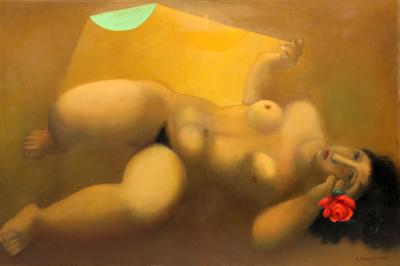
Remo Farruggio (1904–1981) was a distinguished artist whose belief that "a painting must have a soul" shaped his approach to art. Born in Palermo, Italy, he immigrated to the United States in 1918 and became a citizen by 1924. His artistic education began at the National Academy of Design, followed by studies at the Beaux-Arts Institute in Paris and the New York School of Industrial Art under Monhegan artist A.J. Bogdanove.
In the late 1930s, Farruggio became involved with the Works Progress Administration as a WPA artist. His work gained recognition, culminating in his first solo exhibition at the Julien Levy Gallery in New York City, facilitated by the Federal Art Project. He also shared his knowledge as an educator, teaching at the Federation of Artists School in Detroit in the early 1940s and later at the Museum Art School in Portland, Oregon, during the mid-1950s.
While he primarily lived in New York City, Farruggio spent many summers in Provincetown, Massachusetts. The vibrant community of Monhegan artists nearby drew him to the island, where he became an integral part of the local art scene, working and living at the Lobster Pot.
Farruggio's work was widely exhibited, with representation in galleries across New York, Mexico, and Italy. Notably, his paintings were featured in "American Paintings Today" at the Metropolitan Museum of Art in 1950 and the "International Watercolor Exhibition" at the Brooklyn Museum in 1955. In addition to his early solo exhibition at the Julien Levy Gallery, he showcased his art in venues like the Galeria Arte Contemporaneo in Mexico City and the Galleria Schneider in Rome. His legacy as a passionate artist continues to resonate in the art community.
In the late 1930s, Farruggio became involved with the Works Progress Administration as a WPA artist. His work gained recognition, culminating in his first solo exhibition at the Julien Levy Gallery in New York City, facilitated by the Federal Art Project. He also shared his knowledge as an educator, teaching at the Federation of Artists School in Detroit in the early 1940s and later at the Museum Art School in Portland, Oregon, during the mid-1950s.
While he primarily lived in New York City, Farruggio spent many summers in Provincetown, Massachusetts. The vibrant community of Monhegan artists nearby drew him to the island, where he became an integral part of the local art scene, working and living at the Lobster Pot.
Farruggio's work was widely exhibited, with representation in galleries across New York, Mexico, and Italy. Notably, his paintings were featured in "American Paintings Today" at the Metropolitan Museum of Art in 1950 and the "International Watercolor Exhibition" at the Brooklyn Museum in 1955. In addition to his early solo exhibition at the Julien Levy Gallery, he showcased his art in venues like the Galeria Arte Contemporaneo in Mexico City and the Galleria Schneider in Rome. His legacy as a passionate artist continues to resonate in the art community.

 Loading...
