












Gustave Baumann
American, 1881 - 1971

Gustave Baumann, born in Germany in 1881 and passing away in New Mexico in 1971, had a remarkable life journey that deeply influenced his art. His family relocated to Chicago in 1891, and at just 17, Baumann worked in a commercial engraving house while pursuing night classes at the School of the Art Institute of Chicago.
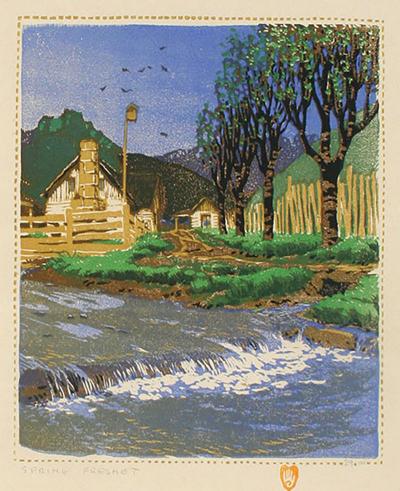
In 1905, he returned to Munich, his place of birth, to enroll in the Kunstgewerbe Schule (Arts and Crafts School). It was there that he honed his skills in wood carving and mastered the European technique of color woodblock prints. After a year in Germany, Baumann returned to the United States and settled in Brown County, Indiana, in 1910. The landscapes of Indiana captivated him, becoming the central theme of his work. He created a series of colored woodcuts titled "In the Hills of Brown."
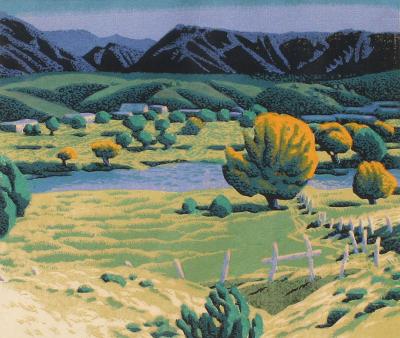
His talent was recognized at the Panama Pacific International Exposition in San Francisco in 1915, where he was awarded the gold medal for printmaking. In 1916, he organized the first national exhibition of color woodcuts by American artists at the Art Institute of Chicago. Baumann's artistic journey took a pivotal turn in 1918 when he visited Santa Fe to see his friends Walter Ufer and Victor Higgins. Enthralled by New Mexico's natural beauty, he decided to make it his permanent home, collaborating with renowned artists such as John Sloane, Randall Davey, and Fremont Ellis.
Baumann's contributions to art were acknowledged in 1952 when he was named an Honorary Fellow in Fine Arts by the School of American Research. He continued to live and work in Santa Fe until his death in 1971.
In 1905, he returned to Munich, his place of birth, to enroll in the Kunstgewerbe Schule (Arts and Crafts School). It was there that he honed his skills in wood carving and mastered the European technique of color woodblock prints. After a year in Germany, Baumann returned to the United States and settled in Brown County, Indiana, in 1910. The landscapes of Indiana captivated him, becoming the central theme of his work. He created a series of colored woodcuts titled "In the Hills of Brown."
His talent was recognized at the Panama Pacific International Exposition in San Francisco in 1915, where he was awarded the gold medal for printmaking. In 1916, he organized the first national exhibition of color woodcuts by American artists at the Art Institute of Chicago. Baumann's artistic journey took a pivotal turn in 1918 when he visited Santa Fe to see his friends Walter Ufer and Victor Higgins. Enthralled by New Mexico's natural beauty, he decided to make it his permanent home, collaborating with renowned artists such as John Sloane, Randall Davey, and Fremont Ellis.
Baumann's contributions to art were acknowledged in 1952 when he was named an Honorary Fellow in Fine Arts by the School of American Research. He continued to live and work in Santa Fe until his death in 1971.

 Loading...
