





Robert McGuffin
Journeyman Extraordinaire for Henry Connelly, Part II
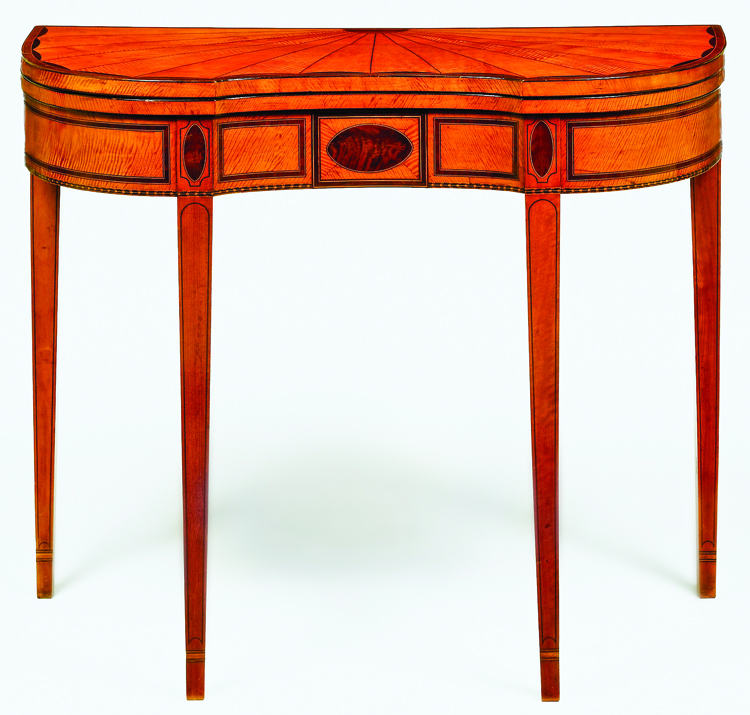
- Fig. 1: One of a pair of card tables made by Robert McGuffin (1779/1780–after 1863) for Henry Connelly, Philadelphia, 1807. Satinwood, mahogany and rosewood with white pine and oak. Collection of Mrs. George M. Kaufman. Photography by Gavin Ashworth.
In the early nineteenth century, Philadelphia experienced a brief but superlative period of cabinetmaking. As the financial, commercial and maritime capital of the new Republic in the boom years prior to the War of 1812, its newly affluent citizens supported a cabinetmaking trade that produced an extraordinary group of inlaid furniture, based on English and European Neoclassical designs. Robert McGuffin (1779/1780–after 1863), a journeyman in Henry Connelly’s (1770–1826) shop, was a major contributor to this sophisticated group that included the products from the shops of Joseph Barry, George G. Wright, Ephraim Haines, John Aitken and Adam Hains. As discussed in a previous article in Antiques & Fine Art,1 analysis of three signed pieces by McGuffin confirms him as one of the most skilled cabinetmakers in Federal Philadelphia and serves as the basis for attribution of other unmarked pieces produced in that important shop.
The distinctive veneering and construction features of the three signed objects—an inlaid satinwood card table (Fig. 1), a mahogany sideboard (Fig. 2), and an inlaid satinwood sewing table (Fig. 3)—provide a reliable benchmark to attribute other pieces to McGuffin’s hand. Based on figures 1–3, three other unmarked tables (Figures 4–6) are almost certainly the products of McGuffin’s work during his tenure in the Connelly shop.
An attributed sewing table (Fig. 4) employs the very tightly curled satinwood that McGuffin seemed to relish, two rayed semicircles flanking a central book-matched oval on the top, and labor-intensive rosewood cross-banded rectangles on the aprons.
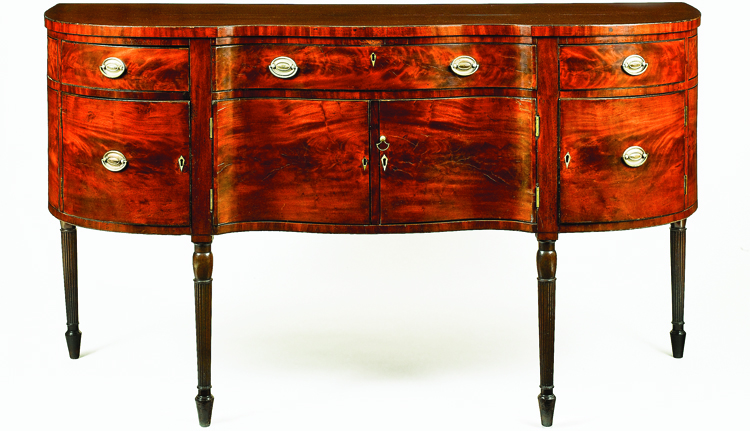
- Fig. 2: Sideboard made by Robert McGuffin (1779/1780–after 1863) for Henry Hollingsworth, and labeled by Henry Connelly, Philadelphia, 1806. Mahogany, white pine, yellow poplar, dark wood stringing and silvered brass handles, escutcheons and hinges. Collection of the Philadelphia Museum of Art (1951.11.1). Photography by Gavin Ashworth.
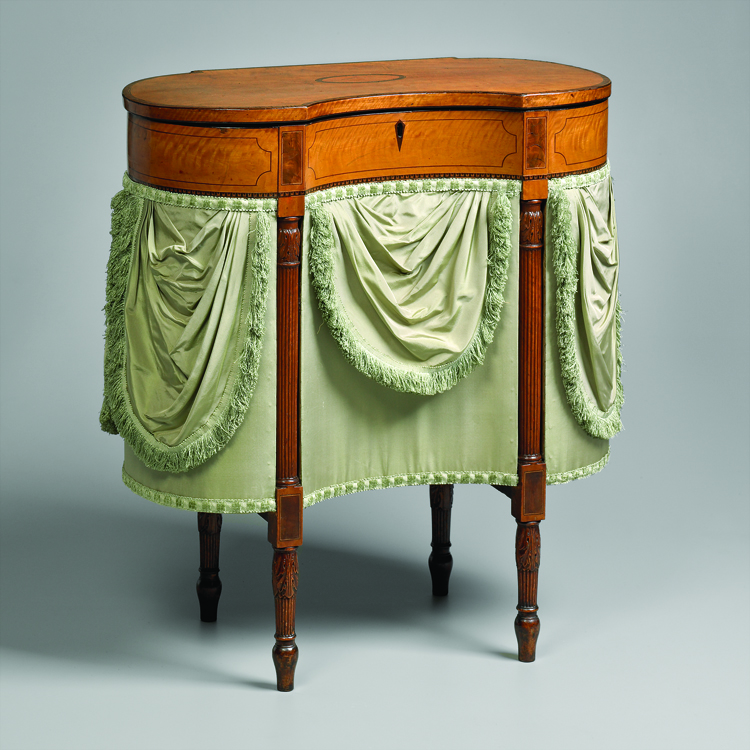
- Fig. 3: Sewing table made by Robert McGuffin (1779/1780–after 1863) for Henry Connelly, Philadelphia, 1808. Made for Henry Pratt. Satinwood, mahogany and rosewood with yellow poplar. Courtesy, Yale University Art Gallery (1936.306).
Both the signed and the attributed sewing tables are structurally similar to one another. The only real differences are that the attributed table has rails built up of four laminates rather than the three seen on the signed table, and the former lacks the two drawers underneath the compartments on the right and left sides. The difference in number of laminates for the rails is typical of the variation seen in a large shop that employed many journeymen.
The veneered decoration on the two tables shows McGuffin’s love of variation on a theme. The common elements are: the rosewood cross-banding flanked by stringing pairs that frame the tops and outline the oval and rectangular panels filled with satinwood fields; ebony edging of the corners of the tops; branch mahogany panels outlined with light-dark stringing in the stiles and blocks of the legs (rectangles on one table and ellipses on the other); and the use of the same patterned inlay banding at the bottom of the aprons, directionally reversed on each table.
The inscription on the signed card table provides convincing evidence that the attributed sewing table was also made by McGuffin. The rayed tops of the card table (Fig. 5) and two sewing tables share the same concept, handled in creative ways. He adapted his signature half sunburst seen on the card table top by using two smaller half-sunbursts on each end of the kidney shape of the attributed sewing table. Each has tightly curled satinwood for each ray that emanates from a branch mahogany semi-circle outlined by light-dark stringing, the rays separated by ebony stringing and terminated with partial circles of ebony. Both have satinwood-fielded ellipses of different forms on the tops, highlighting his grasp of geometric variation.
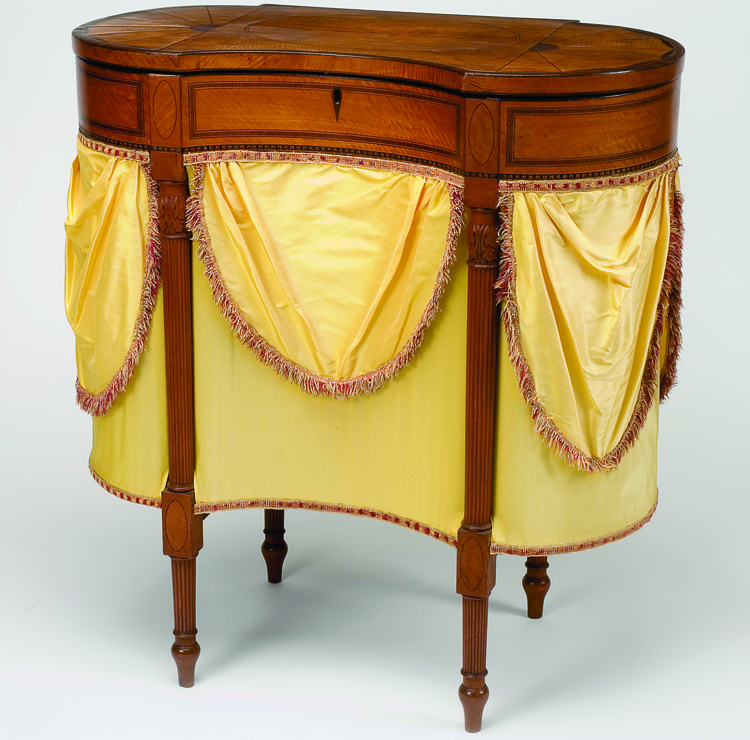
- Fig. 4: Sewing table, attributed to Robert McGuffin (1779/1780–after 1863) for Henry Connelly, Philadelphia, 1806–1811. Satinwood, mahogany, rosewood, dark wood stringing with white pine and yellow poplar. H. 28⅝, W. 26, D. 13½ in. Courtesy, Winterthur Museum (57.914).
Since the legs are almost certainly the work of outside specialists (indicative of the piecework system), differences between the signed card table and attributed sewing table are to be expected, depending on which turner and carver the Connelly shop was patronizing when each table was made.
A quirky structural feature shared by both tables adds further evidence that the tables were both made by McGuffin in the Connelly shop.2 The lower shelf that forms the bottom of the upholstered section has two pilot holes drilled completely through the shelves and the small mahogany rails that are tenoned into the lower leg blocks to support it, visible from the underside. These holes were for small screws (two on each side for the unsigned table, three each for the signed table), that were driven down through the shelf and into the support rails. The chances that these distinctive through-pilot holes are coincidental in different shops are next to none.
The curly satinwood breakfast table (Fig. 6), with top fashioned in a double kidney shape (Fig. 7), has a history of descending from Thomas McKean Jr. (1779–1852), probably commissioned at the time of his marriage in 1809 to Sarah Clementine Pratt (apparently unrelated to the Sarah Pratt who owned the signed sewing table). Family lore says it belonged to Thomas McKean’s father of the same name, who was a signer of the Declaration of Independence for Delaware and Governor of Pennsylvania from 1799 to 1808. In his mid-seventies, when McGuffin was working in Philadelphia, it is unlikely that the elder McKean was buying expensive new furniture, unless he ordered the table as a wedding present for his son and bride.
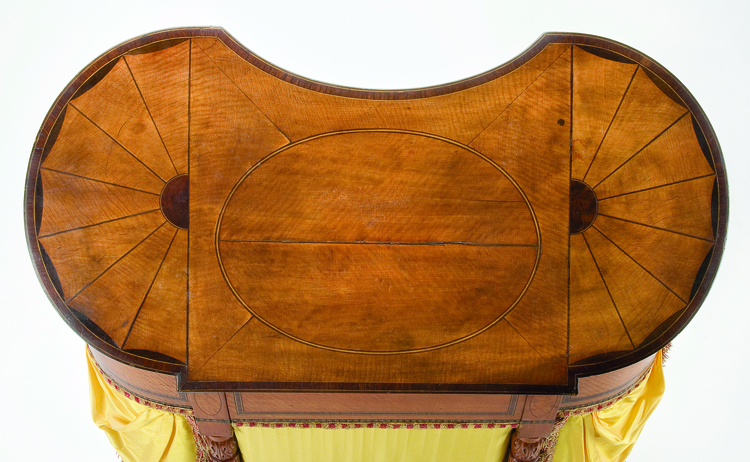
- Fig. 5: Detail of the rayed top on the attributed sewing table illustrated in figure 4. Courtesy, Winterthur Museum.
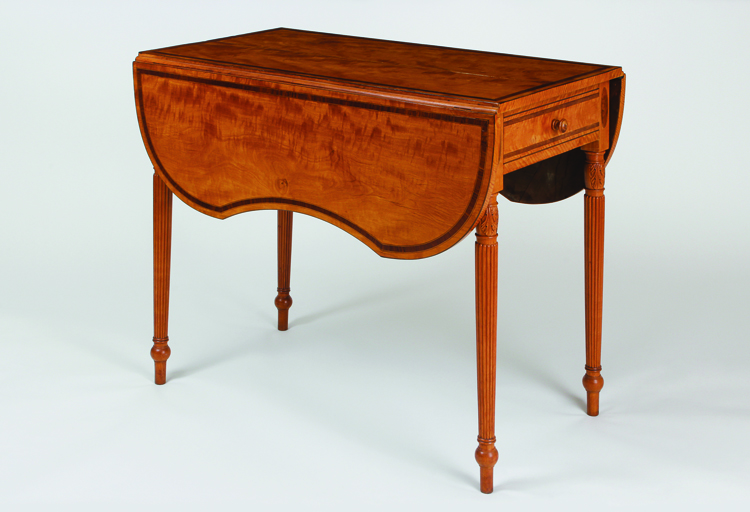
- Fig. 6: Breakfast table, attributed to Robert McGuffin (1779/1780–after 1863) for Henry Connelly, Philadelphia, 1806–1811. Made for Thomas McKean, Jr. or perhaps his father, then Governor of Pennsylvania. Curly satinwood, figured mahogany, rosewood, light and dark stringing with white pine, yellow poplar and oak. H. 28½, W. 34¾, D. (closed) 18¾ in. Private collection. Photography by Laszlo Bodo.
The inlaid and veneered surfaces of the breakfast table have many of McGuffin’s traits. The top of the table is veneered with figured satinwood, with the requisite rosewood cross-banded frame around the perimeter of the top, in turn flanked by his signature light-dark string pairing. The corners of the top are inlaid with ebony and the edge fascias veneered in intensely curly satinwood, as are the aprons at the ends of the table, all set in opposing directions. A drawer in one end and a false one on the other are both inlaid with bands of rosewood cross-banding. Remarkably, Connelly was able to supply the carving and turning specialists with solid curly satinwood blanks that closely matched the aprons. The blocks above the legs are long, extending below the lower edge of the apron as seen on the signed and attributed sewing tables. The ellipses inlaid into the stiles of the legs are “branch” (a period term for “crotch” grain) mahogany, and book-matched (Fig. 8).
The structural elements have many features in common with the signed tables. The leaves have angled pine “clamps” framing the pine substrates to eliminate any end-grain on the edges for the best bond of the veneers. The drawer dovetails have slight extensions of the saw kerfs. The oak double-fly rails that support each leaf have knuckle joints that are virtually identical to those on the signed card tables, complete with a vertical line intersecting the scribed “X” that marks the center of the iron pin.
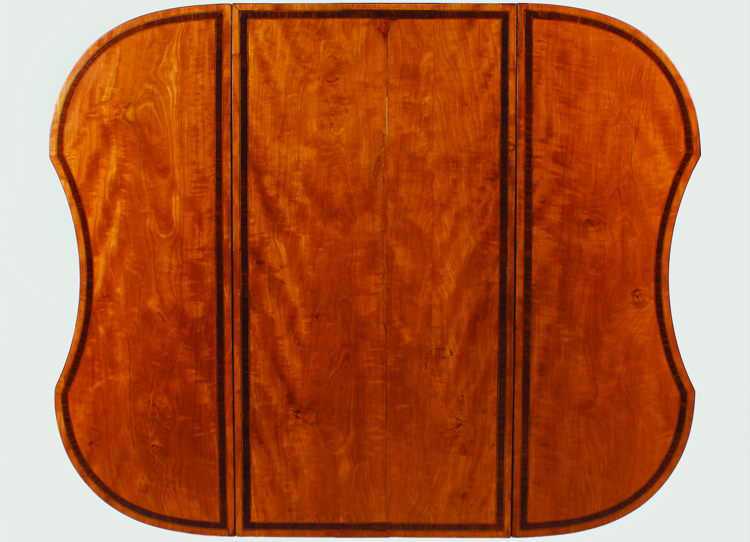
- Fig. 7: Detail of the double kidney-shaped top (with leaves extended) of the breakfast table illustrated in figure 6. Photography by Laszlo Bodo.
Presuming that McGuffin was the maker of the Masonic table (Fig. 9), imagine his delight when he was asked to execute that important commission! The symbolic Masonic imagery was tailor-made for a cabinetmaker enthralled by geometric shapes.3 The table has all the earmarks of McGuffin’s work. The figured satinwood in the rayed top is punctuated with all of his skillful flourishes. Though the case has hollow sides and canted corners instead of deeply rounded ends, the overall shape is a variant of the kidney form. The apron has the familiar rosewood cross-banded rectangles and central ellipses of branch mahogany, here stacked in a double row to accommodate the height of the case. The eagles that protect the contents of the “arc” are perched on the cantilevered blocks at the tops of the legs. Sharing several distinctive traits with the legs of the breakfast table, both were likely turned and carved by the same specialists.
The interior is fitted with two layers of removable trays in three sections. The center trays are a virtual geometry lesson in Masonic imagery formed by thin mahogany partitions in the shapes of diamonds, pointed ellipses, squares, quatrefoils, triangles, rectangles, stars and crescents. The two side trays are each a half of a keystone, which together symbolize the center stone in the Masonic royal arch. All four trays are fitted with silvered lifting rings reminiscent of the expensive silvered hardware on the signed sideboard. The interior of the case is veneered with satinwood and mahogany, with rosewood cross-banding framing the mirror under the top. The upper edge of the case (the top side of the case walls) is decorated with light-dark stringing pairs, inlaid almost like pin striping on a fancy carriage. In three places, the stringing pairs come together to form one line and then diverge again, giving McGuffin a forum to show off his remarkable facility with inlay.
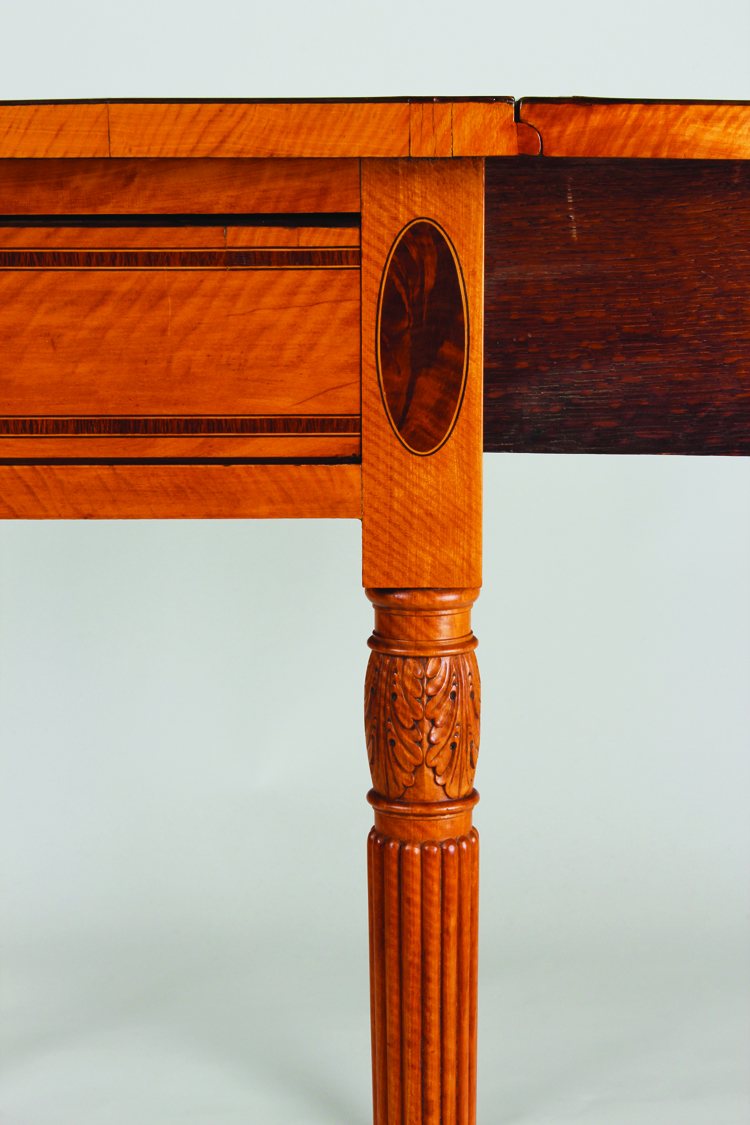
- Fig. 8: Detail of the end of the breakfast table illustrated in figure 6. Photography by Laszlo Bodo.
The early stages of the transformation of the cabinetmaking trade from artisanal craft to manufacturing industry were beginning to be felt in the first decade of the 1800s. Specialization of tasks allowed shop owners to save money by outsourcing aspects of production such as carving, turning and finishing (and probably table-gate production), while employing cheaper, unskilled or apprentice labor to complete the simplified tasks. These embryonic forms of industrialization reduced the demand for, and wages of, skilled journeymen.4 While McGuffin’s veneering skill surely insulated him from most of these changes, he probably felt the pinch to some degree. Additionally, the style of fashionable furniture was changing from that influenced by the English Regency to the French antique taste popularized by Pierre de La Mésangère in his serial publication Collection de Meubles et Objets de Gout, 1802–1835. The new style moved away from the highly contrasting veneer work that McGuffin excelled at, preferring instead broader spans of dark mahogany veneer on heavier forms inspired by Egyptian, Greek, and Roman designs.
Perhaps these changes persuaded McGuffin to try his hand at being a proprietor of his own cabinet shop. At some point between 1809 and 1811, he left the employment of Henry Connelly. In 1811, the Philadelphia tax lists and directories cite the cabinetmaking partnership of Robert McGuffin and Samuel Anderson at 12 South 5th Street.5 McGuffin’s decision to start a new venture was probably ill-timed. Because of the economic uncertainty leading up to the war with Britain, affluent Philadelphians were likely holding off on commissions of expensive high-style furniture. He disappears from the tax records and directories in 1812, and may have gone to Wilmington, Delaware, where he married Susan Naff the next year.6
By 1812, McGuffin had borrowed money from his business partner Samuel Anderson, apparently in preparation to move back to his hometown of Newville, Pennsylvania.7 The first two of his five children were born that year and in 1813. On October 29, 1813, McGuffin placed a notice in the Carlisle Herald announcing the commencement of his cabinet business in Newville, where he lists “French or Egyptian Bureaus” among the forms he is offering to make—evidence that he had embraced the new French styles and that he had probably learned to make Egyptian chests in Connelly’s shop a few years prior to leaving Philadelphia.
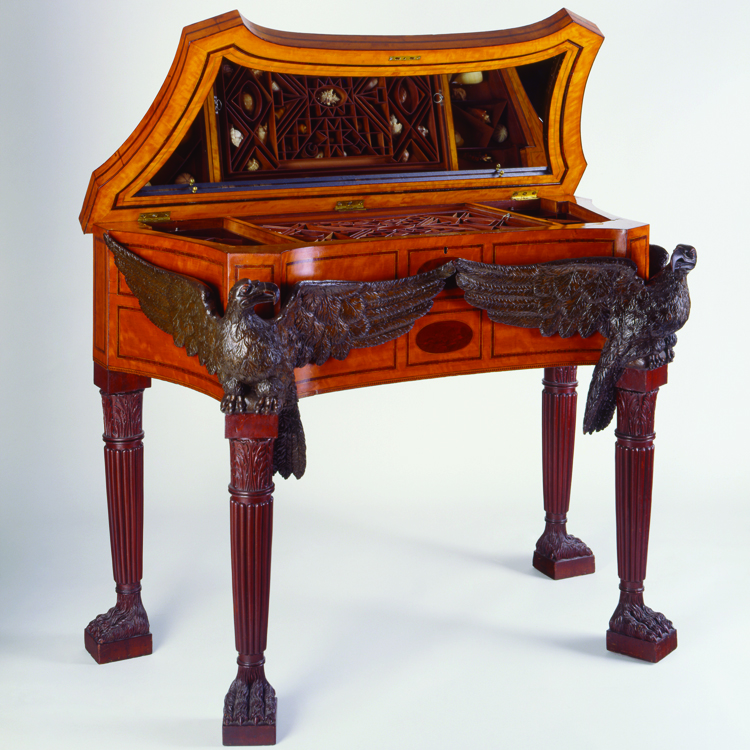
- Fig. 9: Masonic table, attributed to Robert McGuffin (1779/1780–after 1863) for Henry Connelly, Philadelphia, 1806–1811. Wavy satinwood, mahogany, rosewood, light and dark stringing, silvered handles with white pine and yellow poplar. H. 31, W. 47, D. 21¾ in. Courtesy, Winterthur Museum (57.714). Photography by Gavin Ashworth.
McGuffin lived in Newville until 1828, where he and his wife Susan raised five children on what was probably a modest income. In 1818, he purchased a plow and pitchfork to do a little farming to augment his business.8 While in Newville, he signed two pieces of furniture, a desk and a washstand, both made of locally available woods in the more rural styles that appealed to his new clientele, who no doubt had far smaller budgets than the political and business leaders who patronized Connelly’s shop in Philadelphia.9 He brought several suits against local residents for nonpayment for coffins, that staple of general cabinetmaking shops located outside urban centers.10
In 1829 McGuffin moved his business and family to Carlisle, eleven miles to the east. At age fifty-three he filed an insolvency petition to the Cumberland County court, citing “a growing debility” that prevented him from working. Later that year he moved to New Castle, northwest of Pittsburgh and near the Ohio border. Here he lived out the rest of his life with his family, running his business into the 1850s and dying sometime after 1863. In the 1860 census, he is listed as having $1,800 in real estate and $500 in personal estate.11
Scholarship continues to parse out the contributions of cabinetmakers like Robert McGuffin. As usual, these studies raise many unanswered questions. In this case, did McGuffin work in Joseph Barry’s Philadelphia shop before joining Connelly? What is his connection to George G. Wright, a foreman in the Barry shop, making very similar satinwood furniture with rayed tops?12 Can any of the known Egyptian chests be linked to McGuffin and Connelly? What other pieces can be attributed to his hand? The authors intend to explore many of these questions in a continuing study to gain a better understanding of the cabinetwork and the people active in this exuberant period of American history.

Clark Pearce is an independent scholar and consultant to museums and collectors in American arts and is based in Essex, Massachusetts. Merri Lou Schaumann is an independent historian and author based in Carlisle, Pennsylvania. Catherine Ebert is a collector and independent scholar based in Florida.
2. For a thorough study of the Yale sewing table, see David L. Barquist, American Tables and Looking Glasses (New Haven: Yale University Art Gallery, 1992): 290–293. Though Mr. Barquist suggests that the Winterthur sewing table was not made by McGuffin, further study of the larger group of newly identified signed work by him, along with other pieces that can be confidently attributed, make McGuffin’s authorship much more likely.
3. The table was likely made for a Mason. See Nicholas R. Bell, “An Arc of the New Republic,” American Furniture, Chipstone Foundation (2009): 28–41.
4. Deborah Ducoff-Barone, “Checklist of Cabinetmakers and Chairmakers of Philadelphia 1800–1815,” Antiques 139, no.5 (May 1991): 986–95.
5. No furniture is yet known from this partnership, or any furniture made by Anderson before joining McGuffin. Apparently, Anderson was in partnership with Robert Wellford, the English immigrant composition ornament maker, for a brief period in 1805. See Dard Hunter, A Directory of Cabinetmakers and Allied Trades in Philadelphia to 1820,” Winterthur Program in Early American Culture thesis, 1954.
6. The fact that Henry Connelly also married a Delaware woman a few years earlier raises the suspicion that the connection between the two men extended beyond McGuffin’s employment in Connolly’s firm.
7. Prothonotary, Civil Case Papers, 1816 April Term #39. Cumberland County Archives, Cumberland County, PA.
8. Vendue of William Laird, L–33, Cumberland County Register of Wills, filed May 8, 1822.
9. Not illustrated. Photographs in the author’s files.
10. Prothonotary, Justice of the Peace Docket of John Heap (of Newville, PA) Case #804 Nov. 27, 1819, Cumberland County Archives, Cumberland, PA documents McGuffin suing George Geese for $8 for a coffin. (Same JP Docket) Case #805, Nov. 29, 1819. McGuffin suing William Purdy for $9 for a coffin.
11. U.S. Census, 1860: Pollock Township, Lawrence County, Pennsylvania.
12. See Pearce, Ebert and Kirtley “From Apprentice to Master: The Life and Career of Philadelphia Cabinetmaker George G. Wright,” American Furniture, Chipstone Foundation (2007): 110–31.