




Picasso’s Ceramics: When the Master Played with Form
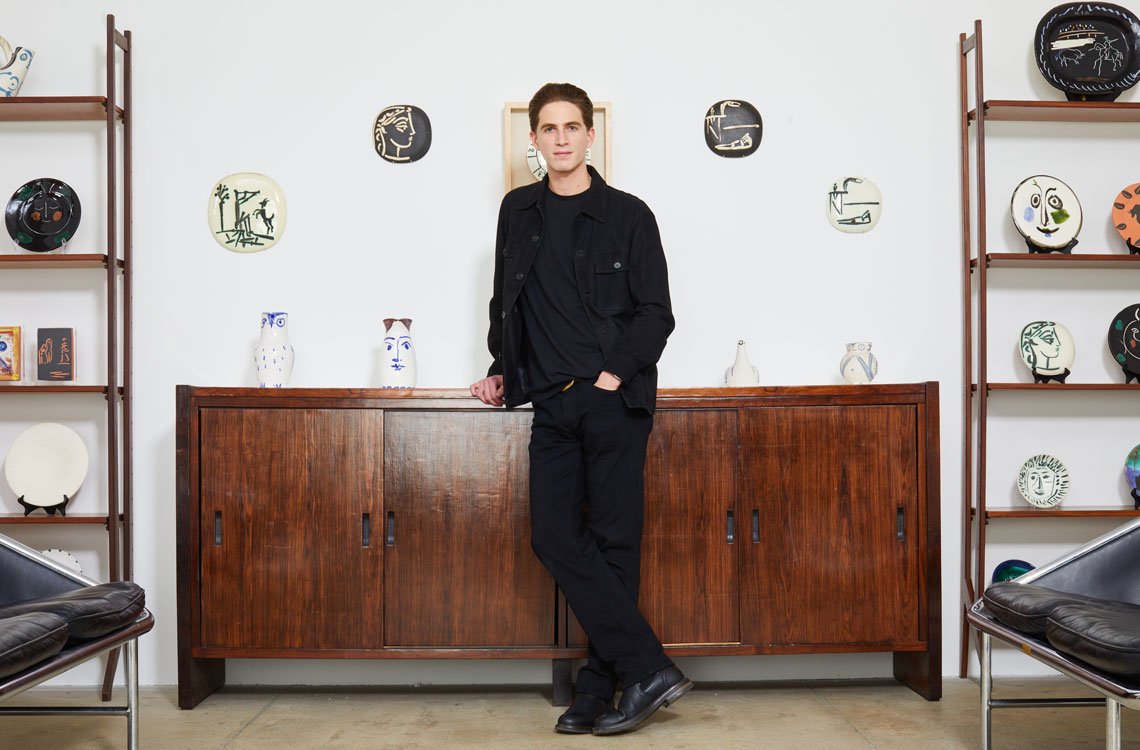 |
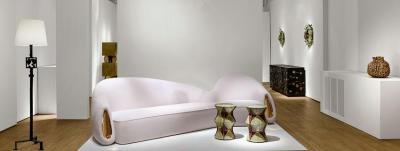
Founder Aaron Katz at Jeans Gallery in the New York Design Center. 23-year-old Katz began buying, selling, and collecting Picasso ceramics as a teenager, following his grandmother’s and parents’ collecting interest in the work. The gallery is named for his late grandmother Jean Katz, an early collector who bought from the Madoura Gallery in the south of France. Photo: Evan Miller |
 |
by Benjamin Genocchio
“Picasso ceramics have been a part of my life and my family for as long as I can remember,” says Aaron Katz, owner of Jeans Gallery on the 10th floor of the New York Design Center in midtown Manhattan. His grandmother, Jean Katz, began collecting Picasso’s ceramics in the 1960s, and his parents went on to amass their own more substantial, world-class collection.
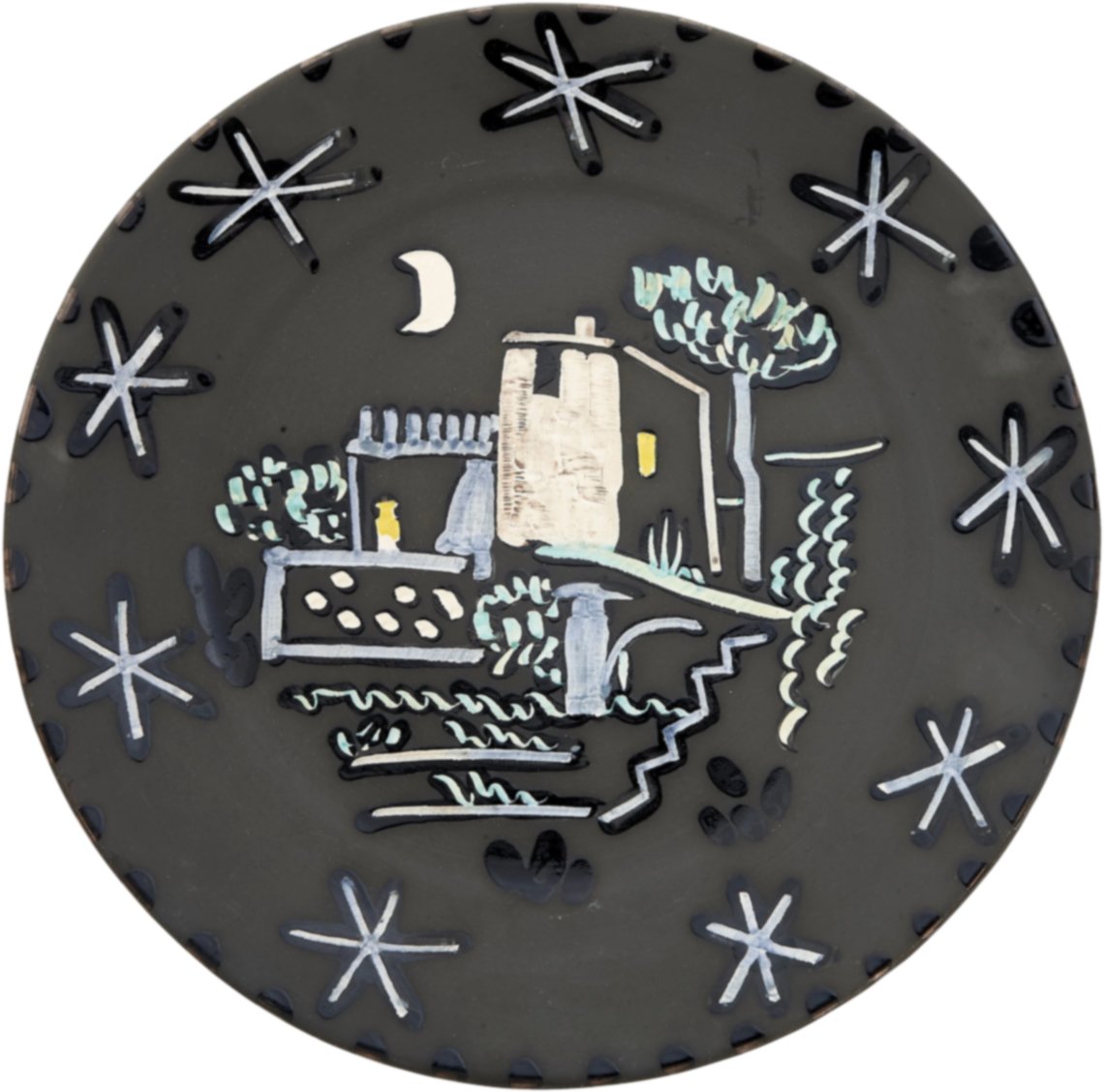 | |
Paysage (A.R. 208), conceived in 1953 and executed in a numbered edition of 200 (16 in.) Photo: David Bear |
Katz, 23, began building his own Picasso ceramics collection as a teenager. “I would buy at auction or on eBay, and as I gained more knowledge about their quality and how to authenticate them, I would sell or trade for better ones,” he says. “I found out I enjoyed the buying and selling part, hunting down rare examples, and sharing them with my family and others. I enjoy working with the material so much that I decided to open a gallery.” Katz opened Jeans Gallery in the The Gallery at 200 Lex in the New York Design Center in 2024. The gallery is named for his grandmother, who he says instilled in him the importance of Picasso’s ceramics. It was not until several international museum shows in the 1990s that Picasso’s ceramics came to be regarded as important artworks in their own right, worthy of display and collection alongside the artist’s other works.
Picasso produced ceramics between 1947 and 1971 in the south of France, where he had lived after leaving Paris at the end of World War II. He created around 4,000 original designs for ceramics, most of which he painted himself at the Madoura Pottery studio in Vallauris, a famous French pottery town. Of these 4,000 original designs, 633 were eventually chosen by the Madoura Pottery Studio team and Picasso to be produced and sold as editions in various sizes. It is estimated that around 120,000 editioned pieces were made at the Madoura Pottery Studio and sold initially as inexpensive souvenirs of the artist’s work to tourists visiting the south of France. “He wasn’t throwing clay pots at the Madoura Studio in Vallauris," Katz explains. “He was there advising and designing the original form and appearance of the ceramics, and then the potters would throw a design in various quantities and paint them.”
Today, the original ceramic pieces produced by Picasso are mostly in museums and fetch enormous prices if and when they ever come up for sale. The editioned pieces are also increasingly difficult to find, for Katz estimates that a good amount have been either lost, broken, or discarded over the decades, making the total number in circulation much less. “It doesn’t feel like there are 120,000 floating about,” he says.
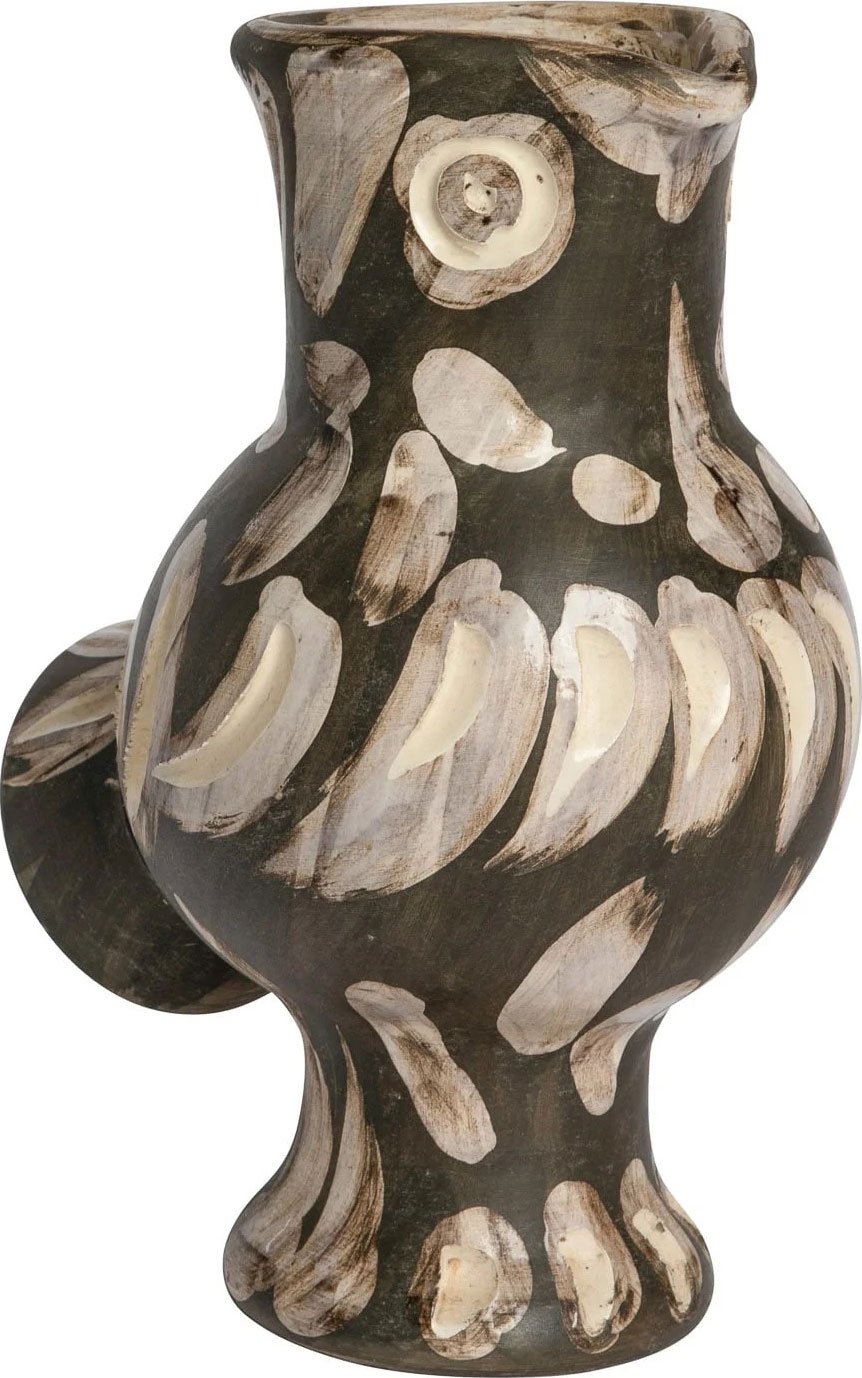 | |
Chouette (A.R. 605), conceived in 1969 and executed in a numbered edition of 500 (12 in.) Photo: David Bear |
Georges and Suzanne Ramié were ceramic artists and the founders of Madoura Pottery studio in Vallauris, where they collaborated with Picasso on the creation of his entire ceramic oeuvre. They wrote the catalog raisonné on Picasso’s ceramics, which remains the ultimate guide to his artwork in clay. It has also become collectible — copies of the book have sold at auction for $8,000.
“Picasso designed most of his ceramics at Vallauris during the first seven years, from the late 1940s up to 1953–54,” Katz says. The artist continued to design ceramics up until 1971, so there is an enormous spectrum of styles and designs. “There is something for everyone when it comes to Picasso ceramics,” Katz says, “which is why I think they have been so popular for decades among interior designers and decorators.”
Katz sees Picasso’s ceramics as something of a turning point in Picasso’s life and career. “Before the 1950s, his art was much more serious and political, and I think after the war, turning to ceramics was an opportunity for him to have fun and enjoy making art again. He was successful, had two young children, and was living in the south of France, so it’s not surprising you find a spirit of joy and playfulness in his ceramics.”
Katz also believes ceramics were a way for the artist to explore ideas of shape, volume, and form in art. “There is an obvious sculptural quality to his Madoura Studio ceramics,” he says, which can be likened to the classical and volumetric figures in his art during the Postwar period. Ceramics were a way to accomplish three-dimensional forms he couldn't do on a two-dimensional canvas.”
With the market embrace of Picasso's ceramics have come copies, false attributions, and even some fakes. The issue is that the unique pieces are sometimes hand-signed by the artist, but most often not. The edition pieces are rarely hand-signed, edition numbers vary, and frequently there are variants and subsections of designs. Most edition pieces were also painted by studio workers at Madoura; therefore, the colors and details vary from piece to piece — a fact that can complicate attribution and authenticity.
“The first thing to look at with the editions is the markings,” Katz says.” There are at least 14 different ways a Picasso ceramic can be stamped or marked as per the catalog raisonné, but even beyond that, there are variations among the stamps which are sometimes also heavily glazed over,” he explains. “You have to look at nuances in the stamps, look at the individual letters in all the words, make sure the word ‘edition’ is in the right font and in the right size, and the overall positioning of the letters,” Katz explains. The edition number is also important in attribution. “You have to see if other examples with higher edition numbers have been sold, for it is not clear that all of the edition numbers were made for each of the design editions. And sometimes you just have to rely on the design of the ceramic itself and the colors; whether it has some age to it. They were all made in the 1950s, 1960s, and 1970s, so if it looks like it was made yesterday, then it is probably a fake.”
,-1952.jpg) | |
Pichet à glace (A.R. 142), conceived in 1952 and executed in a numbered edition of 100 (13 in.) Photo: Evan Miller |
So what are his personal favorites among the designs? “I like it when Picasso takes a basic form and turns it into a representation of something else — like a jug, a form that has its roots in antiquity, but in his hands it is reimagined as a woman’s profile. Or he takes a simple vase and it is brilliantly transformed into an owl. I like how he metamorphoses the shapes, the form of the subject. He respects the traditional shape of these ceramics and then leans creatively into that.” Katz has seen a steady demand for Picasso ceramics since opening the gallery. “I can’t keep up with the demand, there is such a range that they fit into every kind of interior. They look good on fireplaces, coffee tables, and sideboards, while the plates can be framed or hung on walls, so there are a lot of different ways to display them. The vases, especially the owls, look good in groups,” he says.
Picasso’s ceramics are a great way to combine art history and beauty in an interior in a meaningful way. “These are true modern artifacts,” Katz says. Picasso’s ceramics seem to encompass the genres of fine art, design, and craft, which were once separate but today are very much interconnected. “The ceramics fall into this interesting intersection,” Katz says, “and that is where the art and design markets have gone.”