










Charles Dixon
British, 1872 - 1934
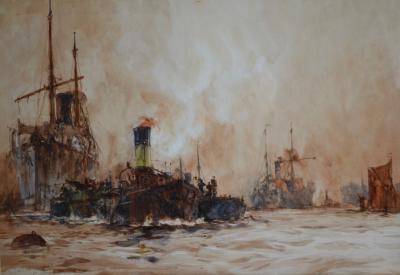
Born on December 8, 1872, and passing away on September 12, 1934, Charles Edward Dixon stands as a prominent British maritime artist who flourished during the late 19th and early 20th centuries. His artistic accomplishments garnered significant acclaim, with his creations regularly gracing the esteemed halls of the Royal Academy's exhibitions. His noteworthy contributions extend to the holdings of the National Maritime Museum, where several of his paintings find a permanent home. Notably, Dixon's artistic prowess found expression not only through static canvases but also within the pages of magazines and periodicals, where his maritime imagery captivated audiences. His abode was nestled in Itchenor, Sussex, a place where he nurtured his passion for sailing. In 1934, this accomplished artist passed away, leaving behind a legacy of seafaring artistry that continues to resonate.
Illustrating the dynamic maritime history, one of his works, a poster, captures the dramatic sinking of RMS Carmania and SMS Cap Trafalgar near Trindade. Dixon's lineage ties him to Alfred Dixon (1842–1919), his father and a successful genre painter who imparted the artistry trade to his son. Charles adeptly followed in his father's footsteps, establishing himself as a professional artist. His repertoire encompassed a spectrum of nautical scenes, including vibrant watercolors depicting coastal life and grand oil paintings that encapsulated historical and contemporary naval subjects. His active participation in the Royal Academy exhibitions solidified his position in the artistic realm, while his creations now reside within the prestigious collection of the National Maritime Museum in London. His artistic journey wasn't confined to traditional mediums; it extended into the realm of magazines and periodicals, most notably, The Graphic.
Dixon's commitment to his craft was recognized with his induction as a member of the Royal Institute of Painters in Water Colours in 1900. Beyond his artistic endeavors, he found solace in the maritime surroundings of Itchenor, Sussex, where he nurtured his affinity for yachting. Ultimately, he drew his last breath at his cherished home on September 12, 1934, leaving behind a legacy that continues to echo through the annals of maritime art history.
Illustrating the dynamic maritime history, one of his works, a poster, captures the dramatic sinking of RMS Carmania and SMS Cap Trafalgar near Trindade. Dixon's lineage ties him to Alfred Dixon (1842–1919), his father and a successful genre painter who imparted the artistry trade to his son. Charles adeptly followed in his father's footsteps, establishing himself as a professional artist. His repertoire encompassed a spectrum of nautical scenes, including vibrant watercolors depicting coastal life and grand oil paintings that encapsulated historical and contemporary naval subjects. His active participation in the Royal Academy exhibitions solidified his position in the artistic realm, while his creations now reside within the prestigious collection of the National Maritime Museum in London. His artistic journey wasn't confined to traditional mediums; it extended into the realm of magazines and periodicals, most notably, The Graphic.
Dixon's commitment to his craft was recognized with his induction as a member of the Royal Institute of Painters in Water Colours in 1900. Beyond his artistic endeavors, he found solace in the maritime surroundings of Itchenor, Sussex, where he nurtured his affinity for yachting. Ultimately, he drew his last breath at his cherished home on September 12, 1934, leaving behind a legacy that continues to echo through the annals of maritime art history.

 Loading...
