


Everett Shinn
American, 1876 - 1953
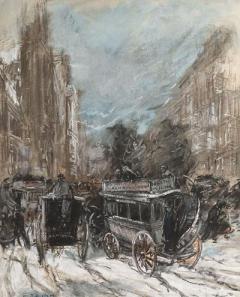
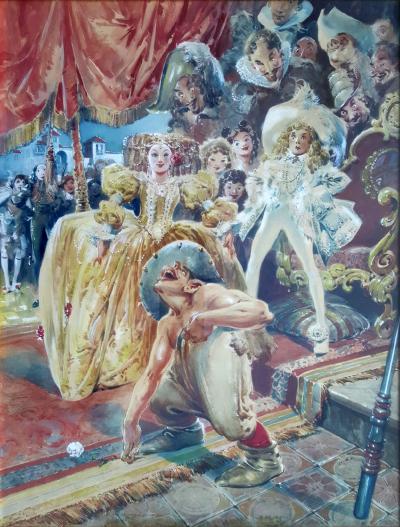
New York, at the turn of the century, was poignantly recorded by a group of pioneering artists commonly referred to as the Ashcan School. The Ashcan School, composed of Robert Henri, William Glackens, George Bellows, George Luks and Everett Shinn, portrayed New York with a fresh and uncompromising manner that was unparalleled at the time. Contrary to prevalent aesthetic theories that touted style and execution, the Ashcan school believed that subject and meaning represented the elements most important to a work; these artists responded reverently to the everyday experiences of urban living.Similar to his colleagues, Everett Shinn investigated the drama of city life whether it was out in the gritty streets or in crowded playhouse. Of the Ashcan school, Shinn is best known as a pastelist, a position of prominence he achieved early in his career. Through his deft handling of the medium, Shinn translated powerful images of city life that had never been fully explored in pastel.Shinn's interest in theater dates back to his childhood in Woodstown, New Jersey, where he faithfully attended local parades, carnivals and shows. Early in his career as a magazine illustrator in Philadelphia, Shinn put on plays at Robert Henri's Walnut Street studio. In New York, Shinn built a small theater in his home on Waverly Place which could seat as many as fiftyfive people. The artist wrote, directed and produced numerous plays as well as organized a group of actors known as "The Waverly Street Players." In his travels to London and Paris in 1900 the artist attended numerous operas, plays and concerts which fostered an even greater fascination with theater. As a result of Shinn's experiences with European entertainment the artist after 1900 began focusing more intently on images of the theater rather than diverse activities of the streets in New York. Shinn was particularly drawn to vaudeville, a form of entertainment comprised of variety shows. Vaudeville since the late nineteenth century, was extremely popular attracting both working and middle class men and woman. By 1912, New York was the national center of vaudeville with prominent theater houses located throughout all the boroughs. Working with pastel, Shinn developed an innovative technique that rendered the medium more dense and painterly, contrary to its conventionally delicate and fragile nature. With a preconceived color composition, Shinn would apply quickly areas of color to a large dampened sheet of paper. As the pigments deed, the delicate, soft quality of the pastel transformed into a hard, opaque medium of intense color. Shinn's superior control of the pastel medium was recognized early on by many critics. A.E. Gallatin commented in 1906: "Shinn is a master of pastel; he knows thoroughly both the possibilities and the limitations of his medium. The material is never strained in endeavoring to get too much out of it; and if technically his pastels are great achievements, pictorially they are also... Shinn has a great contempt for everything academic and does not believe in art schools. This disregard for precedent and academic law has resulted in a decided freshness of vision." (As quoted in E. DeShazo, Everett Shinn: A Figure of His Time, New York, 1974, p. 58-59)Biography courtesy of Roughton Galleries, www.antiquesandfineart.com/roughton
Everett Shinn Paintings
Everett Shinn Paintings
Everett Shinn depicted the grit and glamour of city life, revealing the faceless despair of the unemployment line and the vibrant spectacle of the theatre. Born in New Jersey, Shinn trained at the Pennsylvania Academy of the Fine Arts and began working as an illustrator for "Harper's," "Vanity Fair," and "Life." At the beginning of the twentieth century, he gained prominence as a member of the Ashcan School, or The Eight, a tightly-knit group of artists that included Robert Henri, George Luks, and Ernest Lawson. Connected by their interest in Social Realism and urban subjects, The Eight engineered a radical departure from academic convention. Widely exhibited during his lifetime, Shinn's work is now featured in the Whitney Museum of American Art, the Metropolitan Museum of Art, the Corcoran Gallery of Art, and the Museum of Fine Arts, Boston.
Biography courtesy of Questroyal Fine Art, LLC, www.antiquesandfineart.com/questroyal
Biography courtesy of Questroyal Fine Art, LLC, www.antiquesandfineart.com/questroyal


 Loading...
