









Felix Francois Georges Philibert Ziem
1821 - 1911
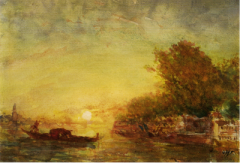
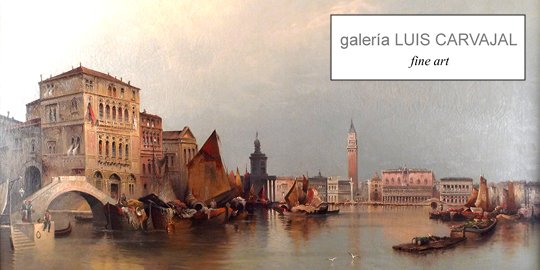
Felix Francois Georges Philibert Ziem (1821-1911) was born in Beaune, France, on the Cote d'Or, in the heart of Burgundy, to a Croatian father and Burgundian mother. He studied at the Ecole d'Architecture de Dijon and for a time was a practicing architect. However, along with painters Guardi and Canaletto, it is the city of Venice to which his name is most closely linked. Venice is the subject of his finest paintings, and composer Frederic Chopin referred to the city as Ziem's spiritual home. Ziem was well-traveled, visiting Algiers, Austria, Belgium, Constantinople, Egypt, England, Greece, Holland, Russia, and Turkey, but it was to Venice that he repeatedly returned.
He was an active participant in the Paris Salons from 1849 on, and made frequent trips to Barbizon, where he lived in a small circus caravan while painting. After 1888 his paintings show the influence of the Barbizon School's naturalistic approach, a greater attention to atmosphere and an increasingly impressionist style. Ziem owned houses in Venice, Martigues, Nice (where he wintered), and on rue Lepic in Paris. Among his students was the young English Princess Victoria, later queen of Britain. Ziem assisted less fortunate artists and established charities, among them an asylum for the blind.
He was the recipient of many awards and honors and was made a Chevalier of the Legion of Honor in 1857 and an Officer of that order in 1878. On his death Ziem bequeathed to the city of Paris a number of studies and drawings from his studio. His paintings are found in museum collections throughout Europe as well as in North America.
He was an active participant in the Paris Salons from 1849 on, and made frequent trips to Barbizon, where he lived in a small circus caravan while painting. After 1888 his paintings show the influence of the Barbizon School's naturalistic approach, a greater attention to atmosphere and an increasingly impressionist style. Ziem owned houses in Venice, Martigues, Nice (where he wintered), and on rue Lepic in Paris. Among his students was the young English Princess Victoria, later queen of Britain. Ziem assisted less fortunate artists and established charities, among them an asylum for the blind.
He was the recipient of many awards and honors and was made a Chevalier of the Legion of Honor in 1857 and an Officer of that order in 1878. On his death Ziem bequeathed to the city of Paris a number of studies and drawings from his studio. His paintings are found in museum collections throughout Europe as well as in North America.
(1821-1911) Felix Ziem was born in Beaume on the Cote d'Or to a Croatian father and a Burgundian mother. He studied at the Ecole d'Architecture de Dijon and was briefly a practicing architect. As a painter, he was active in the Paris Salons beginning in1849. Ziem made frequent trips to Barbizon and after 1888 his paintings show the influence of the Barbizon School's naturalistic approach, along with a greater attention to atmosphere and an increasingly impressionistic style. He was a great traveler, visiting Algiers, Austria, Belgium, Constantinople, Egypt, England, Greece, Holland, Russia, and Turkey, but it was to Venice that he returned time and time again. That city is the subject of his finest paintings, prompting the composer Frederic Chopin to observe that it Venice was Ziem's spiritual home. Indeed, along with the Italian masters Guardi and Canaletto, Ziem's works stand as some of the best evocations of that city ever painted. Ziem owned houses in Venice, Martigues, and Nice, where he wintered, and on rue Lepic in Paris. Among his students was the young English Princess Victoria, later queen of the British Empire. Ziem was known to assist less fortunate artists and established numerous charities, including an asylum for the blind. He was the recipient of many awards and honors, and was made a Chevalier of the Legion of Honor in 1857 and an Officer of that order in 1878. Ziem died in 1911 and was buried in the Pere Lachaise Cemetery in Paris. He bequeathed a collection of his own studies and drawings to the city of Paris, and his paintings are found in museums throughout Europe, England, and North America.
Biography courtesy of Roger King Gallery of Fine Art, www.antiquesandfineart.com/rking
Biography courtesy of Roger King Gallery of Fine Art, www.antiquesandfineart.com/rking

