









Fern Isabel Coppedge
American, 1883 - 1951
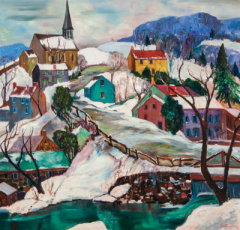
Born Fern Kuns, near Decatur, Illinois, Fern grew up on her family’s farm, a picturesque setting of barns, streams, meadows, and woods. Memories of her childhood (as well as family outings in the snow) would find expression in Coppedge’s paintings of Lumberville and New Hope. Attending the University of Kansas, she met Robert H. Coppedge, a biology professor. The couple married in 1910 and after that Mr. Coppedge mysteriously disappeared from all discussion of the artist. Fern Coppedge studied at the Art Students League with William Merritt Chase in New York and at the Art Students League Summer School under the instruction of John F. Carlson in Woodstock. She then moved to Philadelphia, where she studied with Daniel Garber at the Pennsylvania Academy and under Henry B. Snell at the Philadelphia School of Design for Women. She first visited the New Hope area in 1917 and settled in nearby Lumberville, Pennsylvania, in 1920. Lumberville was also home to Daniel Garber, Clarence Johnson, and William Francis Taylor.
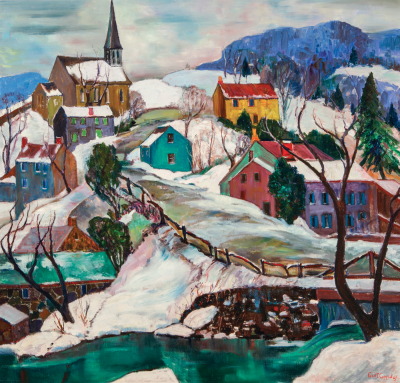
Coppedge was mainly a plein air painter and many of her winter scenes were painted on site or from her car with the back seat removed. It was said by a local art critic for The New Hope magazine in November 1933: “We remember seeing Mrs. Coppedge trudging through the deep snow wrapped in a bearskin coat, her sketching materials slung over her shoulder, her blue eyes sparkling with the joy of life”.
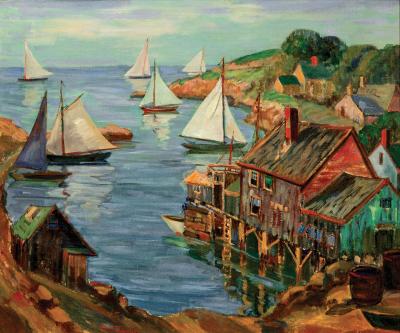
Coppedge divided her time between her home named “Boxwood Studio” in Lumberville, her studio in Gloucester where she often spent summers, and a studio in Philadelphia which she used during exhibitions. She joined “The Philadelphia Ten” in 1922 and exhibited regularly with them through 1935. In the summer of 1925, Coppedge traveled abroad to paint Italy. Upon her return, she exhibited with “The Philadelphia Ten” in 1926. Among the show’s most popular works were Coppedge’s paintings of the Arno River in Florence.
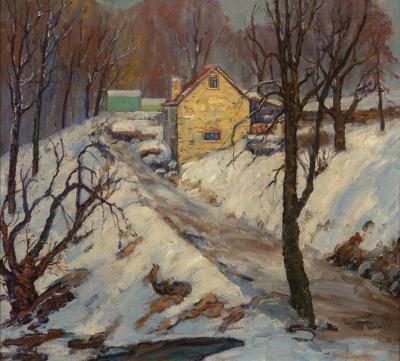
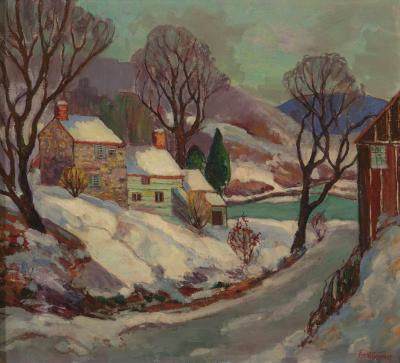
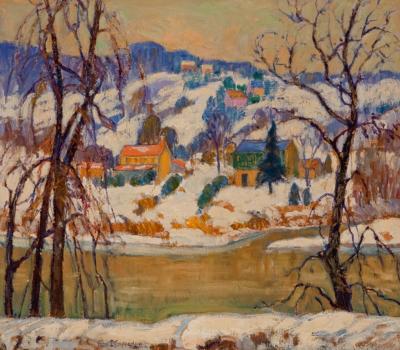
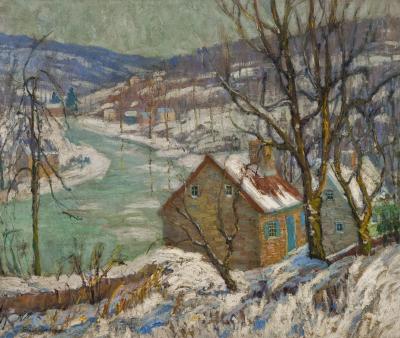
Coppedge has become the most well-known woman in connection with the Pennsylvania Impressionists. She has of late been labeled a colorist, crossing impressionism with modernism. Her bold and unorthodox use of bright vibrant colors, combined with a rich impasto and sophisticated but primitive technique, affords her paintings an innate sense of quality and charm proven to be extremely popular among both critics and collectors alike.
Sources:
New Hope for American Art, James Alterman
Sunday Times Advertiser, Trenton, NJ. October 16, 1949
Sunday Times Advertiser, Trenton, NJ. March 30, 1930
Jim’s of Lambertville Archives, 2005
The New Hope Magazine, November 1933
fern-coppedge-paintings-art
Coppedge was mainly a plein air painter and many of her winter scenes were painted on site or from her car with the back seat removed. It was said by a local art critic for The New Hope magazine in November 1933: “We remember seeing Mrs. Coppedge trudging through the deep snow wrapped in a bearskin coat, her sketching materials slung over her shoulder, her blue eyes sparkling with the joy of life”.
Coppedge divided her time between her home named “Boxwood Studio” in Lumberville, her studio in Gloucester where she often spent summers, and a studio in Philadelphia which she used during exhibitions. She joined “The Philadelphia Ten” in 1922 and exhibited regularly with them through 1935. In the summer of 1925, Coppedge traveled abroad to paint Italy. Upon her return, she exhibited with “The Philadelphia Ten” in 1926. Among the show’s most popular works were Coppedge’s paintings of the Arno River in Florence.
Coppedge has become the most well-known woman in connection with the Pennsylvania Impressionists. She has of late been labeled a colorist, crossing impressionism with modernism. Her bold and unorthodox use of bright vibrant colors, combined with a rich impasto and sophisticated but primitive technique, affords her paintings an innate sense of quality and charm proven to be extremely popular among both critics and collectors alike.
Sources:
New Hope for American Art, James Alterman
Sunday Times Advertiser, Trenton, NJ. October 16, 1949
Sunday Times Advertiser, Trenton, NJ. March 30, 1930
Jim’s of Lambertville Archives, 2005
The New Hope Magazine, November 1933
fern-coppedge-paintings-art

 Loading...
