










Frederick R. Wagner
American, 1864 - 1940
Frederick R. Wagner was born on December 20, 1860 to Conrad S., a saloonkeeper, and his wife Antonio Ackerman Wagner' of Port Kennedy, Pennsylvania. Wagner studied with Thomas Eakins at the Pennsylvania Academy of the Fine Arts, Philadelphia, from 1879 to 1884, and then worked as a demonstrator in anatomy under Eakins and Thomas Anshutz.
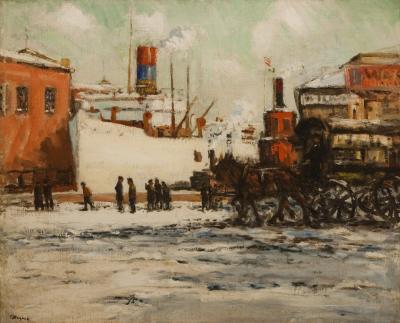
An early American impressionist, Wagner painted in California in the late 1800s and in the Philadelphia area in the early 1900s. Around 1902, he became an illustrator for the Philadelphia Press. He was known for his urban scenes, especially his series of Pennsylvania Railroad pictures. He also created landscapes around New Hope and in Canada and France.
Wagner taught at the Pennsylvania Academy's summer school at Chester Springs, Pennsylvania, for seven years, and then founded the Addingham Summer School of Outdoor Painting. His works were in the annual exhibitions of the Pennsylvania Academy first in 1882 and consistently every year from 1906 to 1940, and in the biennial exhibitions of the Corcoran Gallery of Art, Washington, D.C., between 1907 and 1935. In 1913 he had two works in the landmark Armory Show in New York. Wagner was awarded the Pennsylvania Academy's fellowship prize in 1914, and in 1922 he won an honorable mention at the international exhibition of the Carnegie Institute in Pittsburgh.
Wagner was a member of the Philadelphia Sketch Club, the Philadelphia Water Color Club, and the Philadelphia Art Alliance. His paintings are in the collections of the Reading Public Museum, the Pennsylvania Academy, and the Cleveland Museum of Art.
Wagner died on January 14, 1940.
Biography courtesy of Roughton Galleries, www.antiquesandfineart.com/roughton
An early American impressionist, Wagner painted in California in the late 1800s and in the Philadelphia area in the early 1900s. Around 1902, he became an illustrator for the Philadelphia Press. He was known for his urban scenes, especially his series of Pennsylvania Railroad pictures. He also created landscapes around New Hope and in Canada and France.
Wagner taught at the Pennsylvania Academy's summer school at Chester Springs, Pennsylvania, for seven years, and then founded the Addingham Summer School of Outdoor Painting. His works were in the annual exhibitions of the Pennsylvania Academy first in 1882 and consistently every year from 1906 to 1940, and in the biennial exhibitions of the Corcoran Gallery of Art, Washington, D.C., between 1907 and 1935. In 1913 he had two works in the landmark Armory Show in New York. Wagner was awarded the Pennsylvania Academy's fellowship prize in 1914, and in 1922 he won an honorable mention at the international exhibition of the Carnegie Institute in Pittsburgh.
Wagner was a member of the Philadelphia Sketch Club, the Philadelphia Water Color Club, and the Philadelphia Art Alliance. His paintings are in the collections of the Reading Public Museum, the Pennsylvania Academy, and the Cleveland Museum of Art.
Wagner died on January 14, 1940.
Biography courtesy of Roughton Galleries, www.antiquesandfineart.com/roughton
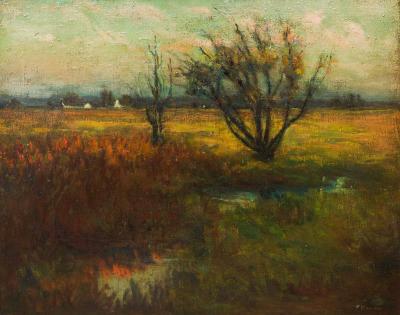
Frederick R. Wagner
"Evening Pasture" | Frederick Wagner (American, 1864-1940)
H 31 in W 37 in
$ 4,200
 Loading...
