


Georges Braque
French, 1882 - 1963
Georges Braque (1882–1963) was a groundbreaking French artist whose work played a key role in shaping the course of modern art. Born in Argenteuil, France, he began his career training in decorative painting before pursuing fine art studies in Le Havre and Paris. Initially influenced by the bold colors and expressive brushwork of the Fauves, Braque quickly shifted his focus to structure and form.
In 1907, inspired by Paul Cézanne’s geometric approach to nature, Braque began a close collaboration with Pablo Picasso. Together, they developed Cubism, a revolutionary style that fragmented objects into flattened, abstracted planes and multiple viewpoints. This new visual language challenged traditional representation and laid the groundwork for countless modernist movements.
Braque was also the originator of papier collé, a technique in which he incorporated cut paper and found materials into his compositions—an innovation that directly influenced collage in modern art. His work extended beyond painting to include drawing, sculpture, printmaking, and later in life, stained glass and stage design.
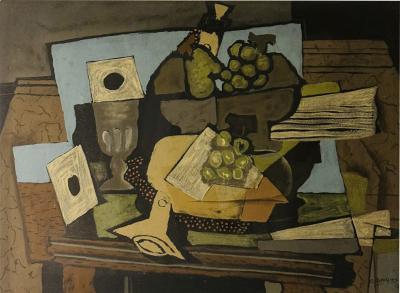
After serving in World War I and recovering from serious injuries, Braque returned to painting with a softened Cubist style, embracing more naturalistic elements while maintaining his commitment to structure and harmony. Over the following decades, he created a rich body of still lifes and interiors, marked by lyrical color and spatial complexity.
In 1961, Braque became the first living artist to have a solo exhibition at the Louvre. He died in 1963, leaving behind a legacy as one of the most influential and inventive figures in 20th-century art.
In 1907, inspired by Paul Cézanne’s geometric approach to nature, Braque began a close collaboration with Pablo Picasso. Together, they developed Cubism, a revolutionary style that fragmented objects into flattened, abstracted planes and multiple viewpoints. This new visual language challenged traditional representation and laid the groundwork for countless modernist movements.
Braque was also the originator of papier collé, a technique in which he incorporated cut paper and found materials into his compositions—an innovation that directly influenced collage in modern art. His work extended beyond painting to include drawing, sculpture, printmaking, and later in life, stained glass and stage design.
After serving in World War I and recovering from serious injuries, Braque returned to painting with a softened Cubist style, embracing more naturalistic elements while maintaining his commitment to structure and harmony. Over the following decades, he created a rich body of still lifes and interiors, marked by lyrical color and spatial complexity.
In 1961, Braque became the first living artist to have a solo exhibition at the Louvre. He died in 1963, leaving behind a legacy as one of the most influential and inventive figures in 20th-century art.
200


Sold


 Loading...
