









Hendrik-Dirk Kruseman Van Elten
Dutch, 1829 - 1904
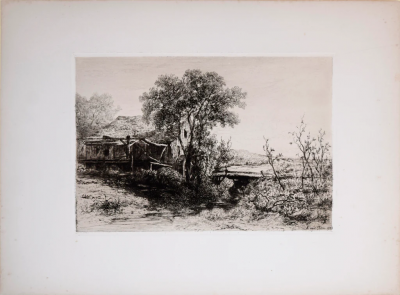
A painter of refined, meticulously-rendered landscapes, Hendrik-Dirk Kruseman Van Elten enjoyed a prominent career in the second half of the nineteenth century. Born in Holland, Van Elten received formal training from the Haarlem painter Cornelius Lieste and culled artistic inspiration from his travels through Germany, France, Switzerland, and Belgium. He achieved great success in the Netherlands before immigrating to the United States in 1865: his early career was marked by his election to the Royal Academies of Amsterdam and Rotterdam and by the Gold Medal that he won at the Amsterdam International Exposition of 1860. Once in the United States, Van Elten became a fixture in New York City's famed Tenth Street Studio Building. The building housed the dominant figures in American art, and Van Elten worked alongside such innovative painters as Frederick Church, Albert Bierstadt, and William Merritt Chase. Alternating between epic landscapes and more intimate scenes, Van Elten's sensitive depictions of the natural world earned him his own renown.
Van Elten was instrumental in introducing the precepts of the Dutch Golden Age to American audiences. In his landscapes, he employed Dutch techniques - boldly horizontal formats, low horizons, and an emphasis on wide, open space - to construct tranquil images of untouched, American nature. He tempered their composed quality with the brilliant light and color of the Hudson River School, mixing traditional elements with a more contemporary style.
Van Elten's paintings were exhibited for over thirty years at the National Academy of Design, where he was named an Associate and an Academician. He helped to found the American Watercolor Society and the New York Etching Club and was a member of the Brooklyn Art Association and the British Society of Painter-Etchers in London. He also exhibited at institutions throughout the United States, including the Boston Art Club, the Pennsylvania Academy, the Art Institute of Chicago, and the Denver Artists Club. Today, his work can be found in such important collections as the National Academy of Design Museum, The Brooklyn Museum of Art, and the Museum of Fine Arts, Boston.
Biography courtesy of Questroyal Fine Art, LLC, www.antiquesandfineart.com/questoroyal
Van Elten was instrumental in introducing the precepts of the Dutch Golden Age to American audiences. In his landscapes, he employed Dutch techniques - boldly horizontal formats, low horizons, and an emphasis on wide, open space - to construct tranquil images of untouched, American nature. He tempered their composed quality with the brilliant light and color of the Hudson River School, mixing traditional elements with a more contemporary style.
Van Elten's paintings were exhibited for over thirty years at the National Academy of Design, where he was named an Associate and an Academician. He helped to found the American Watercolor Society and the New York Etching Club and was a member of the Brooklyn Art Association and the British Society of Painter-Etchers in London. He also exhibited at institutions throughout the United States, including the Boston Art Club, the Pennsylvania Academy, the Art Institute of Chicago, and the Denver Artists Club. Today, his work can be found in such important collections as the National Academy of Design Museum, The Brooklyn Museum of Art, and the Museum of Fine Arts, Boston.
Biography courtesy of Questroyal Fine Art, LLC, www.antiquesandfineart.com/questoroyal


