










Jean-Francois Millet
French, 1814 - 1875
Jean-François Millet, born in 1814 in the Norman village of Gruchy, was the eldest of a large farming family. His parents prioritized education, fostering his early interest in literature and the arts. In 1833, he began training with local portrait painter Bon Dumouchel and later studied under Lucien-Théophile Langlois. By 1837, Millet moved to Paris to attend the École des Beaux-Arts, studying under Paul Delaroche.
After a challenging start as a portrait artist, he moved back to Cherbourg before settling in Paris with his wife, Pauline-Virginie Ono. His early works reflected the influence of Spanish painters he encountered at the Louvre. Following the tragic loss of his wife to tuberculosis, Millet shifted his focus to rural scenes, employing a technique known as manière fleurie to appeal to a wider audience.
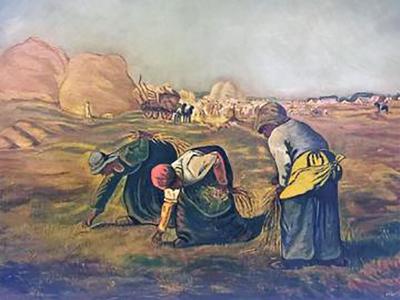
In 1849, Millet joined fellow artists in Barbizon, devoting himself to depicting rural life. His groundbreaking works, such as "The Sower" and "The Gleaners," imbued agricultural labor with dignity and symbolism, garnering both acclaim and controversy. He became a prominent figure in the Barbizon School, creating compositions that reflected the nobility of the peasantry while integrating personal memories from his childhood in Normandy.
Millet's later works increasingly featured landscapes and were characterized by emotional depth, influencing artists like Vincent van Gogh. Despite a humble lifestyle, his success grew through exhibitions in Paris and abroad, leading to his acceptance into the international art community.
Millet's art, rooted in the social realities of peasant life, transcended mere realism. He idealized rural existence with a focus on formal qualities, striking drawing, and inventive composition. He died on January 20, 1875, and was buried in Barbizon, leaving behind a legacy that shaped the depiction of rural life in art.
After a challenging start as a portrait artist, he moved back to Cherbourg before settling in Paris with his wife, Pauline-Virginie Ono. His early works reflected the influence of Spanish painters he encountered at the Louvre. Following the tragic loss of his wife to tuberculosis, Millet shifted his focus to rural scenes, employing a technique known as manière fleurie to appeal to a wider audience.
In 1849, Millet joined fellow artists in Barbizon, devoting himself to depicting rural life. His groundbreaking works, such as "The Sower" and "The Gleaners," imbued agricultural labor with dignity and symbolism, garnering both acclaim and controversy. He became a prominent figure in the Barbizon School, creating compositions that reflected the nobility of the peasantry while integrating personal memories from his childhood in Normandy.
Millet's later works increasingly featured landscapes and were characterized by emotional depth, influencing artists like Vincent van Gogh. Despite a humble lifestyle, his success grew through exhibitions in Paris and abroad, leading to his acceptance into the international art community.
Millet's art, rooted in the social realities of peasant life, transcended mere realism. He idealized rural existence with a focus on formal qualities, striking drawing, and inventive composition. He died on January 20, 1875, and was buried in Barbizon, leaving behind a legacy that shaped the depiction of rural life in art.


 Loading...
