




Jerome Myers
American, 1867 - 1940
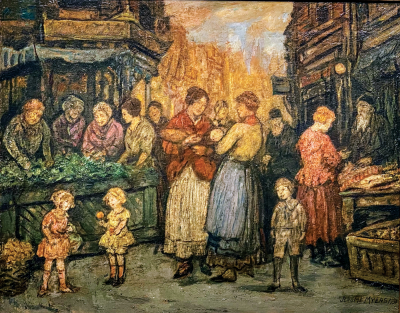
Originally from Petersburg, Virginia, Jerome Myers began his career as a sign painter in Baltimore. After moving to New York City in 1886, he earned a living by painting theater sets and working in the art department of the Herald Tribune while taking night classes at Cooper Union and the Art Students League, where he studied under George de Forest Brush.
About 1906, Myers became affiliated with the New York realists, later known as the Ashcan School. He was especially close to John Sloan who encouraged him to paint outdoors and who introduced him to the other painters in the group. Although not an official member of this group, Myers was one of the first American artists to depict the changing urban scene in the early twentieth century. He portrayed the tenements and immigrant populations of New York City's Lower East Side in a realistic style, yet his works are unique in their concentration on picturesque and charming moments of city life.
Myers painted with Impressionist brushwork and light colors, and many of his works appear glittering, almost bejeweled. He used a quick, sketchy technique, conveying the movement of crowds and the colors of marketplaces or outdoor concerts. His work expresses the optimism and novelty of modern life rather than its harshness or trials. Myers was instrumental in the organization of the famous Armory Show in 19l3, and his work was exhibited in it alongside that of well-known Ashcan School painters.
Biography courtesy of Roughton Galleries, www.antiquesandfineart.com/roughton
About 1906, Myers became affiliated with the New York realists, later known as the Ashcan School. He was especially close to John Sloan who encouraged him to paint outdoors and who introduced him to the other painters in the group. Although not an official member of this group, Myers was one of the first American artists to depict the changing urban scene in the early twentieth century. He portrayed the tenements and immigrant populations of New York City's Lower East Side in a realistic style, yet his works are unique in their concentration on picturesque and charming moments of city life.
Myers painted with Impressionist brushwork and light colors, and many of his works appear glittering, almost bejeweled. He used a quick, sketchy technique, conveying the movement of crowds and the colors of marketplaces or outdoor concerts. His work expresses the optimism and novelty of modern life rather than its harshness or trials. Myers was instrumental in the organization of the famous Armory Show in 19l3, and his work was exhibited in it alongside that of well-known Ashcan School painters.
Biography courtesy of Roughton Galleries, www.antiquesandfineart.com/roughton

 Loading...
