










John Edward Costigan
American, 1888 - 1972
Excerpts from: John E. Costigan: An Artist of Rich Contrasts
By Carol Sims
Born in the latter part of the Nineteenth Century, Costigan fought in World War I, survived the loss of his livelihood during the Great Depression, and witnessed the ascendancy of industry and technology—including the production-line automobile, spacecraft, and computers. In this maelstrom of events, there were also tumultuous changes in art. Impressionism, once revolutionary, began to look passé—almost quaint—with the staggered ascent of Cubism and Surrealism, then Abstract Expressionism and Pop Art.
During these momentous upheavals, Costigan’s impressionistic figural art continued to win awards and be lauded by his peers. John Edward Costigan lived for eighty-four years, winning forty-six awards from 1920 to 1972, the year of his death. Throughout his life, the artist was true to himself, courageous in the face of financial disaster, and resourceful.
Born in Providence, Rhode Island to Irish-American parents on February 29, 1888, life never afforded Costigan the opportunity to pursue an academic education in art, but for a few weeks he studied under William Merritt Chase and George Bridgeman at the Arts Students League in New York City. This was the extent of his formal art instruction. Costigan did however find other means to hone his skills and experience the camaraderie of other artists, spending nights sketching live models at the Kit Kat Club, a studio on 14th Street that was a favorite haunt of newspaper artists and illustrators. Costigan had confidence that he could learn what he needed to learn from a rigorous discipline of self-teaching—that if he worked hard enough he could develop his own talent. By the time he was thirty years old, Costigan had exhibited at the Corcoran Gallery of Washington D.C., as well as the McDowell Club and Babcock Gallery, both of New York City. His career was well on its way when World War I came along and he enlisted in the army, serving in the 52nd “Pioneer” Infantry Division in France.
In 1928, his illustrious peers at the National Academy of Design brought Costigan into the fold—acknowledging him as their equal—by bestowing upon the artist the distinction of National Academician. This was (and remains) one of the highest honors to be accorded to an American artist. The fact that Costigan achieved the distinction of National Academician with no formal art education is a testament to his talent and work ethic.
By Carol Sims
Born in the latter part of the Nineteenth Century, Costigan fought in World War I, survived the loss of his livelihood during the Great Depression, and witnessed the ascendancy of industry and technology—including the production-line automobile, spacecraft, and computers. In this maelstrom of events, there were also tumultuous changes in art. Impressionism, once revolutionary, began to look passé—almost quaint—with the staggered ascent of Cubism and Surrealism, then Abstract Expressionism and Pop Art.
During these momentous upheavals, Costigan’s impressionistic figural art continued to win awards and be lauded by his peers. John Edward Costigan lived for eighty-four years, winning forty-six awards from 1920 to 1972, the year of his death. Throughout his life, the artist was true to himself, courageous in the face of financial disaster, and resourceful.
Born in Providence, Rhode Island to Irish-American parents on February 29, 1888, life never afforded Costigan the opportunity to pursue an academic education in art, but for a few weeks he studied under William Merritt Chase and George Bridgeman at the Arts Students League in New York City. This was the extent of his formal art instruction. Costigan did however find other means to hone his skills and experience the camaraderie of other artists, spending nights sketching live models at the Kit Kat Club, a studio on 14th Street that was a favorite haunt of newspaper artists and illustrators. Costigan had confidence that he could learn what he needed to learn from a rigorous discipline of self-teaching—that if he worked hard enough he could develop his own talent. By the time he was thirty years old, Costigan had exhibited at the Corcoran Gallery of Washington D.C., as well as the McDowell Club and Babcock Gallery, both of New York City. His career was well on its way when World War I came along and he enlisted in the army, serving in the 52nd “Pioneer” Infantry Division in France.
In 1928, his illustrious peers at the National Academy of Design brought Costigan into the fold—acknowledging him as their equal—by bestowing upon the artist the distinction of National Academician. This was (and remains) one of the highest honors to be accorded to an American artist. The fact that Costigan achieved the distinction of National Academician with no formal art education is a testament to his talent and work ethic.
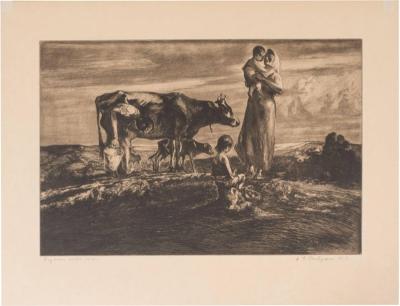
John Edward Costigan
John Costigan Signed Original Pastoral Etching by John E. Costigan Circa 1930
H 14 in W 18 in D 1 in
$ 1,245

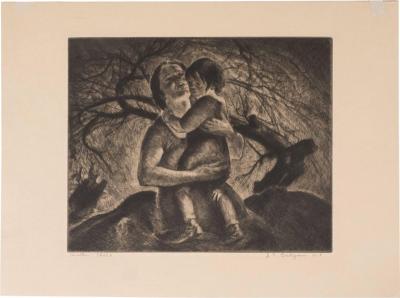
John Edward Costigan
"Mother and Child" A Signed Limited Edition Etching by John E. Costigan
H 14 in W 18 in D 1 in
$ 1,245

John Edward Costigan
"Woman, Boy and Goats", Original Signed Etching by John E. Costigan Circa 1930
H 12 in W 17 in D 1 in
$ 1,245
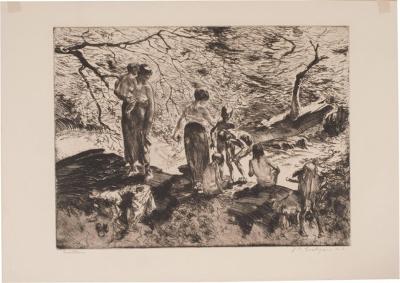
John Edward Costigan
"Bathers" by John E. Costigan, Original Limited Edition Signed Etching
H 12 in W 17 in D 1 in
$ 1,245
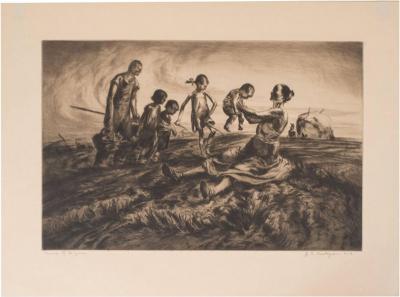
Sold
 Loading...
