







John La Farge
American, 1835 - 1910
Artist Bio: John La Farge
John La Farge (1835-1910) was a multifaceted American artist renowned for his contributions as a painter, stained-glass designer, muralist, and illustrator. Born into affluence in New York City, La Farge initially pursued a law degree at Mount St. Mary's College before shifting his focus to art in 1858. His artistic journey began in Paris, where he mingled with leading French artists, studied Old Masters at the Louvre, and was influenced by modern color theories. He briefly studied under Thomas Couture and was further inspired by Romantic and Pre-Raphaelite works in England.
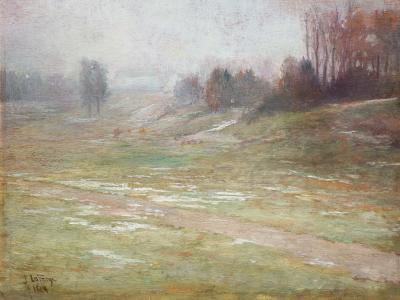
After returning to the U.S., La Farge settled in Newport, Rhode Island, studying under the American Barbizon painter William Morris Hunt. This period marked the start of his dedication to painting from nature, creating landscapes and floral still lifes characterized by a modern, fluid approach.
During the 1870s and 1880s, La Farge's prolific output included oils, watercolors, and book illustrations, as well as significant mural and stained-glass projects for religious institutions, including Trinity Church in Boston. His notable masterpiece, "Ascension," was completed in 1885 for the Church of the Ascension in New York City. His stained-glass work extended to landmarks such as the Baltimore Courthouse and the Capitol Building in St. Paul, Minnesota.
La Farge's artistic influence was also felt through his writings, with "Considerations on Painting" published in 1895 based on lectures at the Metropolitan Museum of Art. He was a key figure in the Aesthetic Movement and the mural revival, experimenting with glass overlay techniques and producing thousands of stained-glass windows throughout his career. La Farge passed away in 1910, leaving a lasting legacy in American art.
John La Farge (1835-1910) was a multifaceted American artist renowned for his contributions as a painter, stained-glass designer, muralist, and illustrator. Born into affluence in New York City, La Farge initially pursued a law degree at Mount St. Mary's College before shifting his focus to art in 1858. His artistic journey began in Paris, where he mingled with leading French artists, studied Old Masters at the Louvre, and was influenced by modern color theories. He briefly studied under Thomas Couture and was further inspired by Romantic and Pre-Raphaelite works in England.
After returning to the U.S., La Farge settled in Newport, Rhode Island, studying under the American Barbizon painter William Morris Hunt. This period marked the start of his dedication to painting from nature, creating landscapes and floral still lifes characterized by a modern, fluid approach.
During the 1870s and 1880s, La Farge's prolific output included oils, watercolors, and book illustrations, as well as significant mural and stained-glass projects for religious institutions, including Trinity Church in Boston. His notable masterpiece, "Ascension," was completed in 1885 for the Church of the Ascension in New York City. His stained-glass work extended to landmarks such as the Baltimore Courthouse and the Capitol Building in St. Paul, Minnesota.
La Farge's artistic influence was also felt through his writings, with "Considerations on Painting" published in 1895 based on lectures at the Metropolitan Museum of Art. He was a key figure in the Aesthetic Movement and the mural revival, experimenting with glass overlay techniques and producing thousands of stained-glass windows throughout his career. La Farge passed away in 1910, leaving a lasting legacy in American art.

 Loading...
