

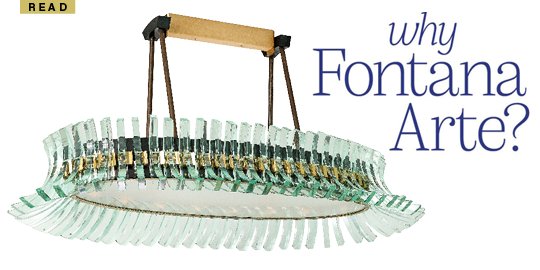
Why Fontana Arte?
 |
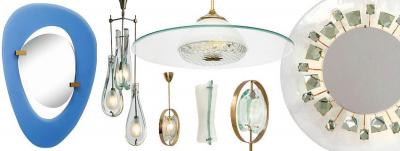
Established in Milan in 1932, Fontana Arte remains one of the great success stories of 20th-century Italian design. Its co-founder and first artistic director, Gio Ponti, designed the iconic Bilia lamp as well as the 1932 coffee table. Pietro Chiesa succeeded him as artistic director in 1933 and designed over a thousand objects, some of which are still in production today, including the Cartoccio vase (1932) and the Luminator floor lamp (1933). In the Post-War era, Max Ingrand took Fontana Arte to a new level of innovation and commercial success, and his Abat-Jour table lamp is the most iconic of all their many lights. Gae Aulenti, Renzo Piano, and Paula Navone were some of the other designers who contributed to the brand in the following decades. Incollect asked four dealers why Fontana Arte is so exceptional and why it remains worth collecting today.
 | 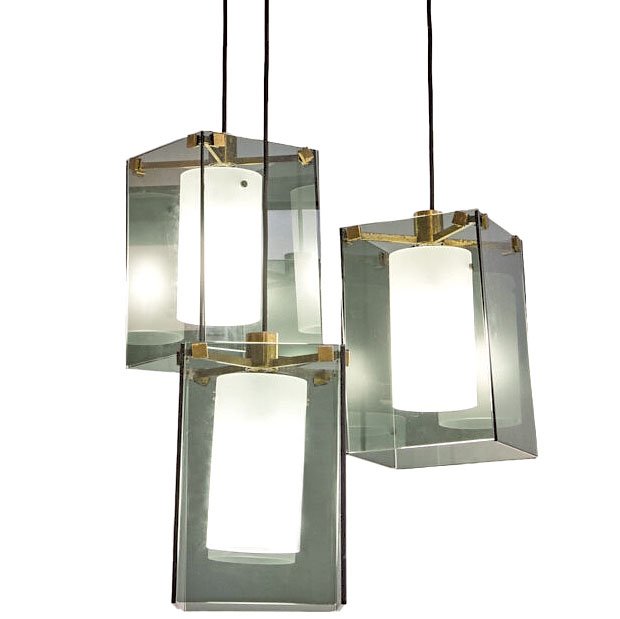 | |
Left: Rare pair of sconces by Max Ingrand for Fontana Arte. Frosted conical glass shade with beveled edge, deeply beveled crystal finial, 3-prong trident mount in polished brass. Italy, circa 1955. Available from Maison Rapin on Incollect.com. Photo: courtesy Maison Rapin. Right: Model No. 2210 adjustable 3-light pendant by Max Ingrand for Fontana Arte. Smokey tinted glass shades with frosted glass diffuser, brass structure. Each pendant drop can be adjusted independently. Italy, circa 1960. Available from Maison Rapin on Incollect.com. Photo: courtesy Maison Rapin. | ||
How would you explain the importance of Fontana Arte in the history of design to a new collector?
Fontana Arte is a real ‘must have’ for any true collector — not only did it quickly become (and then remain) the most important modern glass designer in Italy, but it was the first to adopt a true design-oriented approach to production. Rather than producing practical commercial or decorative glass, the company aimed to create a wide range of refined objects and lighting pieces in which design was absolutely central.
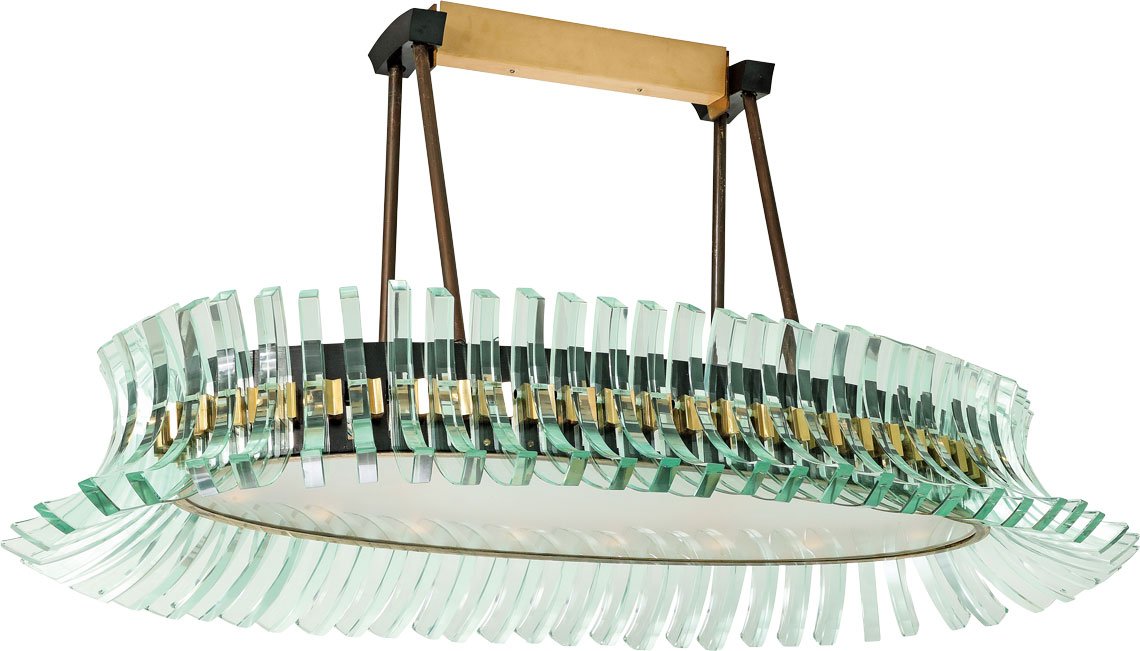 |
Model No. 1880 chandelier by Max Ingrand for Fontana Arte. A tour de force of a fixture, and a very rare model. Glass, frosted glass, brass, and painted metal with 60 crystal glass fins. Italy, circa 1956. Available from Donzella on Incollect.com. Photo: courtesy Donzella Ltd. |
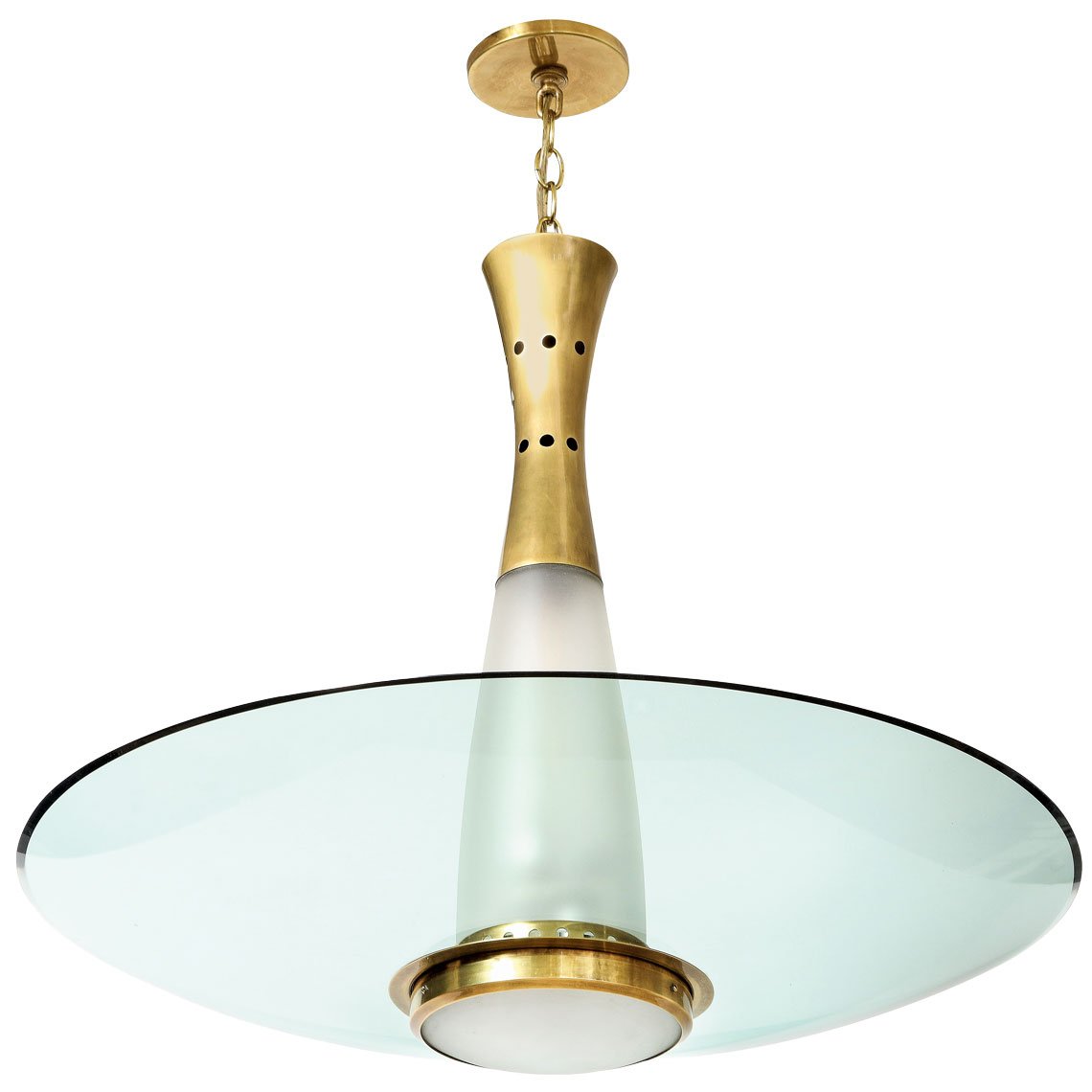 | |
Rare Frosted Cone Chandelier by Max Ingrand for Fontana Arte. A beautiful and rare model. Colored glass, frosted glass, and brass. Italy, circa 1955. Available from Donzella on Incollect.com. Photo: courtesy Donzella Ltd. |
What is different and special about Fontana Arte?
At the core of the company’s work is plate glass. Before Luigi Fontana and Gio Ponti partnered to create Fontana Arte in 1932, Fontana had a thriving business supplying plate glass, which was a technological innovation at that time, for modern buildings. Plate glass remained an intrinsic and distinctive part of the company’s ethos and brand style.
Can anyone afford to buy a work of Fontana Arte?
While their pieces were so chic and appeared to be expensive, most were modestly priced and intended for popular distribution. Their guiding belief was that everyone should be able to have elements of luxury in their home. As a result, while there are many models that remain rare and are therefore expensive, there are also many models that were huge sellers and can readily be found on the secondary market. Some are still in production today.
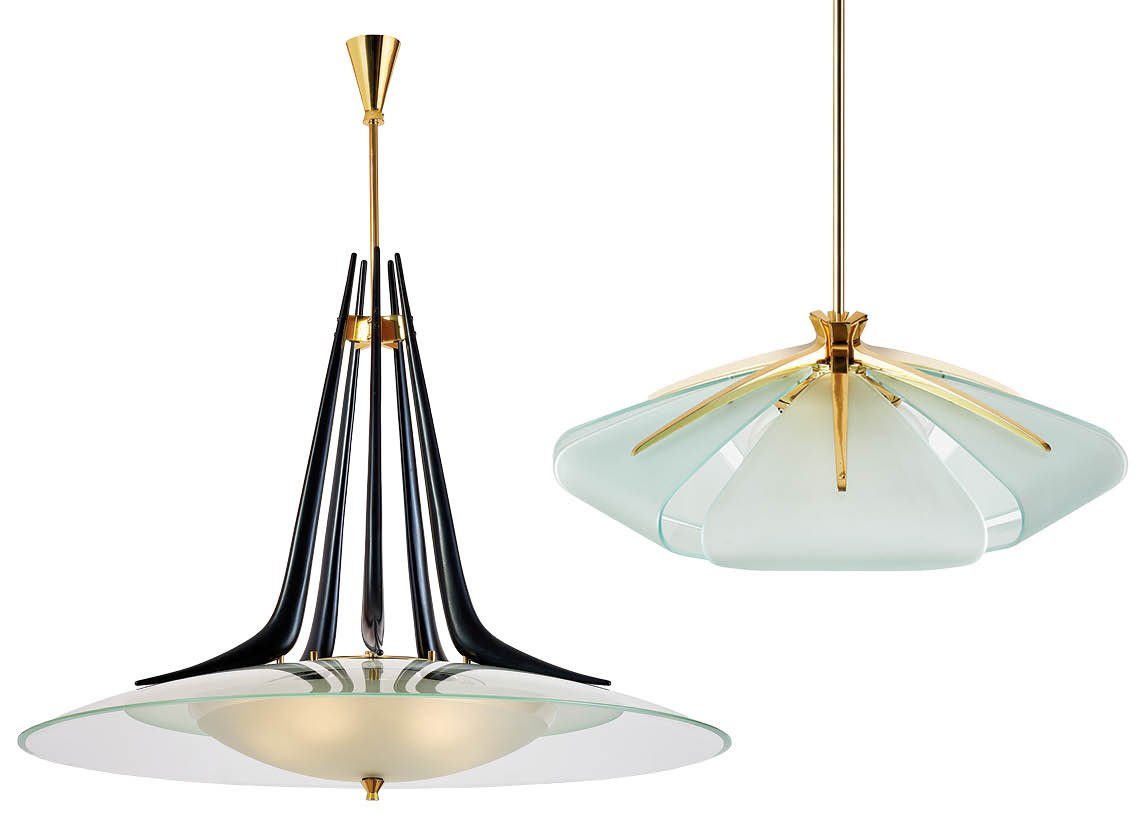 |
Left: An extraordinary and rarely seen chandelier by Max Ingrand for Fontana Arte. Abstracted black metal struts soar from the 31” glass bowl to the shaft. The light is diffused through a beautifully wrought heavy satin glass bowl, encircled by a rich hand-ground beveled edge. An architectural statement in glass. Italy, circa 1960. Available from L’Art De Vivre on Incollect.com. Photo: Dan Mayers. Right: Rare Max Ingrand Pendant Chandelier for Fontana Arte. An extremely rare work with a futuristic sculptural form. Elliptically beveled glass petals with stunning sculpted hyperboloid bronze mounts. Italy, circa 1956. Available from L’Art De Vivre on Incollect.com. Photo: Dan Mayers. |
Charles and Patricia Fuller, L’Art De Vivre
Fontana Arte designs never seem to go out of style. Why is that?
It all comes down to the purity of the design and the sophistication of the craftsmanship. Adapting ancient artisanal glass-forming techniques into new ways to stretch the boundaries of what glass could do, they led the way in rejecting the fussiness of traditional Murano work and opened new horizons for the glassmaking trade. Rather than focusing, as its predecessors had, on the decorative qualities of blown molten glass, Fontana Arte embraced the architectural modernity of transparent, plate glass, reshaping it into sensuous, abstract forms — sculptures of light — in ways that were avant-garde then and feel avant-garde today.
What qualities do you look for when purchasing Fontana Arte pieces?
The best Fontana Arte pieces are harmonious and gracefully proportioned, while lending their forward-looking contours to the most contemporary of interiors, even as they celebrate the skilled handwork of Fontana Arte’s accomplished artisans. One example is a recently acquired, rare chandelier designed by Max Ingrand, circa 1960, with architectural black metal struts that soar upwards above an umbrella-shaped glass bowl. Another equally rare chandelier by Ingrand, created in 1956, delicately folds glass into origami petals in a completely new way, and that, to me, prefigures the ribbonlike metamorphosis of metal by contemporary architects such as Zaha Hadid.
 |
Rare Model No. 2459 chandelier by Max Ingrand for Fontana Arte. Acid-etched satin glass, a ring of 16 chiseled glass tiles, nickeled brass structure. Italy, circa 1965. Available from Portuondo on Incollect.com. Photo: courtesy Portuondo. |
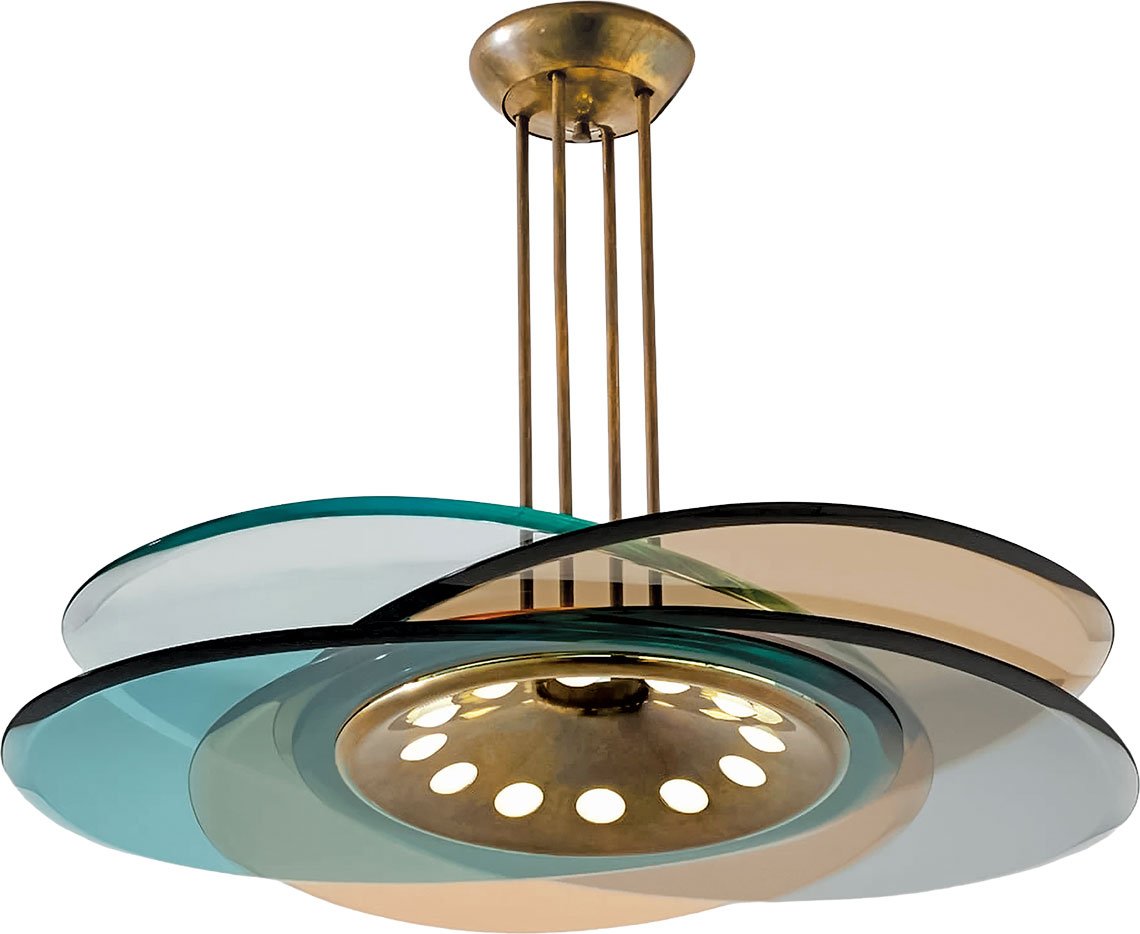 | |
Model No. 1452 ceiling light by Max Ingrand for Fontana Arte. Polished and beveled glass in five different colors, brass structure. Italy, circa 1953. Available from Portuondo on Incollect.com. Photo: courtesy Portuondo. |
What are the most sought-after Fontana Arte designs and why?
In our opinion, the most prized Fontana Arte designs today are those created during the periods under the creative direction of Gio Ponti, Pietro Chiesa, and, later, Max Ingrand, as they collectively define the company’s extraordinary relationship with glass and light. Ponti, who was instrumental in the early vision of Fontana Arte, helped establish the idea that glass could be used not only decoratively but architecturally, giving the company a refined and modern identity from the beginning. Chiesa’s work in the 1930s elevated this vision through remarkable technical mastery and sculptural clarity, creating pieces where the purity of the material itself became the design. Later, Ingrand’s lighting, in the 1950s and 1960s, brought a new scale and luminosity to the brand, producing chandeliers and fixtures that are monumental, yet always elegant.