




John Little
Canadian, 1907 - 1984

Born in Alabama in 1907, John Little was a prominent artist whose journey unfolded in the vibrant realm of American art. His early education at the Buffalo Fine Arts Academy laid the groundwork for his artistic pursuits, which later led him to study under influential figures such as George Grosz and Hans Hofmann.
Hofmann's "Push Pull" theory became a cornerstone for Little, offering insights into the translation of three-dimensional nature into two-dimensional paintings through the interplay of space, form, and color. In 1946, Little embarked on a series of vibrant paintings, characterized by interlocking forms and cubist-inspired compositions with mythical titles. The pivotal moment came when his work, including the angular abstraction "Pagan Ritual" (1946), caught the attention of the art community during a group show at the California Palace of the Legion of Honor in San Francisco. This success led to his first solo exhibition later that year.
The late 1940s marked a transformative period for Little. Influenced by the avant-garde atmosphere of the Hamptons, he purchased and renovated a three-hundred-year-old house, turning it into a studio. The Hamptons became a hub for artistic luminaries like Jackson Pollock, Lee Krasner, and many others.
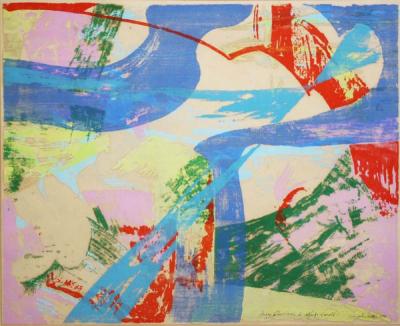
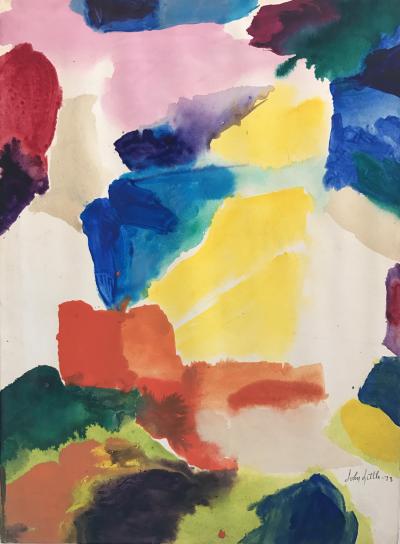
Little's artistic evolution continued into the 1950s, exemplified by works like "Ominous Night" (1951), reflecting a self-assured style of gestural abstraction. Departing from strict drawing, he embraced a form and color-driven approach. "Congo" (1959) showcased a vibrant and architecturally inspired composition, marked by a harmonious interplay of blues, greens, violets, and whites, with accents of yellow, ochre, and cadmium red.
In the late 1950s, Little ventured into collage works on paper, ranging from spare and simple compositions to riotous displays of materials and color, such as "Untitled" (1959). Often starting with a page from the New York Times, he applied layers of painted and torn paper, oil paint, and other materials, infusing these works with the same aggressive energy found in his oils.
John Little's significant contributions to the art world were honored in 1982 with a retrospective at Guild Hall in East Hampton. His artistic legacy endures, as he remained active until his passing in 1984
Hofmann's "Push Pull" theory became a cornerstone for Little, offering insights into the translation of three-dimensional nature into two-dimensional paintings through the interplay of space, form, and color. In 1946, Little embarked on a series of vibrant paintings, characterized by interlocking forms and cubist-inspired compositions with mythical titles. The pivotal moment came when his work, including the angular abstraction "Pagan Ritual" (1946), caught the attention of the art community during a group show at the California Palace of the Legion of Honor in San Francisco. This success led to his first solo exhibition later that year.
The late 1940s marked a transformative period for Little. Influenced by the avant-garde atmosphere of the Hamptons, he purchased and renovated a three-hundred-year-old house, turning it into a studio. The Hamptons became a hub for artistic luminaries like Jackson Pollock, Lee Krasner, and many others.
Little's artistic evolution continued into the 1950s, exemplified by works like "Ominous Night" (1951), reflecting a self-assured style of gestural abstraction. Departing from strict drawing, he embraced a form and color-driven approach. "Congo" (1959) showcased a vibrant and architecturally inspired composition, marked by a harmonious interplay of blues, greens, violets, and whites, with accents of yellow, ochre, and cadmium red.
In the late 1950s, Little ventured into collage works on paper, ranging from spare and simple compositions to riotous displays of materials and color, such as "Untitled" (1959). Often starting with a page from the New York Times, he applied layers of painted and torn paper, oil paint, and other materials, infusing these works with the same aggressive energy found in his oils.
John Little's significant contributions to the art world were honored in 1982 with a retrospective at Guild Hall in East Hampton. His artistic legacy endures, as he remained active until his passing in 1984
 Loading...
