







Jonas Lie
American, 1880 - 1940
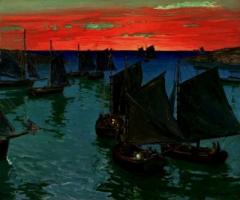
A painter best known for views of New York City and the New England coast, Jonas Lie worked in a vigorous, colorful style reflecting the influence of French Impressionism and the realism of the Ashcan School. He was born in Moss, Norway, the son of a Norwegian engineer and his American wife. The artist’s family included several prominent figures from the literary and artistic world. Two of his aunts were famous pianists and composers, and he was named for an uncle who was a distinguished writer. Lie’s first interest was in music. He attended family concerts beginning at age three. When his father died in 1892, Lie’s life changed abruptly. He was sent to live for three months with Christian Skredvig, a painter who resided near Oslo. From this first exposure to the visual arts, he decided to become a painter. At the conclusion of the three months, he was sent to live with his famous uncle and namesake in Paris. Residing with his uncle at 11 Avenue de la Grande Armée in Paris, Lie found himself at the center of a community of expatriated Scandinavian literary figures. Among those who visited his uncle’s home were the Norwegian composer Edvard Grieg and the Norwegian playwright Hendrik Ibsen. After learning of his interest in drawing, Lie’s uncle enrolled him in a small private art school and took him on visits to the Louvre. After graduating from school, Lie was faced with the responsibility of supporting his mother and sisters and took a job as a designer of textile patterns at Manchester Mills in New York. During the evenings he attended classes at the National Academy of Design, Cooper Union, and the Art Students League. He spent his Sundays painting in a studio he rented in Manhattan and sketching at Rockaway Beach. His role model during his early New York years was Fritz Thaulow, a fellow Norwegian painter who worked in an Impressionist style. After leaving his job in 1906 in order to concentrate on art, Lie became influenced by the works of the Eight, the group of American artists who were focusing on urban subjects, which they painted in a realist fashion with dark tonalities and vigorous brushwork. Lie embraced the ideology of the Eight and adopted their bold techniques. In 1909, Lie returned to Paris, spending three months painting along the river Seine. He then traveled to Norway for a stay that lasted eighteen months. Upon returning to America in 1910, Lie expanded his subject matter to include views of mountainous countrysides and shores. He began to paint along the New England coast and in the Adirondacks, subjects he focused on throughout the rest of his career. In 1913, Lie traveled to Panama, where he observed and recorded the construction of the Panama Canal. In a series of paintings, he depicted the tremendous steel works and documented the way that huge masses of earth were being moved to create the waterway. Lie’s Panama Canal series brought him a significant amount of renown. His paintings of the subject were purchased by the Metropolitan Museum of Art, the Detroit Institute, and the United States Military Academy at West Point. Works by Lie may be found in many important public and private collections including the Art Institute of Chicago; the Brooklyn Museum; the Carnegie Institute, Pittsburgh; the Cleveland Museum of Art, Ohio; the Corcoran Gallery of Art, Washington, D.C.; the Detroit Institute of Arts; the Metropolitan Museum of Art, New York; and the Museum of Fine Arts, Boston.
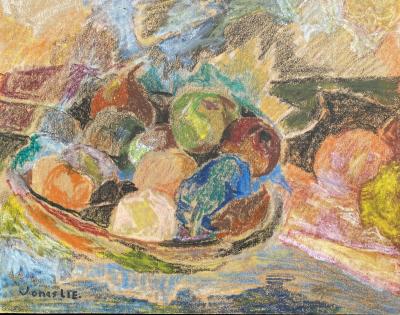
Jonas Lie Paintings
Jonas Lie Paintings

 Loading...
