






Jules Dupre
French, 1811 - 1889
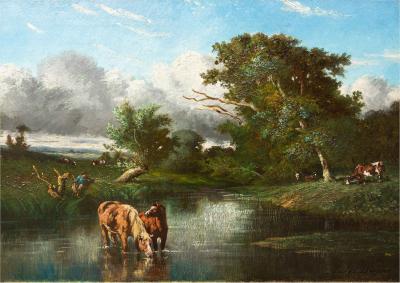
Jules Dupre was born in Nantes on April 5, 1811. His father was an artist, who decorated porcelain and held the position of director at several porcelain factories. In 1822, Dupre worked for his father as an apprentice porcelain decorator. His early training as an artist was in the industrial arts, as it was for many of his contemporaries. While working with his father, he also executed drawings and paintings from nature. He was influenced by his close association with De Marne and Bertin, and in 1829 Dupre went to Paris, where he further developed as an artist through his friendship with Cabat. He also met the artists Decamps, Jeanron and Huet at this time. He traveled to Great Britain in 1831, where he sketched and studied paintings by the English landscapists.
Upon his return, he traveled extensively through the French provinces, which were a great inspiration for him. He began exhibiting in the early 1830s and in 1833 four of his works were accepted at the Salon. His official recognition came in 1835, when he exhibited four landscapes at the Salon, and received a third-class medal. He also included works in regional exhibitions, which were becoming increasingly important, as they supported and promoted local painters and upcoming Parisian artists. It was at this time that Dupre became a key figure in the Barbizon group. He developed close ties with other Barbizon painters, and began to promote relations with independent art dealers.
When Dupre showed seven paintings at the 1839 Salon, it was to be his last exhibition until 1852, and a turning point in his career. This was due to the insensitivity of the jury, and the lack of understanding of many of his colleagues. He organized, along with Cabat, Huet, Isabey, Corot and Rousseau, a petition to change the jury system. After the 1848 Revolution, Dupre became a member of the commission created to reorganize the Salon. In 1849, he received the Legion d'honneur, and continued to achieve financial success. At this time, he re-entered the Salon as an exhibitor. In 1867, he exhibited at the Exposition Universelle, and in 1883 at the Exposition Centennale. Jules Dupre had fully developed by the 1870s, and was considered one of the leading landscape painters of the time. He continued to paint until his death in 1889.
Biography courtesy of Roughton Galleries, www.antiquesandfineart.com/roughton
Upon his return, he traveled extensively through the French provinces, which were a great inspiration for him. He began exhibiting in the early 1830s and in 1833 four of his works were accepted at the Salon. His official recognition came in 1835, when he exhibited four landscapes at the Salon, and received a third-class medal. He also included works in regional exhibitions, which were becoming increasingly important, as they supported and promoted local painters and upcoming Parisian artists. It was at this time that Dupre became a key figure in the Barbizon group. He developed close ties with other Barbizon painters, and began to promote relations with independent art dealers.
When Dupre showed seven paintings at the 1839 Salon, it was to be his last exhibition until 1852, and a turning point in his career. This was due to the insensitivity of the jury, and the lack of understanding of many of his colleagues. He organized, along with Cabat, Huet, Isabey, Corot and Rousseau, a petition to change the jury system. After the 1848 Revolution, Dupre became a member of the commission created to reorganize the Salon. In 1849, he received the Legion d'honneur, and continued to achieve financial success. At this time, he re-entered the Salon as an exhibitor. In 1867, he exhibited at the Exposition Universelle, and in 1883 at the Exposition Centennale. Jules Dupre had fully developed by the 1870s, and was considered one of the leading landscape painters of the time. He continued to paint until his death in 1889.
Biography courtesy of Roughton Galleries, www.antiquesandfineart.com/roughton

 Loading...
