



Ossip Zadkine
Russian, 1890 - 1967

Ossip Zadkine was born in 1890 in Russia. In 1905 he left Russia to attend art school in London and eventually worked for a wooden-ornament maker. Zadkine then moved to Paris, where he briefly studied at the École des Beaux-Arts; he gave up academic training after a few months to work independently.
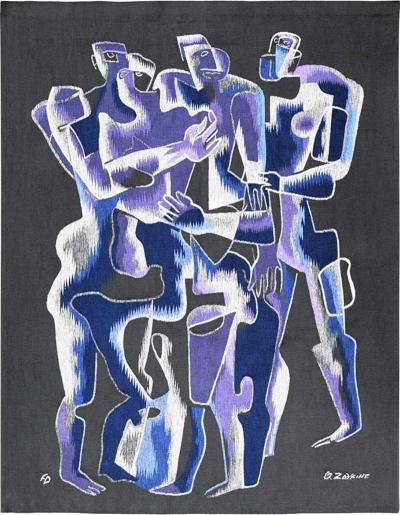
Soon after settling in Paris, Zadkine became friends with a number of avant-garde artists, including Pablo Picasso. Zadkine developed a lyrical and expressive style, typically sculpting elongated figures with simplified features. About 1917, however, he adopted a new approach in his drawings and sculptures, substituting his previously graceful and sensitive lines with a more angular approach influenced by Cubism. Zadkine was also drawn to the expressiveness of Auguste Rodin, so he combined a Cubist geometric analysis of form with a dramatic emotionalism, as seen in his sculpture Musicians (1924).
During World War II, Zadkine lived in the United States, teaching at the Art Students League in New York City. He returned to France after the war. Zadkine was awarded the grand prize for sculpture at the Venice Biennale in 1950 and the grand prize of the city of Paris in 1960. His work can be found in many permanent museum collections, including the Museum of Fine Art in Boston, Museum of Modern Art, National Gallery of Art in Washington, DC, Tate Gallery in London, Hirschhorn Museum, Philadelphia Museum of Art, Royal Museums of Fine Art of Belgium, Museum Jan ver der Togt in the Netherlands, and, in Paris at the Musee de Zadkine, Musee Lorrain, and Musee de Grenoble.
Ossip Zadkine Art Sculpture Prints Drawings Works on Paper
Soon after settling in Paris, Zadkine became friends with a number of avant-garde artists, including Pablo Picasso. Zadkine developed a lyrical and expressive style, typically sculpting elongated figures with simplified features. About 1917, however, he adopted a new approach in his drawings and sculptures, substituting his previously graceful and sensitive lines with a more angular approach influenced by Cubism. Zadkine was also drawn to the expressiveness of Auguste Rodin, so he combined a Cubist geometric analysis of form with a dramatic emotionalism, as seen in his sculpture Musicians (1924).
During World War II, Zadkine lived in the United States, teaching at the Art Students League in New York City. He returned to France after the war. Zadkine was awarded the grand prize for sculpture at the Venice Biennale in 1950 and the grand prize of the city of Paris in 1960. His work can be found in many permanent museum collections, including the Museum of Fine Art in Boston, Museum of Modern Art, National Gallery of Art in Washington, DC, Tate Gallery in London, Hirschhorn Museum, Philadelphia Museum of Art, Royal Museums of Fine Art of Belgium, Museum Jan ver der Togt in the Netherlands, and, in Paris at the Musee de Zadkine, Musee Lorrain, and Musee de Grenoble.
Ossip Zadkine Art Sculpture Prints Drawings Works on Paper


 Loading...
