













Scot Heywood
American, 1951
Lives and works Los Angeles, California
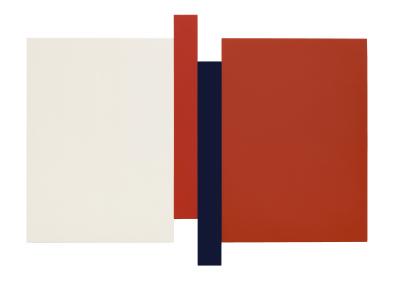
Born in 1951 in Los Angeles, Scot Heywood has pursued a course of non-representational, geometric abstract
painting for more than 30 years. A self-taught artist, Heywood’s works are indebted to the origins of geometric
abstraction in such artists as Kasimir Malevich and Piet Mondrian, though he has crafted a thoroughly personal
interpretation. The artist’s exquisite attention to detail and presentation are evident in the careful placement of
individual panels, as well as the refned diagonal layering of paint.
A viewer would be mistaken to consider Heywood’s paintings to be standard examples of the minimalist
monochrome. His work invites extended contemplation, and engages with viewers on visual, physical and
conceptual levels. David Pagel of the Los Angeles Times has written on the experience of regarding Heywood’s
work, explaining that, “To stand before one of these paintings, each of which is the size of a generously scaled
doorway, is to fnd your whole body involuntarily adjusting itself to the subtly out-of-whack geometry of Heywood’s
art.”
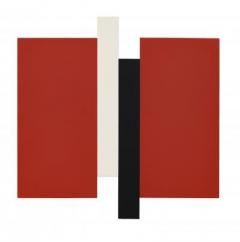
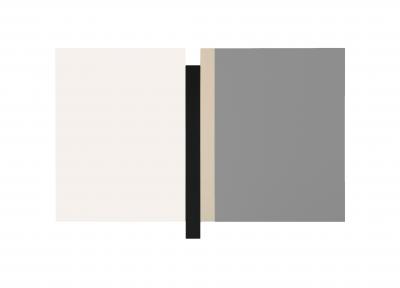
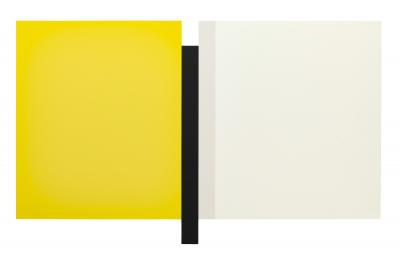
It is this disorienting geometry that characterizes Scot Heywood’s art. Small but unexpected asymmetries and careful
“notches” disrupt the smooth rectangularity of his wood and canvas surfaces, creating a dialogue between form and
color that implicates the space of the gallery. Daniella Walsh for THE Magazine described the sophisticated game
being played here when she wrote that Heywood’s works “establish a new perceptual reality, incorporating the wall
as negative space.”
In this way, the walls of the gallery become part of the work, functioning as more than a passive backdrop for the
paintings. The relationship between the walls, the works, and the viewers are all held up for examination. In this
atmosphere, the works take on architectural qualities. According to Jody Zellen of Artweek, they then allow for an
exploration of “the relationships between presence and absence with respect to a given architectural space.”
Scot has shown frequently in Southern California since the late 1970s. His work has been featured in over a dozen
solo shows, and is often included in signifcant group exhibitions such as Marks and Movement: Five Painters at the
Santa Monica College Barrett Gallery in 2011. His paintings are also represented in numerous collections, including
the Frederick Weisman Foundation.
Scot Heywood paintings
Born in 1951 in Los Angeles, Scot Heywood has pursued a course of non-representational, geometric abstract
painting for more than 30 years. A self-taught artist, Heywood’s works are indebted to the origins of geometric
abstraction in such artists as Kasimir Malevich and Piet Mondrian, though he has crafted a thoroughly personal
interpretation. The artist’s exquisite attention to detail and presentation are evident in the careful placement of
individual panels, as well as the refned diagonal layering of paint.
A viewer would be mistaken to consider Heywood’s paintings to be standard examples of the minimalist
monochrome. His work invites extended contemplation, and engages with viewers on visual, physical and
conceptual levels. David Pagel of the Los Angeles Times has written on the experience of regarding Heywood’s
work, explaining that, “To stand before one of these paintings, each of which is the size of a generously scaled
doorway, is to fnd your whole body involuntarily adjusting itself to the subtly out-of-whack geometry of Heywood’s
art.”
It is this disorienting geometry that characterizes Scot Heywood’s art. Small but unexpected asymmetries and careful
“notches” disrupt the smooth rectangularity of his wood and canvas surfaces, creating a dialogue between form and
color that implicates the space of the gallery. Daniella Walsh for THE Magazine described the sophisticated game
being played here when she wrote that Heywood’s works “establish a new perceptual reality, incorporating the wall
as negative space.”
In this way, the walls of the gallery become part of the work, functioning as more than a passive backdrop for the
paintings. The relationship between the walls, the works, and the viewers are all held up for examination. In this
atmosphere, the works take on architectural qualities. According to Jody Zellen of Artweek, they then allow for an
exploration of “the relationships between presence and absence with respect to a given architectural space.”
Scot has shown frequently in Southern California since the late 1970s. His work has been featured in over a dozen
solo shows, and is often included in signifcant group exhibitions such as Marks and Movement: Five Painters at the
Santa Monica College Barrett Gallery in 2011. His paintings are also represented in numerous collections, including
the Frederick Weisman Foundation.
Scot Heywood paintings




 Loading...
