







Thomas Henry Hope
American, 1832 - 1926
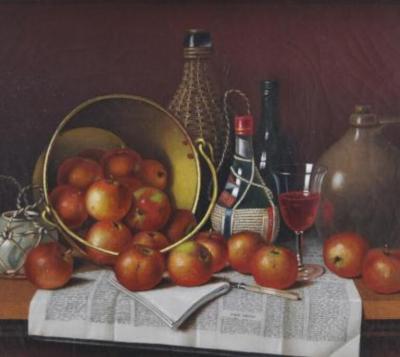
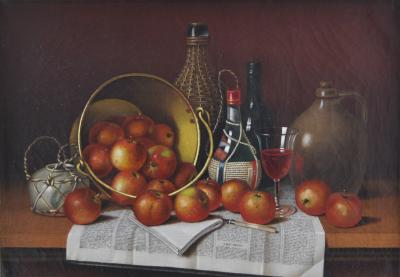
Thomas Henry Hope (1832-1926) was mainly known for his trompe l’oeil still-lifes, in the style of William Harnett and John F. Peto, his fellow students at the Pennsylvania Academy of the Fine Arts. Hope’s teacher there was George Bensell. Hope may have been Peto’s cousin since Peto’s father’s name was Thomas Hope Peto. Hope immigrated with his wife and baby daughter from England to America in 1864 and served as a musician in the Civil War. It is believed that he worked as a bandmaster to earn a living and only later did he become a full-time artist. He was most likely the T.H. Hope who exhibited Interrupted Meditations at the National Academy of Design in 1882, a year after he graduated from the PAFA. Hope settled in South Norwalk, Connecticut.
A relationship to Peto seems likely because both artists played the coronet. In addition, they seemed to share many of the same objects in still-life painting, for instance, the newspaper, basket-covered wine bottles, coins and bank notes. A contemporary noted two other works by Hope: “One represents a bag of tobacco with the contents partly visible; a meerschaum pipe
with smoke issuing from the bowl, an old ink stand, box of matches lying loosely about, the whole jumbled together on a table leaf in that careless way so often seen in a gentleman’s smoking room. The other presents an earthen mug, copy of Weekly Ledger, account book, much work, pipe and matches.” Hope also executed The Artist’s Letter Rack, dated 1886, an amazing fool-the-eye assemblage of letters, notices, cards, photos and a newspaper held on the wall under ribbons tacked into the wood. According to John Wilmerding, it is “more colorful and cluttered than any of Peto’s versions.” The Shelburne Museum in Shelburne, Vermont has a smaller “rack picture” in which the envelopes are addressed to Miss Imogene See, which would have been abbreviated to “I. See.” There are also known landscapes and portraits by Hope, as well as a genre painting owned by the Independence National Historic Park Service in Philadelphia, called Washington, the Boy Hero (ca. 1850). Hope moved to Devon, Connecticut in 1916 and died at the age of ninety-four.
A relationship to Peto seems likely because both artists played the coronet. In addition, they seemed to share many of the same objects in still-life painting, for instance, the newspaper, basket-covered wine bottles, coins and bank notes. A contemporary noted two other works by Hope: “One represents a bag of tobacco with the contents partly visible; a meerschaum pipe
with smoke issuing from the bowl, an old ink stand, box of matches lying loosely about, the whole jumbled together on a table leaf in that careless way so often seen in a gentleman’s smoking room. The other presents an earthen mug, copy of Weekly Ledger, account book, much work, pipe and matches.” Hope also executed The Artist’s Letter Rack, dated 1886, an amazing fool-the-eye assemblage of letters, notices, cards, photos and a newspaper held on the wall under ribbons tacked into the wood. According to John Wilmerding, it is “more colorful and cluttered than any of Peto’s versions.” The Shelburne Museum in Shelburne, Vermont has a smaller “rack picture” in which the envelopes are addressed to Miss Imogene See, which would have been abbreviated to “I. See.” There are also known landscapes and portraits by Hope, as well as a genre painting owned by the Independence National Historic Park Service in Philadelphia, called Washington, the Boy Hero (ca. 1850). Hope moved to Devon, Connecticut in 1916 and died at the age of ninety-four.

 Loading...
